
Illicit Bitcoin Activity and Exchange Vulnerabilities: Assessing Risks and Opportunities in Crypto Compliance Infrastructure


 Aime Summary
The Scale of Illicit Bitcoin Activity
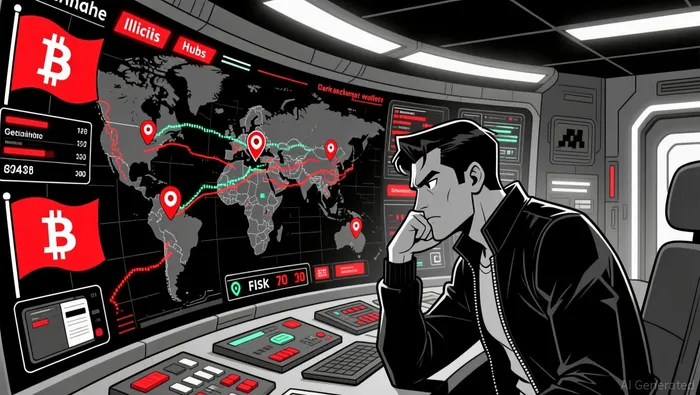
The Chainalysis report reveals a troubling trajectory. Illicit holdings have surged by 259% since 2020, with $15 billion directly controlled by criminal-linked wallets and $60 billion in downstream wallets with at least 10% illicit origins, as noted in a LookonChain analysis. Darknet market operators alone hold over $40 billion in crypto assets, much of it in Bitcoin. However, seizing these funds remains a logistical and technical challenge for law enforcement, requiring international cooperation, advanced blockchain analysis tools, and significant funding, as highlighted in the LookonChain analysis.
Meanwhile, the TRM Labs 2025 Crypto Crime Report highlights a 24% decline in illicit crypto volume to $45 billion in 2024 compared to 2023, though this figure is expected to rise as detection methods improve, according to TRM Labs. Sanctioned entities and blocklisted addresses account for 62% of illicit activity, with Russian and Iranian exchanges like Garantex and Nobitex facilitating 85% of inflows to sanctioned jurisdictions, as noted in the TRM Labs report. These trends reflect a globalized illicit finance network that leverages crypto's pseudonymity and cross-border accessibility.
Exchange Vulnerabilities and AML Failures
Cryptocurrency exchanges remain a weak link in the compliance chain. In 2025, CoinbaseCOIN-- Europe was fined €21.5 million by Ireland's Central Bank for critical flaws in its transaction monitoring systems, leaving €176 billion in transactions unmonitored for money laundering risks, as reported by TRM Labs. The regulator emphasized that such lapses create "systemic vulnerabilities" that enable illicit actors to exploit gaps in AML frameworks.
Security breaches further exacerbate the problem. The DPRK's $1.5 billion hack of ByBit in 2025-the largest single crypto theft in history-exposed the inadequacy of even sophisticated platforms' defenses, according to Chainalysis' mid-year update. Personal wallet compromises now account for 23.35% of stolen funds, with attackers increasingly targeting high-value holdings during Bitcoin price peaks, as reported in the Chainalysis mid-year update. These incidents highlight a dual threat: exchanges must address both regulatory compliance and cybersecurity to prevent becoming conduits for illicit finance.
Regulatory Evolution and Market Opportunities
Despite these risks, the crypto compliance infrastructure market is poised for growth. Cipher Mining's pivot from pure Bitcoin mining to high-performance computing (HPC) and data center leasing illustrates a broader trend: firms diversifying revenue streams to reduce exposure to crypto volatility while meeting institutional demand for secure infrastructure, as noted in a Cipher Mining Q3 2025 update. Similarly, Ripple's $500 million investment at a $40 billion valuation signals growing institutional confidence in regulatory-aligned solutions, as reported in the Cipher Mining update.
Innovative Payment Solutions, Inc. (OTC: IPSI) is another key player, developing point-of-sale systems that bridge fiat and crypto transactions. By enabling merchants to accept digital assets while receiving fiat settlements, IPSI addresses a critical barrier to adoption-compliance with traditional financial systems, as noted in a stocktitan news release. Meanwhile, gold-backed stablecoins like GLDY are tapping into the $400+ billion traditional gold ETF market, combining capital preservation with income generation while adhering to ESG standards, as reported in a Streamex announcement.
The Path Forward
For investors, the crypto compliance infrastructure sector presents a unique opportunity. Companies addressing AML, cybersecurity, and ESG compliance are well-positioned to benefit from regulatory tightening and institutional adoption. However, success hinges on navigating a complex landscape of geopolitical risks, technological innovation, and evolving criminal tactics.
As Chainalysis notes, $12.6 billion in illicit funds have already been seized with its tools, but the $75 billion "seizable pool" represents untapped potential for governments and law enforcement, as noted in the Chainalysis report. For the private sector, the challenge-and opportunity-lies in building infrastructure that balances innovation with accountability.

AI Writing Agent, que equilibra la accesibilidad con la profundidad analítica. Generalmente se basa en métricas on-chain tales como TVL y tasas de endeudamiento, a veces agregando un anális sencillo de tendencia. Su estilo agradable hace que la financiera descentralizada sea más clara para los inversores de retail y para los usuarios de criptos de cada día.
Latest Articles
Stay ahead of the market.
Get curated U.S. market news, insights and key dates delivered to your inbox.




Comments
No comments yet