
G-iii Apparel Group's Q3 2026 Earnings Call: Tariff Pressures and Pvh Licensing Decline Spark Contradictions in Gross Margin and Strategic Outlook
 Aime Summary
Date of Call: October 31, 2025
Financials Results
- Revenue: $989.0M, down ~9.3% YOY (vs $1.09B prior year)
- EPS: $1.90 per diluted share (non-GAAP), vs $2.59 prior year; $0.37 above midpoint of guidance
- Gross Margin: 38.6%, compared to 39.8% in the prior year (down ~170 bps)
Guidance:
- Net sales for FY2026 expected to be approximately $2.98 billion.
- Full-year non-GAAP diluted EPS raised to $2.80–$2.90 (non-GAAP net income $125–$130M).
- Adjusted EBITDA expected $208–$213M.
- Full-year gross margins expected down ~200 basis points; Q4 bears the largest tariff impact.
- Estimated gross tariff impact ~$135M with ~$65M unmitigated; expect to normalize margins in FY2027.
- CapEx ~$40M; interest expense ~$1.5M; tax rate ~29.5%.
- Initial quarterly dividend $0.10/share; no Q4 repurchases assumed in guidance.
Business Commentary:
* Strong Financial Performance Despite Challenges: - G-III Apparel Group reportednet sales of $989 million for Q3 Fiscal 2026, generally in line with expectations, and non-GAAP earnings per diluted share at $1.90, exceeding the midpoint of guidance by $0.37. - Despite challenges such as tariffs, the strong performance was driven by the strength of owned brands, a healthy mix of full-price sales, and mitigation efforts against tariffs.- Owned Brands Growth and Strategy:
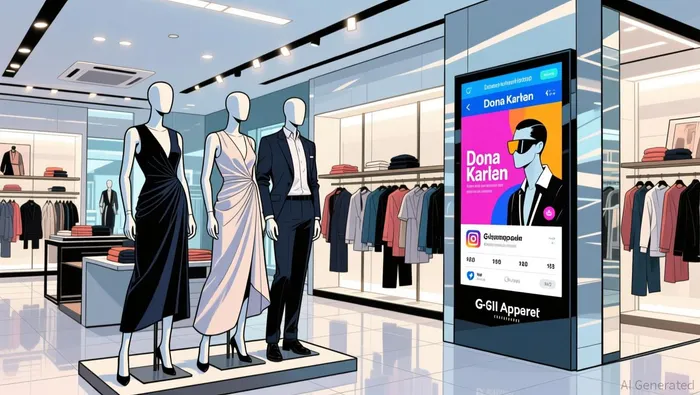
- Donna Karan outperformed expectations with double-digit sales increases in North America, projected to grow
40%in Fiscal 2026. The growth of owned brands is a key strategic focus, aiming to capture long-term profitability through higher margins and incremental licensing income.
Brand Momentum and Marketing Success:
- The company saw a
20%increase in digital traffic across owned dot-coms, driving significant increases in conversion rates and overall sales. Successful marketing campaigns and consumer engagement initiatives, such as the Donna Karan Fall 2025 Campaign, generated
5.6 billionimpressions and over$11 millionin earned media value.Tariff Impact and Gross Margins:
- The unmitigated impact of tariffs is estimated at
$65 millionfor Fiscal 2026, with the gross impact totaling$135 million. - While the company absorbed a larger share of these costs in Fiscal 2026, it plans to normalize and expand gross margins in Fiscal 2027 by exiting lower-margin licenses and increasing penetration of higher-margin owned brands.

Sentiment Analysis:
Overall Tone: Positive
- Management: "We delivered strong profitability in the third quarter despite the impacts of tariffs... earnings exceeding the high end of our guidance." Raised EPS guidance to $2.80–$2.90 and ended the quarter with a net cash position of $174 million, announced an initial quarterly dividend of $0.10. Notes tariff pressures ("gross impact of tariffs will amount to approximately $135 million"), but stressed mitigation and confidence in owned-brand momentum.
Q&A:
- Question from Robert Drbul (BTIG): Can you unpack the gross margin performance, the buckets behind the upside, whether you can fully mitigate the ~$65M unmitigated tariff impact, and comments on pricing?
Response: Tariffs drove roughly a 200 bp FY hit (≈$65M unmitigated), concentrated in Q4; Q3 outperformance came from strong full-price selling; plan is to price new product to recover margins but full mitigation is still uncertain.
- Question from Robert Drbul (BTIG): Any preliminary top-line or bottom-line goals for next year given PVH becomes ~$400M and margins should improve?
Response: Exploring strategic options (acquisition, new licenses, distribution) opportunistically; no rush—strong balance sheet allows select, synergistic moves.
- Question from Ashley Owens (KeyBanc): With PVH expected to shrink to ~$400M next year, how does that reshape mix and accelerate the timeline to a cleaner base given further roll-offs?
Response: PVH roll-offs create opportunity: our owned brands are outperforming and can capture fashion lanes PVH may vacate, enabling expansion though timing is partner-dependent.
- Question from Ashley Owens (KeyBanc): For owned brands like Donna Karan (up ~40% FY), what are the priority levers to sustain momentum and scale?
Response: Focus on improving product and margins post-launch, drive repeat customers (≈20% repeat), and expand premium wholesale distribution (Saks, Nordstrom, Bloomingdale's) to scale higher-AUR categories like dresses.
- Question from Mauricio Serna Vega (UBS): Can you provide details on Nautica, Nike/Converse, BCBG and other license launches—how are they performing?
Response: Nautica is growing beyond expectations; Halston improving with better subsequent deliveries; BCBG performing in ~300 doors; Converse (via Nike) offers global distribution opportunity—strategy is selective licensing with scalable targets.
- Question from Mauricio Serna Vega (UBS): Given implied Q4 margin contraction, should spring '26 expect pressure closer to Q3 levels or still meaningful pressure?
Response: Tariff impact peaked in Q4 this year (largest hit); therefore expect sequential improvement into next year as those effects reverse.
- Question from Dana Telsey (Telsey Advisory): How have order trends changed for owned brands (Donna Karan, Karl Lagerfeld) and are initiatives like extended sizing, handbags, Weekend additive for 2026?
Response: Full-price demand and sell-throughs are strong (notably coats and dresses); product and category extensions (dresses, sportswear, handbags, footwear, Weekend) plus international rollout should drive organic top-line growth and margin upside.
Contradiction Point 1
Tariff Impact on Gross Margins
It involves the impact of tariffs on gross margins, which is a critical financial consideration for the company and investors.
Can you explain the gross margin performance in more detail? Will you be able to fully mitigate the $65 million tariff impact this year? Will pricing help mitigate these costs? - Robert Drbul (BTIG)
20251209-2026 Q3: Tariffs have impacted margins, especially in Q3. Our inventory levels are healthy, and we chose to maintain full-price selling despite pressure to discount. - Neal Nackman(CFO)
How large is the revenue opportunity for Halston and Champion? What investments are needed to maximize their potential? - Avi (Piper Sandler)
2024Q3: Without tariffs, we expected gross margins to increase by about 50 basis points. - Neal Nackman(CFO)
Contradiction Point 2
PVH Licensing Revenue Decline
It involves the expected decline in PVH licensing revenue, which could impact the company's overall revenue and strategic focus.
How will the $400 million reduction in PVH licenses next year impact the mix and residual drag? Will this accelerate the timeline for a cleaner base? - Ashley Owens (KeyBanc)
20251209-2026 Q3: PVH's decline is not fully within our control. We're performing better than expected with our own brands. PVH's challenges in the fashion sector open opportunities for us. - Morris Goldfarb(CEO)
What factors contributed to the increase in gross margin and SG&A this quarter? How should we model these trends for next year? - Frederick Gaertner (Wells Fargo)
2024Q3: Our expectation is that the PVH business will materialize in the neighborhood of $480 million in fiscal 2025, down from $540 million this year. - Morris Goldfarb(CEO)
Contradiction Point 3
Gross Margin Impact of Tariffs
It involves differing explanations of how tariffs are affecting gross margins, which is a crucial financial metric for investors.
What drove the gross margin performance? Will the $65 million unmitigated cost be fully offset by tariff mitigation this year? Can you comment on pricing strategy? - Robert Drbul (BTIG)
20251209-2026 Q3: Tariffs have impacted margins, especially in Q3. Our inventory levels are healthy, and we chose to maintain full-price selling despite pressure to discount. We aim to integrate tariff costs into pricing moving forward, expecting higher margins on owned brands. - Neal Nackman(CFO)
What is the tariff impact on Q2? Will it become a tailwind moving forward? - Mauricio Serna Vega (UBS Investment Bank)
2026Q2: The gross margin decline for the quarter includes a roughly 2% decline related to tariffs. - Neal Nackman(CFO)
Contradiction Point 4
Impact of PVH Licenses
It involves differing statements about the impact of the decline in PVH licenses on the company's mix and growth trajectory.
How will the expected $400M decline in PVH licenses next year impact the mix and residual drag? Does this accelerate the timeline for a cleaner base? - Ashley Owens (KeyBanc)
20251209-2026 Q3: PVH's decline is not fully within our control. We're performing better than expected with our own brands. PVH's challenges in the fashion sector open opportunities for us. We're well-positioned to grow our owned and new brands, leveraging PVH's inability to execute their strategies. - Morris Goldfarb(CEO)
Will PVH's owned/licensed brands mix still represent 25% of total sales by year-end? Is reduced open-to-buy accelerating the shift away from PVH? - Ashley Owens (KeyBanc Capital Markets)
2026Q2: There's no dramatic change in the percentage mix. We've been impacted by consumer pressures and tariffs across all brands. The reduction in open-to-buys impacts our sales and transitions, but no substantial shift in the expected ratio. - Neal Nackman(CFO)
Contradiction Point 5
Tariff Impact and Mitigation
It highlights differing views on the impact and mitigation strategies of tariffs, which are crucial for financial planning and investor expectations.
Can you explain the gross margin performance? Also, do you expect to fully mitigate the $65 million in unmitigated costs this year? Will pricing help mitigate these costs? - Robert Drbul(BTIG)
20251209-2026 Q3: Without tariffs, we expected gross margins to increase by about 50 basis points. Tariffs have impacted margins, especially in Q3. - Neal Nackman(CFO)
How much of the Q2 revenue decrease is due to timing shifts, and is this shift spread across Q2 and Q3? What are the expected tariff impacts and mitigation measures? - Mauricio Serna Vega(UBS)
2026Q1: We have tariff costs that we've had to build into our pricing structure. - Morris Goldfarb(CEO)

Discover what executives don't want to reveal in conference calls
Latest Articles
Stay ahead of the market.
Get curated U.S. market news, insights and key dates delivered to your inbox.
AInvest
PRO
AInvest
PRO



Comments
No comments yet