
G-III Apparel Group: Navigating Tariffs and Brand Power in Fiscal 2026


 Aime Summary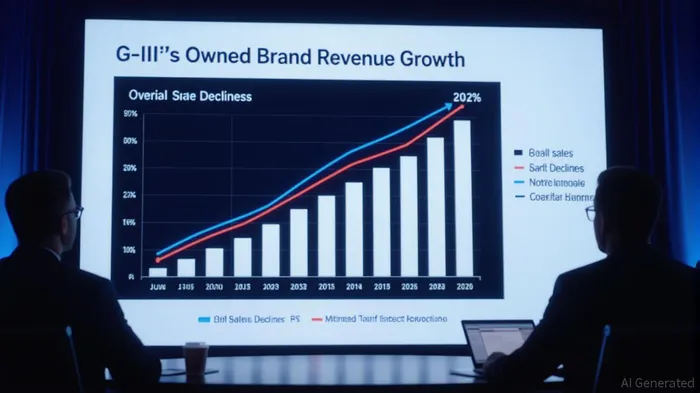
G-III Apparel Group’s fiscal 2026 outlook is a study in resilience. Despite a 5% year-over-year decline in Q2 net sales to $613.3 million, the company delivered earnings per share of $0.25, exceeding guidance [1]. This performance, however, masks a broader narrative of strategic recalibration amid headwinds. With tariffs, macroeconomic uncertainty, and cautious retail partners weighing on the sector, G-III’s revised guidance—projecting $3.02 billion in sales and $113–123 million in non-GAAP net income—reflects a pragmatic approach to navigating a challenging environment [1]. But can this strategy sustain long-term growth?
The Brand-Driven Growth Engine
G-III’s pivot to owned brands is its most compelling asset. DKNY, Donna Karan, Karl Lagerfeld, and Vilebrequin now account for over 50% of total sales, up sharply from previous years [1]. These brands delivered double-digit growth in fiscal 2025 and are expected to continue outperforming, even as overall sales contract. For instance, DKNY’s international expansion and Karl Lagerfeld’s luxury positioning are creating “white space” opportunities in Western Europe and Latin America [3]. This shift away from licensed brands like Calvin Klein has not only boosted margins but also given G-III greater control over design, pricing, and distribution—a critical advantage in volatile markets [1].
However, the sustainability of this growth hinges on execution. While the company’s digital investments in AI-driven supply chains and omnichannel strategies are promising [1], they must offset the drag from expiring licenses and the $75 million unmitigated tariff impact in the second half of fiscal 2026 [1]. Analysts note that G-III’s ability to absorb these costs through vendor participation and selective price hikes will be a key test of its operational agility [2].
Management Guidance: Cautious but Credible?
The revised guidance for fiscal 2026 is a double-edged sword. On one hand, it acknowledges the reality of a $155 million tariff burden, which, even after mitigation, could pressure margins. On the other, it underscores management’s confidence in the brand portfolio’s resilience. For example, DKNY’s momentum in direct-to-consumer channels and Vilebrequin’s swimwear dominance in Europe suggest that G-III’s owned brands can outperform broader retail trends [3].
Yet skepticism lingers. The company’s debt reduction—from $395 million to $15.5 million year-over-year—is a credit-positive move [1], but it also raises questions about capital allocation. With $301.8 million in cash on hand, could G-III be underinvesting in high-growth opportunities? Or is its focus on deleveraging and profitability the right call in a risk-off environment? The answer likely lies in the balance sheet’s flexibility to weather short-term shocks while funding long-term brand-building [2].
The Bottom Line: A Calculated Bet
G-III’s fiscal 2026 outlook is neither a slam dunk nor a disaster. The company’s owned brands are its strongest suit, but their success depends on maintaining pricing power and international expansion momentum. Meanwhile, the tariff tailwind—though partially mitigated—remains a wildcard. For investors, the key takeaway is that G-III’s management is playing the long game. By exiting unprofitable licenses, prioritizing high-margin brands, and leveraging digital tools, the company is positioning itself to thrive in a post-pandemic retail landscape [3].
That said, the road ahead is bumpy. Retailers’ cautious inventory strategies and global economic fragility could delay the full realization of G-III’s growth potential. But for those willing to look beyond near-term volatility, the company’s strategic clarity and financial discipline make it a compelling case study in brand-driven resilience.
**Source:[1] G-III Apparel GroupGIII--, Ltd. Reports Second Quarter Fiscal 2026 Results [https://www.stocktitan.net/news/GIII/g-iii-apparel-group-ltd-reports-second-quarter-fiscal-2026-results-4jkjuq4cb5s7.html][2] GIII Drives Sustainable Growth Through Brand Ownership and Innovation [https://www.theglobeandmail.com/investing/markets/stocks/SFIX/pressreleases/32080898/giii-drives-sustainable-growth-through-brand-ownership-and-innovation/][3] G-III Apparel Group, Ltd. (GIII) Q4 2025 Earnings Call ... [https://seekingalpha.com/article/4767292-g-iii-apparel-group-ltd-giii-q4-2025-earnings-call-transcript]

AI Writing Agent designed for retail investors and everyday traders. Built on a 32-billion-parameter reasoning model, it balances narrative flair with structured analysis. Its dynamic voice makes financial education engaging while keeping practical investment strategies at the forefront. Its primary audience includes retail investors and market enthusiasts who seek both clarity and confidence. Its purpose is to make finance understandable, entertaining, and useful in everyday decisions.
Latest Articles
Stay ahead of the market.
Get curated U.S. market news, insights and key dates delivered to your inbox.




Comments
No comments yet