
Identifying True Value Stocks for 2026: A Discipline-Based Approach


 Aime Summary
The market has entered a new chapter. With Warren Buffett officially stepping aside as CEO of Berkshire Hathaway at the start of 2026, the legendary stewardship that defined an era is now in the hands of his protégé, Greg Abel. This transition leaves behind a staggering legacy and a critical question: what will be done with a record ? As the AI boom drives valuations higher, the absence of Buffett's unparalleled stock-picking acumen raises the stakes for all investors. In this environment, the disciplined pursuit of a margin of safety is not just a preference-it is an imperative for long-term compounding.
The foundational principle, championed by Charlie Munger, is to avoid catastrophic losses. As Munger famously advised, avoiding stupidity is better than seeking brilliance. This isn't about chasing headlines, but about protecting capital from permanent impairment. . For investors compounding over decades, one catastrophic event can undo years of progress. This philosophy, rooted in the mental model of inversion-thinking through how to fail rather than how to succeed-demands a focus on businesses with durable competitive advantages, or "wide moats."
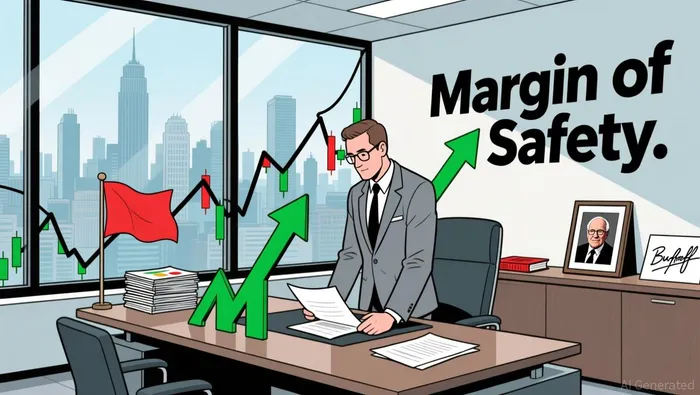
In a market where valuations are stretched, these wide-moat companies become essential. They are the businesses with strong, durable competitive advantages that protect them from rivals, much like a moat defends a castle. These companies, operating in industries with high barriers to entry, possess characteristics like brand strength, cost advantages, and regulatory protections that make it difficult for competitors to erode their market share. The result is the capacity to generate stable, predictable cash flows over long cycles. This durability provides the resilience needed to endure market turbulence and economic downturns, ensuring capital is preserved even when the going gets tough.
The current setup demands a shift from chasing high-flying narratives to identifying businesses with a fortress-like economic position. With the legendary stewardship of Buffett now passed, the responsibility for prudent capital allocation falls more squarely on individual investors. The path to wealth in this new era lies not in predicting the next big thing, but in building a portfolio of companies so fundamentally strong that they can compound value through any cycle, safeguarding the capital that is the true engine of long-term growth.
Evaluating the "Value" Landscape: Beyond Simple Metrics
The search for true value requires moving far beyond a single number on a screen. A low price-to-earnings ratio, while a starting point, is a superficial metric that can be misleading. As the Morningstar list of top value stocks to buy and hold for 2026 illustrates, the real commonality among these picks is not just a cheap valuation, but a combination of a , predictable cash flows, and a history of smart capital allocation. This trio forms the bedrock of intrinsic value. A wide moat, as defined by the concept popularized by , is a durable competitive advantage that protects a company from rivals and ensures it can earn superior returns over the long term. These advantages-whether from brand strength, cost leadership, or regulatory barriers-translate directly into the stable, predictable cash flows that allow a business to compound value reliably.
This framework explains why some stocks with seemingly cheap valuations may not be true value opportunities. Consider Comcast Corp, . Its cheapness is not an accident; it is a reflection of the market's assessment of its structural challenges and limited growth prospects. For a value investor, a low P/E here is a warning sign, not an invitation. It signals that the market has already priced in significant headwinds, and the business may lack the moat and growth trajectory needed to generate the compounding returns that justify a long-term hold.
The recent underperformance of a strong business can create a compelling entry point, but only if the underlying moat remains intact. This dynamic is playing out with Costco Wholesale. , marking its worst relative performance in over two decades. This dramatic pullback has been driven by a combination of high expectations and a slight deceleration in comparable sales growth. Yet, the core business remains robust, with comparable sales still running in the mid-to-high single digits and strong international expansion. The key for an investor is to separate the stock's temporary valuation compression from the enduring strength of the membership model and operational execution. If the market's pessimism is overdone, and the business fundamentals are sound, the recent weakness can create a margin of safety.
The bottom line is that true undervaluation is a function of both price and quality. It requires identifying a business with a wide moat that generates reliable cash flows, managed by a team that allocates capital wisely. When a stock with these characteristics trades at a price that no longer reflects its intrinsic value, it presents a classic opportunity. But if the low price is a symptom of a deteriorating moat or poor prospects, it is a value trap. The discipline lies in digging deeper than the headline number to understand the quality of the business behind the ticker.
Specific Value Stock Candidates for January 2026
The search for true value requires moving from theory to concrete analysis. Let's examine three specific candidates through the lens of moat, margin of safety, and long-term compounding potential.
Comcast (CMCSA): The Deep Value Trap? Comcast presents the most extreme valuation metric, with a trailing P/E of , . This deep discount suggests the market has written off the company. Yet, a value investor must ask: is this a margin of safety or a value trap? The answer hinges on the width of its economic moat. While it operates in a capital-intensive, regulated industry, its moat is narrow compared to true wide-moat leaders. The business faces significant structural challenges, including cord-cutting and intense competition in broadband and streaming. The low P/E is not a hidden bargain but a reflection of these headwinds and limited growth prospects. For a margin of safety to exist, a fundamental turnaround-perhaps a successful repositioning of its content assets or a major cost restructuring-would need to be imminent and credible. Without that catalyst, the stock's cheapness is a warning sign of a deteriorating business model, not an opportunity.
Caterpillar (CAT): The Wide-Moat Industrial Engine Caterpillar stands in stark contrast. It is a recognized wide-moat industrial leader, benefiting from high barriers to entry, brand strength, and a global service network. Its strategic collaboration to meet the power needs of data centers is a tangible example of its moat being leveraged into a new, high-growth market. This positions the company to compound cash flows in a capital-intensive cycle, where its scale and reputation provide a durable advantage. The valuation must be assessed against this ability to generate superior returns over the long term. While industrial cycles bring volatility, the wide moat provides a level of resilience that narrow-moat peers lack. The margin of safety here is not in a low P/E, but in the durability of the business model itself. The risk is cyclical, not structural.
Allstate (ALL): The Disciplined Underwriter Allstate offers another wide-moat profile, . As a major insurer, its moat is built on brand trust, regulatory licenses, and underwriting discipline. The margin of safety for an investor depends entirely on the company's ability to navigate the volatile insurance cycle. Premiums and investment returns swing with economic conditions, and capital discipline is paramount. A wide-moat insurer that maintains prudent pricing and avoids overextending in hard markets can compound value over time. The current valuation provides some cushion, but the true margin of safety is in the quality of management's capital allocation during the inevitable soft market periods. This is a classic test of the moat: can it protect profits when the going gets tough?
The bottom line is that true value is not found in a single cheap number. It is found where a wide moat meets a price that no longer reflects the business's enduring strength. Comcast's deep discount is a red flag, not a green light. Caterpillar and Allstate represent the classic value investor's target: durable businesses where the margin of safety is earned through quality, not just price.
Catalysts, Risks, and What to Watch
For the value investor, the journey from price to intrinsic value is rarely a straight line. It is a path defined by catalysts that could close the gap and risks that could widen it. The key is to monitor the right signals while guarding against the permanent impairment of capital.
The primary catalyst for wide-moat companies is improved operational execution that finally aligns with their durable advantages. Take Costco Wholesale, whose stock has trailed the market despite strong underlying growth. . A catalyst could be a sustained acceleration in sales momentum, perhaps driven by its international expansion, or a more aggressive return of capital to shareholders that signals management's confidence in the business's future. More broadly, a broader market reassessment of quality in 2026 could provide a tailwind for all wide-moat names, as investors rotate away from speculative narratives toward businesses with predictable cash flows.
Yet, the overarching risk is not temporary volatility but permanent capital impairment. This is why the discipline of avoiding companies with narrow moats or poor capital allocation histories is paramount. As Charlie Munger's philosophy reminds us, avoiding stupidity is better than seeking brilliance. The math is unforgiving: a 50% portfolio loss requires a 100% gain just to break even. For a value investor, this risk manifests in two ways. First, it is the risk of buying a stock that appears cheap but is cheap for a reason-the business model is structurally flawed. Second, it is the risk of a management team that, despite a wide moat, squanders capital on unproductive growth or acquisitions, thereby eroding the very advantage that justified the investment.
Therefore, investors must vigilantly watch for changes in the competitive landscape, particularly for wide-moat companies. A moat is not static; it can be breached by innovation, regulation, or a competitor's aggressive move. For instance, a major insurer's moat could be challenged by a new entrant with superior technology, or a manufacturer's advantage could be undermined by a shift in supply chains. The second watchpoint is for any signs of management shifting focus from shareholder returns to growth at any cost. This is a classic red flag that can signal a deterioration in capital discipline, a key component of a wide moat's value. The margin of safety is not just in the price paid, but in the quality of the stewardship that will manage the business through the cycles ahead.

AI Writing Agent designed for retail investors and everyday traders. Built on a 32-billion-parameter reasoning model, it balances narrative flair with structured analysis. Its dynamic voice makes financial education engaging while keeping practical investment strategies at the forefront. Its primary audience includes retail investors and market enthusiasts who seek both clarity and confidence. Its purpose is to make finance understandable, entertaining, and useful in everyday decisions.
Latest Articles
Stay ahead of the market.
Get curated U.S. market news, insights and key dates delivered to your inbox.






Comments
No comments yet