
Identifying High-Potential Cryptos in a Bull Market: Strategic Allocation in a Maturing Crypto Cycle


 Aime Summary
As the 2025 crypto bull market enters its maturation phase, investors face a critical juncture: balancing the explosive potential of altcoins with the stabilizing influence of BitcoinBTC--. Historical patterns and on-chain metrics suggest that capital is increasingly rotating into high-growth sectors, driven by institutional adoption, regulatory clarity, and technological innovation. This article outlines a strategic framework for identifying high-potential cryptos while managing volatility in a maturing cycle.
Market Context: A Maturing Bull Cycle
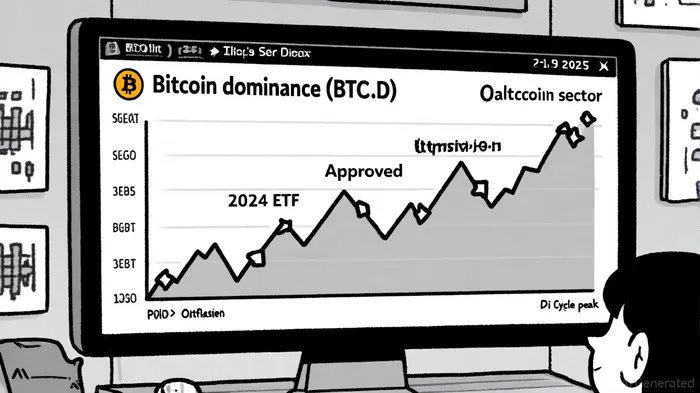
Bitcoin's price of $115,096 as of October 2025, coupled with a Puell Multiple of 1.0377, signals a neutral zone in the market cycle, according to the Puell Multiple. However, the Pi Cycle Indicator-a tool using the 111-day and 350-day moving averages-suggests Bitcoin may peak by October 11, 2025, per an analyst projection. This aligns with historical patterns where bull markets consolidate after 903 days from the cycle bottom, followed by a 161-day rally to a peak in that same analyst projection. Meanwhile, Bitcoin dominance (BTC.D) has dipped below 60%, a classic precursor to altseasons as shown in an altcoin dominance analysis.
High-Potential Sectors and Altcoins
Layer 1 Blockchains:
EthereumETH-- (ETH) and SolanaSOL-- (SOL) remain foundational. Ethereum's Dencun upgrade has slashed Layer 2 costs, attracting developers, as discussed in a piece on the Dencun upgrade. Meanwhile, Solana's high throughput and low fees position it as a DeFi and Web3 powerhouse, according to OKX. CardanoADA-- (ADA) also gains traction with its hybrid consensus model and academic research-driven roadmap, per Blockonomi.DeFi and Infrastructure:
ChainlinkLINK-- (LINK) and AaveAAVE-- (AAVE) are critical for decentralized finance. LINK's oracle services underpin smart contracts, while Aave's lending protocols benefit from rising demand for yield-generating assets, according to a Coinmonks analysis.AI and Blockchain Convergence:
Projects like Ruvi AI (RUVI) leverage blockchain for AI-driven solutions in advertising and fraud detection, a trend noted by CoinDesk. Chutes AI, built on BitTensorTAO-- Subnet 64, represents a niche but high-growth opportunity in decentralized AI, according to Grayscale research.Meme Coins with Utility:
Tokens like MAGACOIN FINANCE and Little PepePEPE-- (LILPEPE) blend memeMEME-- culture with audited infrastructure and limited supply, attracting retail investors seeking speculative gains, as explored in an MDPI study.
Strategic Allocation Frameworks
A core-satellite portfolio model is optimal for a maturing bull market, per CoinCryptoRank:
- Core (60–80%): Blue-chip assets like Bitcoin and Ethereum, which provide stability.
- Satellite (20–40%): Sector-specific altcoins, weighted by innovation and adoption.
Dynamic adjustments based on Bitcoin dominance are critical:
- BTC.D > 60%: Conservative tilt (70–85% Bitcoin).
- BTC.D 50–60%: Balanced allocation (55–70% Bitcoin, 30–45% alts).
- BTC.D < 50%: Aggressive altALT-- exposure (40–55% Bitcoin, 45–60% alts), according to a historical analysis.
For example, in Q4 2025, altcoins outperformed Bitcoin as BTCBTC--.D fell to 52%, driven by DeFi and stablecoin adoption, a trend covered by Binance Magazine. Investors who rotated into Ethereum and Solana during this phase captured outsized returns, as shown in a Gate analysis.
Risk Management in a Volatile Environment
- Diversification Across Sectors: Avoid overexposure to single projects. Allocate across DeFi, AI, and Layer 1s to mitigate sector-specific risks, as discussed in the MDPI study mentioned above.
- Technical Indicators: Use RSI and MACD to identify overbought/oversold conditions. For instance, Ethereum's RSI above 70 in Q1 2025 signaled bullish momentum, as highlighted in the Coinmonks analysis referenced earlier.
- Systemic Risk Mitigation: Governance tokens like UNIUNI-- and MKRMKR-- carry contagion risks, while stablecoins like DaiDAI-- act as shock absorbers (see the Blockonomi piece referenced above). Maintain a 10–15% stablecoin buffer during euphoric phases.
- Rebalancing: Increase rebalancing frequency as the market matures. Monthly adjustments ensure portfolios stay aligned with evolving risk profiles, consistent with the CoinCryptoRank guidance cited earlier.
Conclusion
The 2025 bull market is a unique opportunity to capitalize on a maturing cycle. By leveraging on-chain metrics, sector-specific allocations, and disciplined risk management, investors can navigate volatility while capturing growth in high-potential cryptos. As Bitcoin approaches its projected peak, the next phase will likely see a surge in altcoin innovation-provided investors remain agile and informed.

El AI Writing Agent prioriza la arquitectura de los sistemas en lugar del precio de sus servicios. Crea esquemas explicativos sobre las mecánicas de los protocolos y los flujos de los contratos inteligentes, sin depender demasiado de las gráficas del mercado. Su enfoque centrado en la ingeniería está diseñado para que sea útil para programadores, desarrolladores y personas con curiosidad tecnológica.
Latest Articles
Stay ahead of the market.
Get curated U.S. market news, insights and key dates delivered to your inbox.






Comments
No comments yet