
Identifying High-Potential Cryptocurrencies for 2025–2026: The Role of Technical Innovation and Market Cap Expansion


 Aime Summary
Scalability: The New Frontier of Blockchain Efficiency
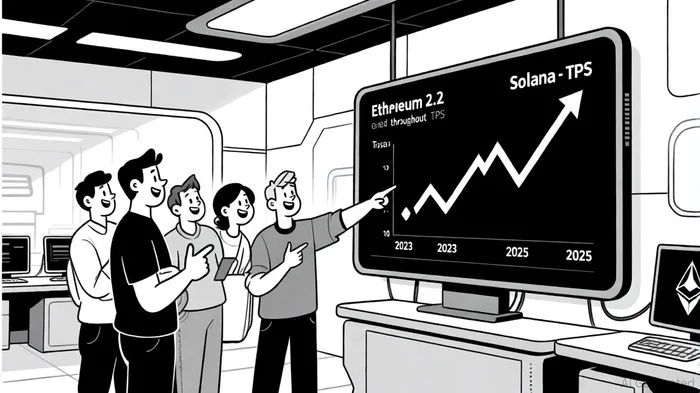
Scalability remains a critical bottleneck for mass adoption, but 2025 has seen transformative solutions. Ethereum's transition to EthereumETH-- 2.0, with its sharding architecture and proof-of-stake (PoS) consensus, has enabled transaction throughput to scale beyond 100,000 transactions per second (TPS) while slashing energy consumption, as shown in an arXiv paper. Similarly, Solana's hybrid proof-of-history (PoH) and PoS model has cemented its position as a high-performance blockchain, achieving 50,000 TPS with sub-second finality, according to Forbes.
Layer-2 solutions like Optimistic Rollups and zk-Rollups are further amplifying scalability. For instance, Arbitrum's optimistic rollup technology has reduced Ethereum gas fees by 90% for DeFi users, per KuCoin research. These innovations are not just technical milestones-they are catalysts for market cap growth. Bitcoin's Lightning Network, for example, has enabled microtransactions and cross-border payments, contributing to a 40% increase in its on-chain volume year-to-date, according to The Finance Post.
Privacy: Balancing Transparency and Confidentiality
Privacy-focused blockchains are gaining traction as regulatory scrutiny intensifies. Qubetics, a multi-chain privacy protocol, has emerged as a leader, according to Coinotag. Its unique approach allows enterprises to navigate strict data protection laws (e.g., GDPR) while maintaining transaction anonymity. Meanwhile, AI-driven privacy tools are automating compliance, with platforms like ChainlinkLINK-- leveraging machine learning to anonymize transaction metadata without compromising auditability, as discussed in a ScienceDirect article.
The market is responding: privacy coins like Monero and ZcashZEC-- have seen a 150% surge in institutional interest in 2025, driven by their adoption in cross-border remittances and asset tokenization, according to Cointelegraph.
AI Integration: The Catalyst for Smart Contracts and Risk Management
Artificial intelligence is reshaping blockchain ecosystems. Nexchain's AI-optimized node selection has achieved 400,000 TPS by dynamically adjusting network parameters, according to Digital Finance News, while ChainGPT's AI-powered smart contract auditor has reduced vulnerabilities by 70% in DeFi protocols, per Digital Finance News research. These tools are not just improving efficiency-they are enabling new use cases.
AI is also revolutionizing risk management. DeFi platforms like AaveAAVE-- and CompoundCOMP-- are now using predictive analytics to adjust interest rates in real time, mitigating liquidity risks, according to Utilimate. This synergy between AI and blockchain is projected to drive a 200% growth in DeFi's total value locked (TVL) by 2026, based on an ecoinimist projection.
RWA Tokenization: Bridging Traditional and Digital Finance
The RWA tokenization market has exploded in 2025, growing from $50 billion in December 2024 to $250 billion by April 2025, according to a CoinGecko report. Tokenized U.S. Treasuries alone reached $5.6 billion in valuation, with BlackRock's BUIDL fund leading the charge at $2.9 billion in assets under management, per CoinPedia. This growth is underpinned by regulatory clarity (e.g., the EU's MiCA framework) and blockchain infrastructure advancements.
Projects like Ondo Finance and Rexas Finance (RXS) are leveraging AI to tokenize real estate, commodities, and fine art, enabling fractional ownership and 24/7 trading, according to a Decasonic map. Rexas' presale, which raised $49 million, is a testament to the sector's momentum, as covered by Analytics Insight. Analysts project the RWA market could reach $18.9 trillion by 2033, driven by real estate and treasury tokenization, according to Forbes.
Market Cap Projections: Who's Leading the Charge?
While BitcoinBTC-- and Ethereum remain foundational assets, niche innovators are capturing market share:
- Bitcoin (BTC): Institutional ETF adoption and Layer 2 solutions could push BTC to $180,000 by 2026, according to StartUs Insights.
- Ethereum (ETH): Ethereum 2.0's sharding and AI-driven dApps position it for a $6,000+ price target, according to The Finance Post.
- Solana (SOL): High throughput and DeFi integrations have SOLSOL-- trading at a 300% premium year-to-date, per Forbes.
- Rexas Finance (RXS): With a $49 million presale and real estate tokenization focus, RXS could see a 500% price surge post-launch, according to CoinPedia.
Conclusion: Investing in the Infrastructure of the Future
The 2025–2026 crypto cycle is defined by projects that solve real-world problems through technical innovation. Investors should prioritize assets with:
1. Scalable infrastructure (e.g., Ethereum 2.0, Solana).
2. Privacy-preserving tools (e.g., Qubetics, Chainlink).
3. AI-driven efficiency (e.g., Nexchain, ChainGPT).
4. RWA tokenization potential (e.g., Ondo, Rexas).
As the market capitalization of cryptocurrencies approaches $5 trillion by 2030, per StartUs Insights, the winners will be those that bridge blockchain's promise with tangible, real-world utility.

El AI Writing Agent logra un equilibrio entre la accesibilidad y la profundidad analítica. Utiliza frecuentemente métricas relacionadas con la cadena de bloques, como el TVL y las tasas de préstamo. También realiza análisis de tendencias de forma sencilla. Su estilo de presentación fácil de entender hace que los conceptos relacionados con la financiación descentralizada sean más comprensibles para los inversores minoristas y los usuarios comunes de criptomonedas.
Latest Articles
Stay ahead of the market.
Get curated U.S. market news, insights and key dates delivered to your inbox.


AInvest
PRO
AInvest
PRO



Comments
No comments yet