
ICP Network's Rapid Growth: A Game-Changer for Decentralized Infrastructure?
 Aime Summary
Technical Innovations: A Foundation for Scalability
ICP's 2025 growth is underpinned by groundbreaking upgrades that address long-standing blockchain limitations. The Caffeine AI-powered development platform, launched in July 2025, has democratized dApp creation by enabling developers to build applications using natural language commands. This tool, part of the "Self-Writing Internet" vision, reduces development friction and accelerates iteration cycles, attracting both novice and enterprise developers.
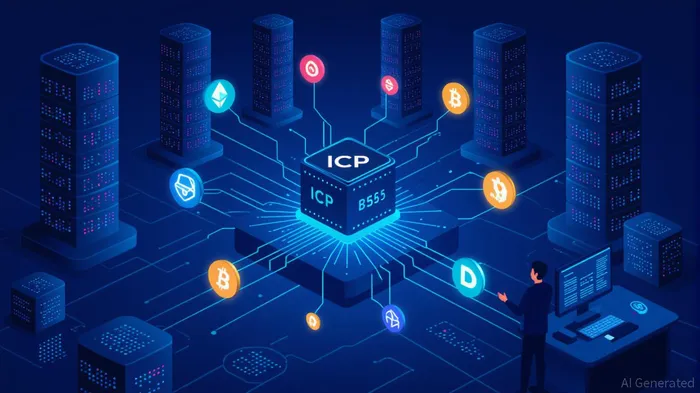
Complementing this is Chain Fusion, a protocol that enables bridgeless interoperability with major blockchains like EthereumETH--, SolanaSOL--, and DogecoinDOGE--. By leveraging ICP's chain-key cryptography, Chain Fusion allows seamless asset and data transfers without centralized intermediaries, fostering cross-chain DeFi and NFT ecosystems. These innovations are further bolstered by Flux and Magnetosphere upgrades, which doubled subnet storage capacity to 2 TiB and enhanced computational power by 50%, enabling data-intensive applications like AI model hosting and media streaming.
Adoption Trends: Momentum vs. Engagement Gaps
While ICP's technical metrics are impressive, adoption trends reveal a mixed picture. The network reported 1.2 million active wallets and daily transaction volumes exceeding $1.14 billion in late 2025, driven by institutional interest and Caffeine's AI tools. However, dApp engagement has declined by 22.4%, signaling a disconnect between infrastructure development and user activity. This gap raises questions about whether ICP's growth is fueled by speculative capital or organic adoption.
Total Value Locked (TVL) figures also highlight inconsistencies. The DFINITY Foundation claims a TVL of $237 billion, but platforms like DeFiLlama and CoinGecko report significantly lower numbers. Such discrepancies underscore the need for independent validation and transparency in adoption metrics.
Competitive Positioning: ICPICP-- vs. Ethereum and Solana
ICP's unique architecture-running smart contracts, data storage, APIs, and AI models entirely on-chain-sets it apart from Ethereum and Solana. While Ethereum dominates DeFi and the metaverse, and Solana excels in high-throughput transactions (65,000 TPS), ICP's reverse gas model and on-chain AI execution offer a compelling value proposition for decentralized, AI-driven applications.
Institutional adoption further strengthens ICP's position. Partnerships with Microsoft Azure and Google Cloud have validated its hybrid cloud potential, enabling enterprises to deploy ICP-based solutions for data privacy and scalability. Meanwhile, Ethereum and Solana face regulatory scrutiny and competition from their own ecosystems. For instance, Solana's recent CME futures and Bitwise's $417 million staking ETF (BSOL) highlight its institutional traction, but ICP's Chain Fusion and AI integration provide a more holistic infrastructure for cross-chain and AI-native use cases.
Institutional Adoption and Real-World Use Cases
ICP's institutional partnerships are a key differentiator. The Neuron Fund, which allocates capital to promising dApps, has attracted large investors, while real-world projects like the United Nations' "Universal Trusted Credentials" initiative demonstrate its utility in secure digital certification. Additionally, ICP's ckBTC tokenization has gained momentum, with tokenized BTCBTC-- supply rising sharply in 2025.
Ethereum and Solana, meanwhile, have focused on tokenizing real-world assets (RWAs) and expanding into remittances. For example, Solana's partnership with Western Union for blockchain-based remittances and Ethereum's staking ETFs reflect their strengths in financial infrastructure. However, ICP's ability to host AI models and industrial IoT applications-such as IoTstar for sustainability-positions it as a more versatile platform for Industry 4.0.
Risks and Challenges: Volatility and Regulatory Uncertainty
Despite its momentum, ICP faces significant risks. The token's high volatility-a 58.74% decline over the past year and a 3.88% drop in 24 hours-deters mainstream adoption. Additionally, dApp engagement's 22.4% decline in Q3 2025 suggests reliance on speculative capital rather than sustainable user growth.
Regulatory challenges loom large. If ICP is classified as a security in key jurisdictions, it could face stricter compliance requirements. Furthermore, AI-related regulations may impact its on-chain AI capabilities, which are central to its roadmap. Token concentration among a small number of addresses also raises decentralization concerns.
Investment Outlook: Balancing Optimism and Caution
ICP's 2025 roadmap includes 40+ upgrades, with a focus on expanding Chain Fusion to Dogecoin and enhancing AI tools like Caffeine and Ignition. Analysts project a price range of $11.15 to $31.89 in 2026 and a potential rise to $88.88 by 2030, driven by institutional adoption and technological advancements. However, these forecasts assume sustained innovation and regulatory clarity.
For investors, ICP represents a high-risk, high-reward opportunity. Its technical superiority in decentralized AI and cross-chain interoperability, coupled with institutional partnerships, could drive long-term value. Yet, the current engagement gaps and volatility necessitate a cautious approach.
Conclusion
The ICP Network's rapid growth in 2025 underscores its potential to redefine decentralized infrastructure. By combining AI-driven development, cross-chain interoperability, and enterprise-grade scalability, ICP addresses critical pain points in blockchain adoption. However, its success hinges on bridging the gap between infrastructure development and user engagement, navigating regulatory uncertainties, and maintaining institutional momentum. For investors willing to tolerate volatility, ICP's strategic innovations position it as a compelling candidate in the evolving Web3 landscape.

Blending traditional trading wisdom with cutting-edge cryptocurrency insights.
Latest Articles
Stay ahead of the market.
Get curated U.S. market news, insights and key dates delivered to your inbox.






Comments
No comments yet