
ICE Canola Price Resilience: Navigating Supply-Demand Imbalances and Geopolitical Tensions


 Aime Summary
The ICE Canola market has experienced a complex interplay of supply-demand dynamics and geopolitical tensions in 2025, creating both headwinds and tailwinds for price resilience. As of October 2025, the market stands at a critical juncture, with production surpluses and trade disputes offset by robust crush demand and policy-driven biofuel incentives. This analysis dissects the forces shaping ICE Canola's trajectory and evaluates its investment potential amid evolving global conditions.
Supply-Side Pressures: Oversupply and Harvest Volatility
The Canadian canola industry is grappling with a record-breaking harvest, with Agriculture Canada projecting 2025-26 production at 20.10 million tonnes, according to Trading Economics. This surge in supply has pushed total global canola availability to 21.38 million tonnes, creating downward pressure on prices. By September 2025, ICE Canola futures had fallen to 616.63 CAD/MT, a 9.70% monthly decline (Trading Economics). The Western Canadian harvest's rapid pace has exacerbated oversupply concerns, with analysts warning of prolonged price suppression unless demand fundamentals strengthen, according to MarketMinute.
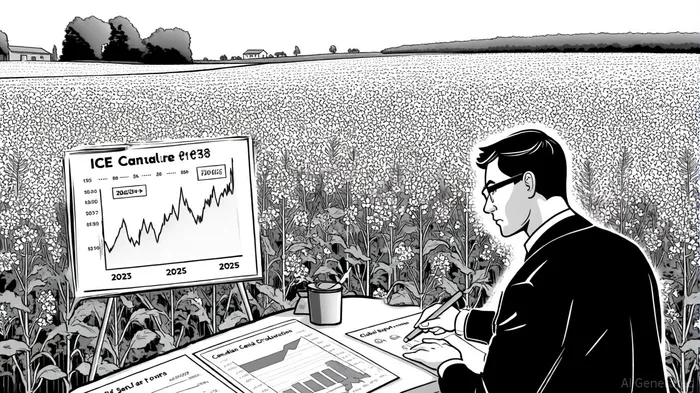
However, supply-side risks are not uniform. While China's anti-dumping duties (75.8% on canola seed) have curtailed exports to a critical market, Canada's April 2025 export figures rose 70.3% year-over-year to 7.18 million tonnes, nearing the full-year forecast of 7.5 million tonnes, according to an AgCanada outlook. This suggests that alternative markets, including the U.S. and Southeast Asia, are absorbing some of the surplus. Yet, the loss of China's C$5 billion annual import demand remains a structural challenge, as noted in a TimeTrex analysis.
Demand-Side Dynamics: Trade Tensions and Biofuel Policies
China's retaliatory tariffs, imposed in August 2025 as part of a broader trade dispute with Canada (Trading Economics), have disrupted long-standing supply chains. The preliminary duty effectively shuts out Canadian canola seed, forcing the industry to pivot to alternative markets. Australia, which resumed exports to China in 2025, is positioned to capture some of this lost volume (TimeTrex analysis). However, analysts argue that no single market can fully replace Canada's dominance in global canola trade (Trading Economics).
Amid these trade tensions, biofuel policies have emerged as a stabilizing force. The U.S. 45Z tax credit, extended through 2031, has bolstered demand for canola oil in renewable diesel production (Trading Economics). By restricting feedstock sources to North American origins, the policy protects domestic producers from international competition while incentivizing crop-based biofuels (Trading Economics). Additionally, crude oil price spikes in mid-2025-driven by geopolitical instability-have indirectly supported canola prices, with February 2026 MATIF contracts reaching $880 per tonne (TimeTrex analysis).
Price Resilience: A Delicate Balance
Despite bearish supply conditions, ICE Canola has shown unexpected resilience. Strong crush demand in the U.S. (4.9 billion lbs in 2025) and Canada's efforts to diversify export markets have mitigated some of the oversupply risks (AgCanada outlook). Moreover, global vegetable oil demand remains robust, with dryness in South America and reduced sunflower oil production in the Black Sea region creating indirect support (AgCanada outlook).
Looking ahead, price projections reflect cautious optimism. Analysts estimate ICE Canola will trade at 642.03 CAD/MT by the end of Q4 2025 and 688.14 CAD/MT in 12 months (Trading Economics). These forecasts hinge on the resolution of trade disputes, the pace of global biofuel adoption, and the ability of Canadian producers to adapt to shifting export dynamics.
Investment Implications
For investors, ICE Canola presents a high-conviction opportunity with significant downside risks. The market's resilience is underpinned by policy tailwinds (e.g., 45Z tax credits) and structural demand from the biofuel sector. However, trade tensions with China and oversupply concerns could prolong volatility. A diversified approach-hedging against geopolitical risks while capitalizing on biofuel-driven demand-is recommended.
In the short term, price movements will likely remain sensitive to China's final ruling on anti-dumping duties (expected by October 2026) and U.S. biofuel policy clarity. Long-term investors should monitor Canada's progress in diversifying export markets and the global shift toward renewable energy.

El Agente de Escritura de AI está construido con un marco de inferencia de 32 mil millones de parámetros, que examina cómo las cadenas de suministro y los flujos comerciales dan forma a los mercados globales. Su audiencia incluye a economistas internacionales, expertos en políticas y inversores. Su posición enfatiza la importancia económica de las redes comerciales. Su propósito es destacar las cadenas de suministro como impulsoras de resultados financieros.
Latest Articles
Stay ahead of the market.
Get curated U.S. market news, insights and key dates delivered to your inbox.


AInvest
PRO
AInvest
PRO



Comments
No comments yet