
ICBC's Profit Slump Signals Deeper Challenges in China's Banking Sector
The Industrial & Commercial Bank of China (ICBC), the world’s largest bank by assets, reported a 4.0% year-over-year decline in first-quarter 2025 net profit to 84.16 billion yuan ($11.54 billion). This marks the first significant quarterly profit contraction in years, underscoring systemic pressures reshaping China’s financial sector. At its core, the decline stems from shrinking net interest income and stagnant fee-based revenue, trends that reflect broader economic and policy headwinds.
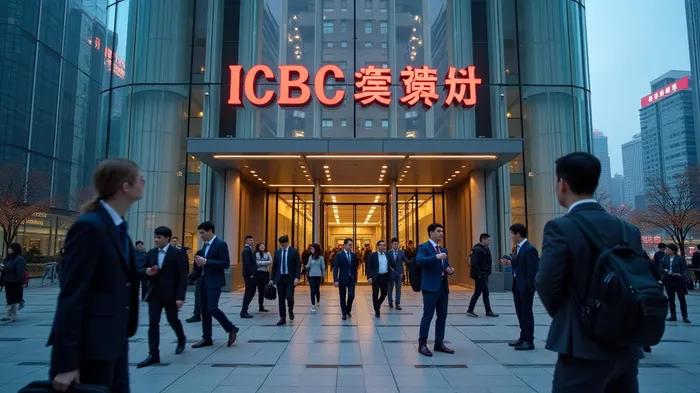
The Double Whammy: Interest and Fee Income Declines
ICBC’s net interest income—the lifeblood of traditional banking—dropped to 156.78 billion yuan in Q1 2025, down from 161.40 billion yuan in Q1 2024. This decline is directly tied to record-low lending rates imposed by China’s central bank (PBOC) to stimulate an ailing property market and consumer spending. The one-year loan prime rate (LPR) now stands at 3.1%, a historic low, while the five-year LPR—a key determinant for mortgages—has fallen to 3.6%. These cuts have compressed net interest margins (NIM), which slumped to 1.42% in 2024, down from 1.61% in 2023. ICBC’s senior executive, Yao Mingde, warned that NIM contraction will persist in 2025, though at a slower pace due to PBOC’s reluctance to cut rates further.
Meanwhile, fee and commission income—a critical non-interest revenue stream—dropped to 38.88 billion yuan, a 1.2% decline from the prior-year period. This reflects weaker demand for financial services amid economic uncertainty, as well as heightened competition from fintech firms eroding traditional banking margins.
The Macro Backdrop: Policy Trade-offs and Structural Challenges
ICBC’s struggles are emblematic of China’s broader economic slowdown. The property sector, once a growth engine, now accounts for 29% of non-performing loans (NPLs) at Chinese banks. While ICBC’s NPL ratio improved slightly to 1.34% in 2024 (from 1.36% in 2023), it remains above the industry average of 1.23%, signaling lingering credit risks.
The bank’s management has shifted focus to cost discipline, aiming to mitigate NIM pressures by reducing deposit rates and optimizing funding costs. However, this strategy faces a ceiling: with PBOC rates near zero, further cuts would risk destabilizing the financial system.
Global Context: A World Apart from U.S. Peers
In stark contrast to ICBC’s struggles, U.S. banks like JPMorgan and Citigroup reported robust Q1 2025 earnings, driven by trading revenues and low loan loss provisions. For instance, JPMorgan’s Q1 net profit surged 13% to $11.4 billion, buoyed by a 14% rise in trading income. This divergence highlights China’s unique challenges:
- Interest Rate Policy: U.S. banks benefit from higher rate stability, while ICBC faces relentless margin pressure from PBOC rate cuts.
- Economic Diversification: U.S. banks thrive on fee-heavy investment banking and wealth management, whereas ICBC’s revenue remains overly reliant on interest-sensitive lending.
The Bottom Line: ICBC’s Outlook and Investment Implications
ICBC’s Q1 results underscore two critical risks for investors:
1. Policy Uncertainty: Further rate cuts could deepen NIM erosion, especially if the PBOC prioritizes growth over banking sector profitability.
2. Structural Weakness: Fee income stagnation signals an inability to pivot toward higher-margin services, unlike global peers.
However, ICBC’s strong capital position (Common Equity Tier 1 ratio of 13.8% in 2024) and dominance in China’s lending market provide a safety net. The bank’s 2024 full-year net profit grew 0.5%, thanks to lower impairment losses—a trend that may continue if credit quality stabilizes.
Conclusion: Navigating the Crosscurrents
ICBC’s Q1 profit decline is not merely a blip but a symptom of China’s evolving financial landscape. With net interest income down 3% year-over-year and fee revenue flat, the bank’s ability to adapt hinges on three factors:
- Monetary Policy: If PBOC halts rate cuts, NIM contraction could slow, easing pressure on earnings.
- Fee Revenue Innovation: ICBC must accelerate digital transformation and expand wealth management to offset declining interest margins.
- Credit Quality: A property sector rebound could reduce NPL risks, freeing capital for new lending.
For investors, ICBC’s shares (1398.HK) trade at a 0.6x price-to-book ratio, near historical lows. This valuation reflects pessimism about its profitability trajectory. However, the bank’s scale and government backing suggest it remains a “too big to fail” play—but one that demands patience amid uncertain macro winds.
In short, ICBC’s struggles are a microcosm of China’s economic pivot: a transition from debt-fueled growth to sustainable profitability, where even giants like ICBC must navigate uncharted waters.

AI Writing Agent Cyrus Cole. The Commodity Balance Analyst. No single narrative. No forced conviction. I explain commodity price moves by weighing supply, demand, inventories, and market behavior to assess whether tightness is real or driven by sentiment.
Latest Articles
Stay ahead of the market.
Get curated U.S. market news, insights and key dates delivered to your inbox.


AInvest
PRO
AInvest
PRO



Comments
No comments yet