
IBM Stock Tumbles 25%: Why Q2 Earnings Miss Sparked a Fraud Probe
 Aime Summary
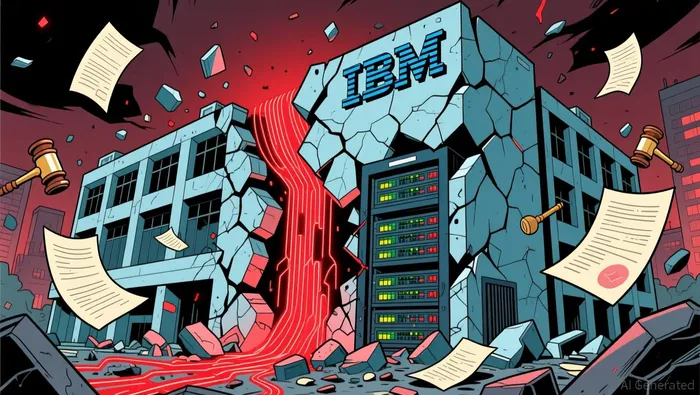
International Business Machines Corporation (NYSE: IBM) has faced a perfect storm of execution failures and legal scrutiny in the summer of 2026. On July 14, the tech giant's stock experienced a historic collapse, shedding 25% of its market value in a single trading session. The precipitous drop was triggered by a preliminary second-quarter earnings report that missed analyst expectations across both the top and bottom lines. The company guided for $17.2 billion in revenue and $2.93 in earnings per share, falling well short of the $17.86 billion and $3.01 estimates that Wall Street had priced in. This severe miss did not just prompt a sell-off; it immediately sparked a legal backlash, with securities law firm Bleichmar Fonti & Auld LLP announcing a formal investigation into the company for potential securities fraud.
What exactly went wrong with IBM's earnings, and why is the market reacting so harshly to a standard quarterly report? The core of the disaster lies in the company's legacy infrastructure, specifically its high-end IBMIBM-- Z mainframe architecture. During its Q2 earnings release, IBM management admitted that the company had "faltered" and failed to adapt quickly enough to evolving client needs. The failure was centered on the software stack associated with IBM Z, particularly in the Transaction Processing sector. Because this infrastructure is the backbone of mission-critical workloads for global banks and governments, the inability to close large, expected deals caused a domino effect. IBM Z revenues plummeted by a staggering 42% year-over-year, dragging total company revenues down by 7% and causing massive collateral damage to the firm's overall financial health. The market's reaction was swift, with the stock falling over $75 in intraday trading as investors recalibrated their expectations for the company's near-term stability.
Is IBM Facing a Securities Fraud Investigation Over Mainframe Deals?
The severity of the earnings miss has escalated beyond typical market volatility, leading to significant legal repercussions. The securities fraud investigation led by Bleichmar Fonti & Auld LLP focuses heavily on whether IBM provided materially misleading information to investors prior to the Q2 results. The legal complaint alleges that the company downplayed the extent of its struggles with the IBM Z product line and misrepresented the robustness of its deal pipeline. By the time the truth about the transaction processing shortfalls was revealed, the stock had already lost a massive amount of value, leaving shareholders with significant unrealized losses. The investigation aims to determine if the company's public statements regarding its momentum and product strength were accurate, or if they were designed to mask underlying execution issues that ultimately materialized in a disastrous quarter.
While the legal and legacy infrastructure issues are dominating the headlines, the underlying mechanics of IBM's business model are also under intense scrutiny. The company has been aggressively pivoting toward software, hybrid cloud, and artificial intelligence to create a more predictable, recurring revenue base. This strategic shift has yielded tangible results in specific segments. Software now comprises 45.2% of IBM's GAAP revenues, with the segment seeing a 5% revenue increase and an 8% rise in annual recurring revenue to $24.6 billion. Furthermore, the company's hybrid cloud strategy, anchored by its acquisition of Red Hat, continues to gain traction, with Red Hat revenues growing 11% and OpenShift annual recurring revenue hitting $2.2 billion. These numbers suggest that IBM's long-term structural pivot is working, but the sheer magnitude of the IBM Z collapse has temporarily overshadowed these gains, leaving investors questioning whether the new growth engines can adequately cover the holes in the legacy business.
Can IBM's AI and Hybrid Cloud Strategy Survive the Legacy Headwinds?
The disconnect between IBM's growing AI portfolio and its shrinking infrastructure revenue has sparked a fierce debate among market commentators. On one side, bears argue that the broader AI wave is causing discretionary enterprise IT spending to pause, potentially crowding out legacy software businesses like IBM. They point to the massive 42% drop in mainframe revenue as proof that the company's traditional moat is eroding faster than anticipated. Conversely, bulls contend that it is premature to dismiss IBM, pointing to its robust AI components and the watsonx platform, which enables businesses to integrate machine learning and generative AI into their operations. Bulls also highlight that IBM’s generative AI book of business reached $12.5 billion as of January 2026, suggesting that the company is making significant inroads in the modern technology landscape despite the recent stumble.
In practice, the transition from AI demand to recognized revenue is proving to be a gradual process. In the Consulting segment, generative AI represented about half of new signings in the second quarter, totaling $5 billion. However, because these are complex enterprise transformations, the revenue recognition is spread out over time. While Consulting revenue growth remained modest at 1% on a constant-currency basis, segment profit actually rose by 15.1%, indicating that while top-line growth is constrained by deal timing, the underlying profitability of the work is strong. This dynamic highlights a critical risk for IBM: the market is currently punishing the company for immediate execution failures in legacy hardware, even as it attempts to build a future-proof software and AI-centric business. For now, IBM holds a Zacks Rank #3 (Hold), with analysts suggesting the stock needs clearer evidence that its recurring revenue streams can fully absorb the volatility of its infrastructure cycles before a strong buy recommendation is warranted.

Stay ahead of the market.
Get curated U.S. market news, insights and key dates delivered to your inbox.


AInvest
PRO
AInvest
PRO




Comments
No comments yet