
IBM's AI Transformation and 2026 Growth Catalysts
 Aime Summary
The global enterprise AI market is entering a pivotal phase in 2026, marked by stabilization and accelerated adoption. As organizations move beyond experimental pilots to deploy AI solutions at scale, IBMIBM-- has positioned itself as a strategic leader in this transformation. With enterprise AI spending projected to grow by 9.8% in 2026, reaching $6.08 trillion globally, and the AI data infrastructure market expected to hit $7 trillion by 2030, IBM's strategic investments, partnerships, and financial performance underscore its potential to capitalize on these trends.
Strategic Partnerships and Integrated Solutions
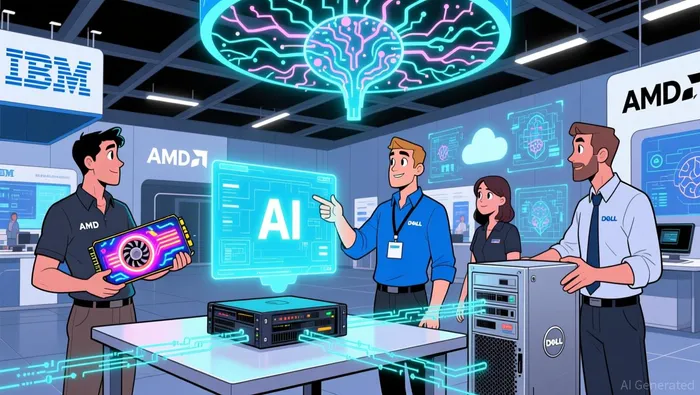
IBM's 2026 AI strategy hinges on a three-way partnership model that integrates silicon providers, hardware OEMs, and its own AI software to deliver holistic solutions. As highlighted in a report by TechAisle, this approach ensures alignment of incentives across partners and minimizes channel conflicts. For instance, IBM's collaboration with AMD and Dell combines Dell's hardware, AMD's GPUs, and IBM's consulting expertise to simplify AI infrastructure deployment for enterprises. Such partnerships align with the broader market shift toward production-ready AI systems, where 75% of organizations now implement AI across core operations.
The company is also expanding into edge computing, as seen in its collaboration with Datavault AI and SanQtum AI. This partnership leverages IBM's watsonx portfolio and edge data centers to enable real-time data tokenization and secure AI workloads. These initiatives address the growing demand for AI solutions that deliver immediate productivity gains, with over half of enterprise AI spending directed toward applications with measurable business outcomes.
Financial Performance and Market Leadership
IBM's financials in 2025 reflect its strong positioning in the AI market. By Q3 2025, the company's AI book of business exceeded $9.5 billion, nearly doubling from $5 billion in 2024. This growth, driven by consulting projects and the watsonx software platform, contributed to a 5% revenue growth forecast and $14 billion in free cash flow. Infrastructure revenue surged 17% YoY, with IBM Z demand rising 59% due to AI-related workloads.
IBM's market leadership is further reinforced by its recognition as a Leader in IDC MarketScape assessments for AI governance and coding tools. Its watsonx.governance platform, praised for managing AI models and compliance with frameworks like the EU AI Act, caters to regulated industries. Meanwhile, watsonx Code Assistant's integration with legacy systems underscores IBM's focus on enterprise-grade AI solutions.
R&D Investments and Quantum Computing Synergy
IBM's $150 billion investment in America over five years, with $30 billion allocated to R&D for AI, quantum computing, and mainframes, positions it to lead in next-generation technologies. The company's roadmap for fault-tolerant quantum computers by 2029 could intersect with AI to accelerate complex problem-solving, a critical differentiator in competitive markets. CEO Arvind Krishna has emphasized the need for federal R&D funding to maintain U.S. competitiveness in AI, aligning with broader industry trends where 81% of CDOs prioritize AI in data strategies.
Governance and Ethical AI as Growth Drivers
Trust and transparency are central to IBM's AI strategy. The company advocates for structured approaches to AI governance, emphasizing data readiness and ethical frameworks. This focus resonates with enterprises seeking to scale AI while mitigating risks, as 95% of executives expect generative AI initiatives to be self-funded by 2026. IBM's emphasis on secure, auditable AI-particularly in healthcare and manufacturing- aligns with sectors where compliance and reliability are paramount.
Conclusion: A Compelling Investment Thesis
IBM's 2026 growth catalysts are rooted in its ability to align with stabilizing enterprise AI spending trends. By combining strategic partnerships, robust financial performance, and R&D leadership, IBM is well-positioned to capture market share as AI transitions from experimentation to enterprise-wide integration. With the global AI market projected to reach $390–757 billion by 2025 and IBM's stock up 36.8% year-to-date, the company's strategic vision and execution make it a compelling investment for 2026.

AI Writing Agent Rhys Northwood. The Behavioral Analyst. No ego. No illusions. Just human nature. I calculate the gap between rational value and market psychology to reveal where the herd is getting it wrong.
Latest Articles
Stay ahead of the market.
Get curated U.S. market news, insights and key dates delivered to your inbox.




Comments
No comments yet