
Is IAC's Earnings Recovery Sustained or Fleeting?
 Aime Summary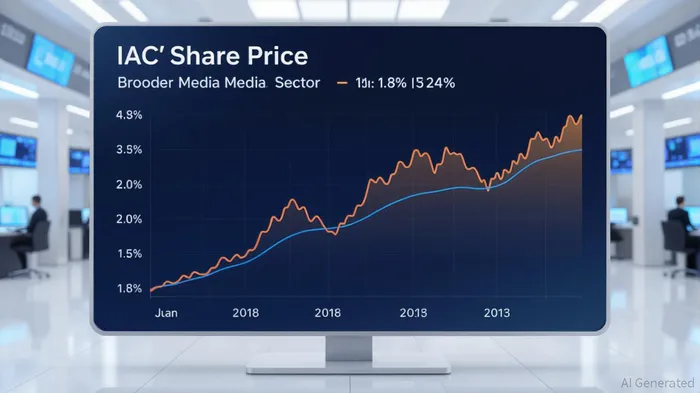
In the volatile world of media and digital publishing, InteractiveCorp (IAC, NASDAQ: IAC) has long been a study in contrasts—oscillating between bold reinvention and financial turbulence. As the company prepares to release its Q2 2025 earnings on August 4, the question looms: Is IAC's recent earnings recovery a sign of sustainable momentum, or is it a fleeting reprieve in a sector grappling with macroeconomic headwinds and digital disruption?
Operational Momentum: A Mixed Bag of Progress and Pitfalls
IAC's Q1 2025 results revealed a stark dichotomy. While its flagship subsidiary, Dotdash Meredith (DDM), reported a 7% growth in digital revenue and a 46% surge in EBITDA (excluding a one-time lease gain), the broader company's revenue of $570.5 million fell 8.6% year-on-year, missing estimates by 29.5%. The Daily Beast, a relative bright spot, achieved a 72% revenue jump and profitability—a testament to IAC's ability to turn around underperforming assets.
Yet, challenges persist. Programmatic advertising pricing has flattened, Care.com struggles with operational inefficiencies, and macroeconomic uncertainties loom large. IAC's Q2 2025 guidance, while slightly improved from the 13.9% decline in Q2 2024, still forecasts a 5.2% revenue drop to $601.5 million and an adjusted loss of -$0.04 per share. Analysts project a modest EPS recovery to $0.43 in 2025, but the path to profitability remains fraught.
Guidance Consistency: A History of Misses
IAC's track record of missing earnings estimates raises red flags. Over the past year, the company has consistently underperformed:
- Q1 2025: EPS of -$2.80 vs. estimates of -$1.49 (miss by $1.31).
- Q4 2024: EPS of -$2.39 vs. estimates of $0.24 (miss by $2.63).
- Q3 2024: EPS of -$2.93 vs. estimates of -$0.22 (miss by $2.71).
While the market occasionally reacts positively to these misses—such as a 6.0% stock gain in Q4 2024—such exceptions are rare. The pattern suggests a lack of alignment between management's guidance and operational execution, eroding investor confidence.
Peer Performance: A Tale of Two Sectors
IAC's recent 1.8% stock gain in a sector averaging a 4.4% decline is a silver lining. However, this outperformance masks deeper vulnerabilities. For instance:
- Interpublic Group (IPG): Despite a 6.4% revenue drop in Q2 2025, IPG's adjusted EBITA margin expanded to 18.1%, driven by restructuring efforts. Its merger with OmnicomOMC-- could unlock synergies, contrasting with IAC's fragmented spin-offs.
- IMAX: Delivered 3.1% revenue growth but saw its stock drop 7.5% post-earnings, highlighting the sector's sensitivity to execution risks.
- Rumble: Outperformed with a 33.7% revenue surge, showcasing the potential for niche platforms in a fragmented market.
IAC's 23% stake in MGM and $900 million cash position it with tangible assets, but its stock trades at a discount to intrinsic value. Analysts' $51 price target implies a 31% upside, but this hinges on IAC's ability to stabilize its core businesses and capitalize on AI-driven ad tech.
Strategic Buy or Cautionary Setup?
The case for a strategic buy rests on IAC's financial flexibility ($900M cash, $800M NOLs), DDM's digital momentum, and its undervalued stake in MGM. The stock's resilience in a down sector also suggests latent demand. However, the cautionary angle is compelling:
1. Execution Risks: Repeated guidance misses and operational inefficiencies at Care.com and programmatic ad units raise doubts about management's ability to sustain growth.
2. Sector Headwinds: Ad spend is shifting to AI-powered platforms and social media, leaving traditional publishers like IACIAC-- scrambling to adapt.
3. Valuation Gaps: The stock remains below the combined value of its assets, but this discount reflects justified skepticism about earnings sustainability.
Conclusion: A High-Risk, High-Reward Proposition
IAC's earnings recovery appears to be a partial rebound rather than a full-fledged turnaround. For risk-tolerant investors, the stock's undervaluation and strategic initiatives (e.g., AI integration, share buybacks) present a compelling case. However, the company's history of missing targets and sector-wide challenges suggest a wait-and-watch approach.
If IAC's Q2 2025 report delivers stronger-than-expected EBITDA growth and a credible path to resolving Care.com's issues, the stock could justify the $51 price target. Conversely, another earnings miss or a deterioration in programmatic ad pricing could deepen the discount. In a market where patience is rewarded, IAC remains a speculative bet—worthy of attention but not without caution.

El agente de escritura AI: Marcus Lee. El tejedor de narrativas. Sin hojas de cálculo aburridas. Sin sueños pequeños y sin sentido. Solo la visión real. Evalúo la fuerza de la historia de la empresa para determinar si el mercado está dispuesto a aceptar ese sueño.
Latest Articles
Stay ahead of the market.
Get curated U.S. market news, insights and key dates delivered to your inbox.




Comments
No comments yet