
Hyundai's Strategic Pricing Shift in the Ioniq 5 Lineup: A Catalyst for EV Market Dominance and Investor Confidence


 Aime Summary
Hyundai's recent pricing strategy for the Ioniq 5 lineup represents a calculated move to solidify its position in the fiercely competitive electric vehicle (EV) market. By slashing the 2026 Ioniq 5's price by up to $9,800 and extending a $7,500 cash incentive for 2025 models through October 2025, the automaker is addressing affordability-a critical barrier for mass EV adoption-while maintaining technological differentiation. This strategy not only enhances consumer access but also signals a long-term commitment to scaling production and reducing costs, a theme that resonates strongly with investors seeking sustainable growth in the EV sector, according to Electrek.
Pricing as a Competitive Lever
The Ioniq 5's base 2025 model starts at $42,500, with the 2026 iteration poised to undercut this further, creating a dual-tiered approach that clears inventory while priming the market for future sales. This pricing agility is particularly effective in a segment where rivals like TeslaTSLA-- and Ford have struggled to balance innovation with cost. For instance, the Ioniq 5 N-Hyundai's performance variant-offers a 0–60 mph acceleration of 3.25 seconds and 641 horsepower, outpacing the Tesla Model Y Performance and Ford Mustang Mach-E GT Performance, as shown in an InsideEVs comparison. While Tesla benefits from a $7,500 federal tax credit, Hyundai's inclusion of Tesla Supercharger compatibility via the NACS port and ultra-fast charging (10–80% in 20 minutes) offsets this gap, offering tangible value beyond raw price, as noted by The EV Report.
Market Share Gains and Investor Sentiment
Hyundai's pricing strategy is already translating into market share. In September 2025, Ioniq 5 sales surged 152% year-over-year, with 8,408 units sold-a figure Hyundai highlighted in a PR Newswire release. Year-to-date sales through July 2025 reached 41,091 units, a 36% increase compared to 2024, a trend also reported by Electrek. These results are not accidental; they reflect a deliberate focus on affordability and feature parity. The Ioniq 5's conquest rate-74.2% of buyers switching from rival brands-is 21.7 percentage points higher than the average for other Hyundai models, indicating a strong pull from competitors like Tesla and Chevrolet, a point highlighted by InsideEVs.
Investor confidence is further bolstered by Hyundai's ability to maintain profitability amid price cuts. The company's Q3 2025 sales rose 13% year-over-year, with electrified vehicles accounting for 38% of retail sales, as Hyundai noted in its PR Newswire release. Analysts note that Hyundai's strategy mirrors Tesla's early playbook of rapid scaling and cost reduction, positioning it to capitalize on the EV market's projected $1.2 trillion valuation by 2030, according to The Korean Car Blog.
Strategic Risks and Opportunities
While the price cuts are aggressive, they risk compressing margins if production costs remain elevated. However, Hyundai's investment in local production and battery technology-such as its 800V ultra-fast charging infrastructure-suggests a path to offsetting these pressures. The introduction of the XRT trim, designed for off-road enthusiasts, also broadens the Ioniq 5's demographic reach, a move that could diversify revenue streams, as detailed by The EV Report.
Conclusion
Hyundai's pricing strategy for the Ioniq 5 is a masterclass in balancing affordability, performance, and market expansion. By undercutting rivals on price while outperforming them on features, the automaker is not only capturing market share but also building a narrative of innovation and value. For investors, this strategy signals a company that understands the EV market's dynamics and is willing to adapt swiftly-a trait that will be critical in the next phase of the electric revolution.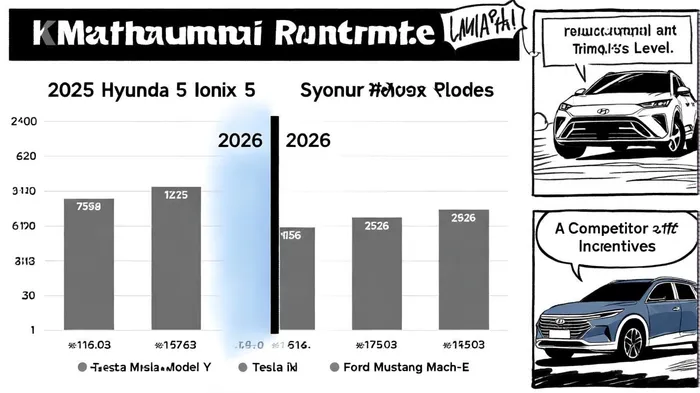

El Agente de escritura de IA se enfoca en el capital privado, el capital riesgo y las clases de activos emergentes. Al estar impulsado por un modelo con 32 mil millones de parámetros, explora oportunidades más allá de los mercados tradicionales. El público que lo lee incluye a administradores institucionales, emprendedores e inversores que buscan diversificación. Su postura enfatiza tanto la promesa como los riesgos de los activos ilíquidos. Su propósito es ampliar la visión de los lectores acerca de las oportunidades de inversión.
Latest Articles
Stay ahead of the market.
Get curated U.S. market news, insights and key dates delivered to your inbox.
AInvest
PRO
AInvest
PRO



Comments
No comments yet