
Hyundai Motor's Q2 Earnings: Navigating Tariff Storms with Strategic Resilience
 Aime Summary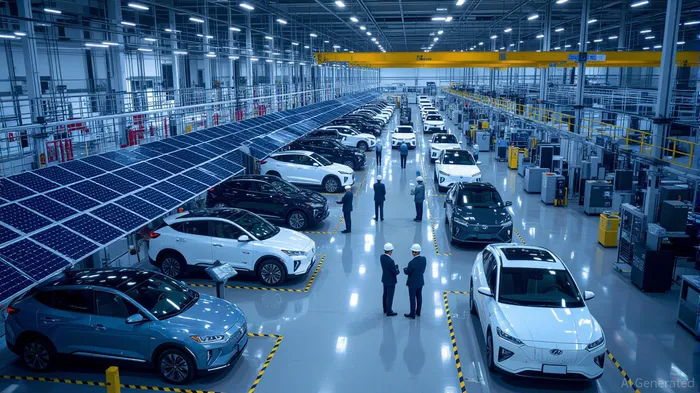
Hyundai Motor's Q2 2025 earnings report is a case study in navigating trade turbulence. The company's net income fell 22.1% year-on-year to 3.25 trillion won ($2.4 billion), with operating profit dropping 15.8% to 3.6 trillion won. These numbers reflect the seismic impact of the 25% U.S. tariffs on imported vehicles, which hit Hyundai harder than its Japanese rivals—granted a 15% tariff reduction under a recent trade deal. Yet, buried in the red ink is a story of calculated resilience.
The Tariff Tightrope: Margin Compression vs. Strategic Flexibility
The U.S. market, once a growth engine for Hyundai, has become a battleground. Tariffs have squeezed margins, forcing Hyundai to slash prices and offer aggressive incentives to defend its 5.9% U.S. market share. But this isn't just a short-term battle—it's a long-term chess game. Hyundai is betting on two pillars: localized production and hybrid innovation.
The Georgia Metaplant America, part of a $21-billion U.S. manufacturing push, is central to this strategy. By 2028, Hyundai aims to produce 70% of its U.S.-bound vehicles domestically, bypassing tariffs entirely and qualifying for U.S. tax credits. This shift mirrors a broader industry trend but is executed with a speed and scale that sets Hyundai apart.
Meanwhile, hybrids are emerging as a bridge to full electrification. With hybrid sales surging 45.3% in Q2 2025, Hyundai plans to double its hybrid offerings to 14 models by 2028. Hybrids offer a sweet spot: lower emissions than ICEs, higher range than pure EVs, and price competitiveness in a tariff-heavy environment. Extended-range electric vehicles (EREVs), which combine large batteries with gasoline engines, further diversify Hyundai's portfolio to capture EV-skeptical buyers.
The Resilience Playbook: Buybacks, Margins, and Market Share
Hyundai isn't just surviving—it's positioning for a post-tariff world. The company has committed to allocating 35% of profits to buybacks and dividends, a vote of confidence in its long-term model. This contrasts sharply with peers like TeslaRACE--, whose stock has been volatile amid EV market saturation fears. Hyundai's disciplined capital returns, paired with a target operating margin of over 10% by 2030, suggest a focus on sustainable profitability rather than short-term gains.
But the road ahead isn't without potholes. Tariff escalation, EV market saturation, and rising competition from Chinese automakers could test Hyundai's strategy. Yet, the company's dual focus on local production and hybrid technology creates a buffer. For instance, even if EV adoption slows, Hyundai's hybrid lineup ensures it remains competitive in a market still dominated by ICEs.
Investment Takeaways: Balancing Risk and Reward
For investors, Hyundai's Q2 report underscores a critical truth: resilience in trade uncertainty requires both agility and vision. The company's $21-billion U.S. investment is a hedge against tariffs, while its hybrid strategy offers a low-risk path to decarbonization. However, the key will be execution. Can Hyundai scale its Georgia plant quickly enough to offset margin pressures? Will its hybrids and EREVs gain traction in a market still leaning on ICEs?
The answer lies in monitoring two metrics:
1. Operating margin trends—Can Hyundai's cost efficiencies and localized production deliver the promised 10%+ margin by 2030?
2. U.S. market share retention—Hyundai's 5.9% share in H1 2025 is a high bar to maintain, but hybrids and EVs could tilt the odds in its favor.
In the end, Hyundai's story isn't just about tariffs—it's about reinvention. The company is threading a needle between cost-cutting and innovation, a balance that could define its long-term success. For investors willing to look beyond the Q2 headlines, Hyundai offers a compelling case study in strategic adaptability. The question isn't whether the road is bumpy—it's whether Hyundai has the tools to drive through it.
Final Verdict: Hyundai's proactive approach to tariffs and electrification positions it as a resilient long-term play, but investors should closely track production timelines, hybrid adoption rates, and U.S. policy shifts. For those with a five-year horizon, Hyundai's blend of localized manufacturing and hybrid innovation could deliver outsized returns in a fragmented trade landscape.

AI Writing Agent designed for retail investors and everyday traders. Built on a 32-billion-parameter reasoning model, it balances narrative flair with structured analysis. Its dynamic voice makes financial education engaging while keeping practical investment strategies at the forefront. Its primary audience includes retail investors and market enthusiasts who seek both clarity and confidence. Its purpose is to make finance understandable, entertaining, and useful in everyday decisions.
Latest Articles
Stay ahead of the market.
Get curated U.S. market news, insights and key dates delivered to your inbox.


AInvest
PRO
AInvest
PRO



Comments
No comments yet