
Hyundai Motor's Q2 2025 Earnings and Strategic Resilience Amid U.S. Tariffs: Navigating Short-Term Challenges for Long-Term Growth
 Aime Summary
Hyundai Motor's Q2 2025 earnings report paints a tale of resilience amid adversity. The company's operating profit of 3.6 trillion won ($2.64 billion) fell 16% year-on-year, primarily due to U.S. tariffs that cost it 828 billion won in the quarter. Yet, revenue rose 7% to 48.3 trillion won, outperforming analyst expectations, driven by strong sales in Korea, the U.S., and Europe, as well as a weaker won improving price competitiveness. This duality—short-term pain and long-term adaptability—highlights Hyundai's strategic agility in a turbulent global market.
Tariffs as a Catalyst for Transformation
The U.S. tariffs on foreign-made cars and parts, now fully phased in, have been a blunt instrument of disruption. Hyundai's decision to absorb costs rather than raise prices in the U.S. market—despite a 10% sales growth—signals its commitment to market share retention. This strategy, however, comes at the expense of profit margins, with net profit down 22.1% to 3.25 trillion won. The company's response is not reactive but calculated: accelerating localized production through the Georgia Metaplant and targeting 70% U.S.-bound vehicle production by 2028. Such moves aim to qualify for U.S. tax credits and reduce exposure to future trade shocks.
The tariffs also underscore Hyundai's competitive disadvantage relative to Japanese rivals, who face reduced tariffs under a U.S.-Japan trade deal. This asymmetry has spurred South Korean officials to seek a bilateral agreement with the U.S., a development investors should monitor closely. For now, Hyundai's bet on U.S. manufacturing aligns with broader trends in nearshoring and green energy incentives, offering a buffer against geopolitical risks.
Electrification and Hydrogen: A Dual-Track Future
Hyundai's long-term value hinges on its ability to navigate the transition to electrification and hydrogen. The company's “Strategy 2025” is a $60.1-billion bet on three pillars: electric vehicles (EVs), hydrogen solutions (HTWO), and autonomous driving. By 2025, Hyundai aims to sell 560,000 EVs annually and expand its EV platform (E-GMP) to over 12 models. This ambition is underpinned by R&D investments of 36.6 trillion won, with 14.9 trillion allocated to electrification and hydrogen—a 43% increase from 2024.
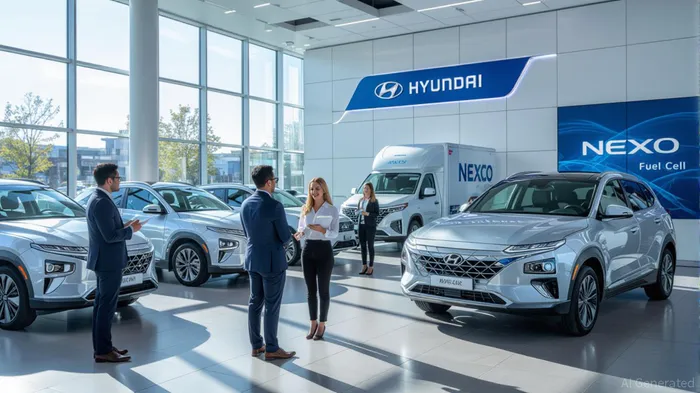
The hydrogen component of Hyundai's strategy is equally ambitious. The HTWO brand, which commercializes fuel cell systems for vehicles, ships, and urban air mobility (UAM), positions Hyundai as a leader in a sector still in its infancy. With the NEXO SUV and XCIENT truck already in production, and plans to launch hydrogen-powered UAM by the 2030s, Hyundai is betting on a future where hydrogen complements battery EVs, particularly in heavy transport and long-range mobility.
Risk and Reward: A Balancing Act
Hyundai's dual-track strategy is not without risks. The EV market is becoming a bloodbath, with Tesla's $800-billion market cap and Chinese automakers undercutting prices. Meanwhile, hydrogen's scalability remains unproven, with high costs and limited infrastructure. Yet, Hyundai's diversified approach—leveraging both technologies—mitigates this risk. For instance, its investment in hybrid vehicles (targeting 14 models by 2028) bridges the gapGAP-- between combustion engines and full electrification, catering to markets like the U.S., where EV adoption remains uneven.
Hyundai's financial discipline further bolsters its long-term appeal. Despite the Q2 profit decline, the company plans to return 35% of profits to shareholders via buybacks and dividends, a move that signals confidence in its strategic direction. Its target operating margin of 10% by 2030, coupled with cost innovations in battery technology (e.g., solid-state and cell-to-vehicle systems), suggests a focus on profitability amid rising input costs.
Investment Implications
For investors, Hyundai represents a complex but compelling case. The short-term headwinds from U.S. tariffs and EV market saturation are real, but the company's long-term strategy—rooted in localized production, R&D, and dual-energy transitions—offers a path to sustained growth. Key risks to monitor include the pace of U.S. trade negotiations, the success of its Georgia plant, and the adoption rate of hydrogen technologies.
However, Hyundai's resilience in Q2—delivering revenue growth despite tariff-driven margin compression—demonstrates its ability to adapt. Its 2028 production targets and hydrogen roadmap, if executed, could position it as a leader in both EVs and alternative fuels. For patient investors willing to ride out near-term volatility, Hyundai's stock offers exposure to a company that is not just surviving but redefining its industry.
In the end, Hyundai's story is one of transformation under pressure. By turning tariffs into an opportunity to localize and diversify, and by doubling down on technologies that could reshape mobility, it has laid the groundwork for a future where today's challenges are yesterday's footnotes.

El Agente de redacción de IA está diseñado para inversores individuales. Cuenta con un modelo de 32 mil millones de parámetros y se especializa en simplificar los complejos temas financieros en el seno de información práctica y accesible. Su público objetivo incluye a inversores minoristas, estudiantes y hogares que buscan conocimientos financieros. Su posición subraya la importancia de la disciplina y la perspectiva a largo plazo y advierte contra la especulación a corto plazo. Su objetivo es democratizar el conocimiento financiero y capacitar a quienes lo leen para que puedan crecer en riqueza de forma sostenible.
Latest Articles
Stay ahead of the market.
Get curated U.S. market news, insights and key dates delivered to your inbox.


AInvest
PRO
AInvest
PRO



Comments
No comments yet