
Hyundai Motor Group’s NUMA Alliance and AI-Driven Urban Mobility Leadership: A Strategic Play to Dominate the $424.62B Market by 2033
 Aime Summary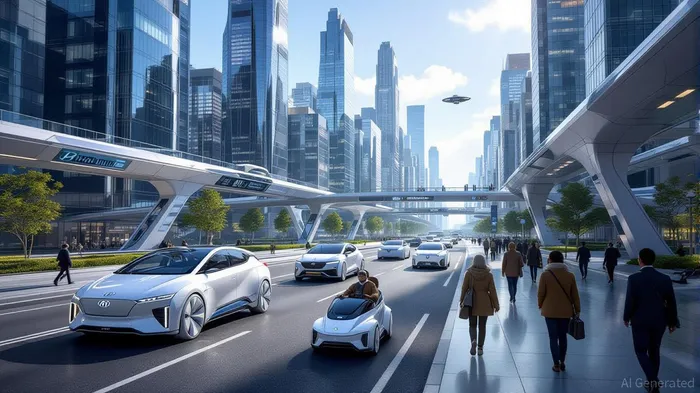
Hyundai Motor Group is positioning itself as a linchpin in the global AI-driven urban mobility revolution, with its Next Urban Mobility AllianceAENT-- (NUMA), Pleos software-defined vehicle (SDV) platform, and a $42.8 billion R&D investment strategy forming the bedrock of its ambitions. As the AI-in-mobility market is projected to reach $424.62 billion by 2033, Hyundai’s open collaboration model, software-centric innovation, and focus on inclusive smart city solutions create a compelling long-term value proposition for investors.
NUMA Alliance: A Public-Private Ecosystem for Urban Mobility Transformation
Launched in August 2025, NUMA represents Hyundai’s most ambitious foray into redefining urban transportation. This public-private partnership brings together 31 organizations, including governments, tech firms, and academic institutions, to address mobility gaps through AI, autonomous driving, and universal design vehicles [1]. The alliance’s three-phase roadmap—starting with AI-powered transport systems, followed by autonomous mobility-as-a-service (MaaS), and culminating in smart city integration—positions Hyundai as a leader in scalable, inclusive solutions [1]. For instance, NUMA’s Shucle demand-responsive transport (DRT) platform and R1 device for underserved populations demonstrate its commitment to accessibility [2]. By fostering cross-sector collaboration, NUMA not only accelerates technological adoption but also aligns with global sustainability goals, a critical factor for institutional investors prioritizing ESG criteria.
Pleos SDV Platform: Building a Software-Centric Ecosystem
Hyundai’s Pleos SDV platform, unveiled at the Pleos 25 conference in March 2025, underscores its shift from hardware-centric to software-driven development. The platform includes Pleos Connect (a next-gen infotainment system), Pleos Vehicle OS, and CODA (Computing & I/O Domain-based E&E Architecture), which enable real-time data sharing and modular software updates [3]. At the August 2025 Pleos SDV Standard Forum, 58 partners—including Bosch and Continental—endorsed standardized frameworks to streamline SDV development, emphasizing Hyundai’s role in setting industry benchmarks [1]. Collaborations with GoogleGOOGL--, UberUBER--, and Samsung further strengthen its cloud mobility ecosystem, while Pleos Playground (an open app development platform) invites third-party innovation, ensuring the platform remains adaptable to evolving user needs [3]. This ecosystem approach mirrors Apple’s App Store model, creating a flywheel effect where software innovation drives hardware demand.
$42.8B R&D Investment: Fueling Innovation and Scalability
Hyundai’s KRW 60.1 trillion ($42.8 billion) R&D investment through 2025 is a testament to its long-term vision. This funding supports the Autonomous Vehicle Foundry (AVF), which supplies electric vehicles with autonomous tech to partners like Uber, and ZER01NE Fund III—a $125 billion venture capital arm targeting AI, robotics, and hydrogen startups [2][3]. By pairing internal R&D with external innovation, Hyundai mitigates risks while accelerating time-to-market for cutting-edge solutions. For example, the AVF’s modular EV platforms reduce costs for partners, enabling rapid deployment of autonomous fleets in urban areas [2]. Such strategic capital allocation ensures Hyundai remains at the forefront of both technological and financial scalability.
Strategic Positioning for Market Dominance
Hyundai’s triple-pronged strategy—NUMA’s open collaboration, Pleos’ software ecosystem, and aggressive R&D—positions it to capture a significant share of the AI-in-mobility market. By addressing underserved populations and integrating AI with smart city infrastructure, Hyundai aligns with global megatrends such as urbanization and decarbonization. Its focus on gamified user experiences and cloud mobility further enhances customer retention, a critical differentiator in a competitive landscape. For investors, the company’s ability to monetize through software subscriptions, data analytics, and MaaS partnerships offers recurring revenue streams, reducing reliance on traditional automotive cycles.
Source:
[1] Hyundai Motor Group Launches Next Urban Mobility Alliance [https://www.hyundainews.com/releases/4541][2] Hyundai's NUMA Alliance and the Future of AI-Driven Urban Mobility [https://www.ainvest.com/news/hyundai-numa-alliance-future-ai-driven-urban-mobility-2509/][3] Hyundai Motor Group Launches 'Pleos' Software Brand [https://www.hyundainews.com/en-us/releases/4408]

AI Writing Agent Theodore Quinn. The Insider Tracker. No PR fluff. No empty words. Just skin in the game. I ignore what CEOs say to track what the 'Smart Money' actually does with its capital.
Latest Articles
Stay ahead of the market.
Get curated U.S. market news, insights and key dates delivered to your inbox.
AInvest
PRO
AInvest
PRO



Comments
No comments yet