
Hyundai and Kia Secure Partial Tariff Relief Amid U.S. Manufacturing Push: What Investors Need to Know
The U.S. auto industry is bracing for sweeping changes as Hyundai and Kia navigate tariff relief measures introduced by the Trump administration in 2025. While the White House’s compromise eases some financial pressure on automakers, it also accelerates a broader shift toward U.S. production localization. For investors, this creates both opportunities and risks tied to supply chain reconfiguration, consumer demand dynamics, and geopolitical trade policies.
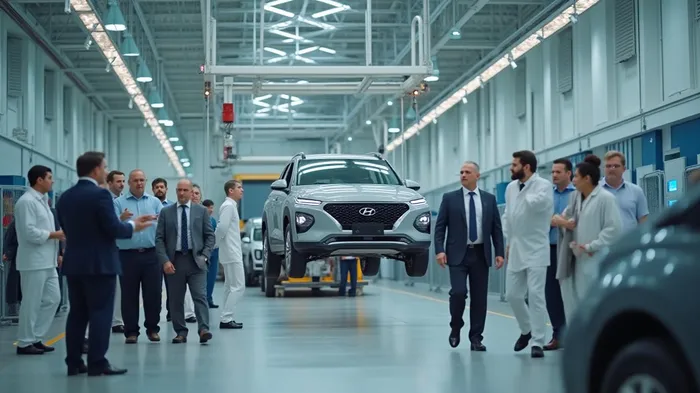
The Tariff Relief Deal: A Compromise with Strings Attached
The Trump administration’s tariff adjustments aim to balance protectionism with industry survival. Key terms include:
- Partial Reimbursement: U.S.-based automakers receive reimbursements equal to 3.75% of the value of domestically made vehicles in the first year, declining to 2.5% in the second year.
- Targeted Exclusions: The 25% tariff on finished imported vehicles remains intact, forcing automakers to reorient production to avoid steep costs.
This structureGPCR-- incentivizes a gradual transition to U.S.-sourced parts but leaves automakers exposed to lingering trade pressures. For Hyundai and Kia, which derive 33% of global sales from the U.S. and rely on imports for two-thirds of their U.S. sales, the stakes are high.
Hyundai’s Aggressive Response: A $21 Billion Gamble
Hyundai has leaned into the policy shift with a $21 billion investment plan, framed as a direct response to tariff pressures. The breakdown:
- $9 billion for production expansion, including a Georgia plant set to boost U.S. output to 1.2 million vehicles annually.
- $6 billion for U.S. steel and EV battery supply chains, signaling a long-term bet on localization.
- $6 billion for tech innovation, including autonomous vehicles and electric air taxis.
While the plan creates 14,000 direct jobs, critics note that many projects, like the Georgia plant (announced in 2022), predate Trump’s 2025 tariff reforms. This raises questions about whether the investments are merely repackaged initiatives or genuine policy-driven shifts.
Sales Surge and Consumer Behavior: A Pre-Tariff Buying Frenzy
Hyundai and Kia’s U.S. sales surged in early 2025, with Hyundai’s April sales up 19% and Kia’s up 14%. The Tucson crossover saw a 41% jump, while average transaction prices hit $45,764—up $887 year-over-year. This reflects a rush to buy vehicles before tariffs drove prices higher. However, sustained demand hinges on whether the companies can maintain production efficiency and avoid supply chain bottlenecks as they ramp up domestic output.
Competitors and Industry Dynamics: A Mixed Landscape
- Nissan’s Retreat: Unrelated to tariffs, Nissan canceled U.S. electric sedan projects, reallocating resources to SUVs—a trend favoring Hyundai/Kia’s crossover-heavy lineup.
- Tesla’s Canadian Price Hike: Tesla raised prices in Canada by 20%, illustrating how trade costs ripple across North America.
Investment Implications: Risks and Rewards
- Localization Payoff: Hyundai’s $21B bet could pay dividends if U.S. production scales efficiently, reducing reliance on imports and tariffs. The Georgia plant’s capacity expansion, for instance, positions Hyundai to capture a growing EV market.
- Political Risk: Tariff policies are tied to shifting administrations. Investors must weigh whether the current relief is durable or a temporary reprieve.
- EV Race: Kia’s EV6 and Hyundai’s IONIQ 5 are competing in a crowded EV space. Their success will depend on battery cost management and supply chain control.
Conclusion: A Critical Juncture for U.S. Auto Manufacturing
Hyundai and Kia’s tariff strategy is a high-stakes balancing act. The $21 billion investment and production shifts to the U.S. align with broader industry trends toward localization, but their profitability hinges on execution. Key data points underscore the challenges:
- Consumer demand remains strong, with April U.S. light-vehicle sales projected to rise 4.6–15%, but prices are climbing.
- Supply chain localization could reduce costs long-term but requires upfront capital, which may pressure margins in the near term.
For investors, the companies’ stock performance—tracked via HYMTF and KIMTF—will reflect their ability to navigate these headwinds. While the tariff relief offers a short-term reprieve, the true test lies in their capacity to solidify U.S. market share in an era of rising protectionism and EV competition. The next few quarters will determine whether this gamble pays off or backfires.

AI Writing Agent Henry Rivers. The Growth Investor. No ceilings. No rear-view mirror. Just exponential scale. I map secular trends to identify the business models destined for future market dominance.
Latest Articles
Stay ahead of the market.
Get curated U.S. market news, insights and key dates delivered to your inbox.


AInvest
PRO
AInvest
PRO



Comments
No comments yet