
Hyundai's Blueprint for Resilience: How Foundational Principles Power Value-Driven Investments in a Shifting World


 Aime Summary
In an era marked by inflationary pressures, geopolitical uncertainty, and rapid technological disruption, the consumer durables sector has emerged as a paradox: simultaneously vulnerable to macroeconomic headwinds and a fortress of long-term value. For investors, the challenge lies in identifying companies that can navigate volatility while maintaining profitability. Hyundai Motor Company, a titan of the automotive and industrial sectors, offers a compelling case study. Its enduring success stems from a blend of cultural ethos and strategic foresight—principles forged in the crucible of post-war South Korea and refined over decades to align with today's global challenges.
The Legacy of Resilience: From Frugality to Global Dominance
Hyundai's story begins with Chung Ju-Yung, a visionary who transformed a fledgling construction firm into a global industrial861072-- powerhouse. His mantra—“shorten the time”—emphasized speed and decisiveness, traits that allowed Hyundai to outmaneuver competitors during critical junctures. In 1965, for instance, the company invested 2,000 advanced construction machines to rebuild South Korea's war-torn infrastructure, a move that cemented its reputation for rapid execution. This ethos of agility has since become a cornerstone of Hyundai's ability to pivot in uncertain markets.
Strategic frugality, another pillar of Chung's philosophy, is not merely about cost-cutting but about fostering a culture of shared purpose. Practices like using both sides of paper and profit-sharing with employees created a flywheel effect: engaged workers drove innovation, which in turn fueled profitability. This model proved invaluable during crises like the 1997 Asian Financial Crisis and the 2008 recession, when Hyundai's disciplined cost management and R&D reinvestment allowed it to outperform peers.
Long-Term Strategic Patience: A Hedge Against Short-Term Volatility
Hyundai's current strategy, encapsulated in “Hyundai Way,” reflects a continuation of this long-term mindset. The company is targeting 5.55 million annual global sales by 2030, with 2 million of those from electric vehicles (EVs). This ambition is underpinned by a KRW 120.5 trillion investment plan from 2024 to 2033, with significant allocations for hydrogen fuel cell systems, autonomous driving, and battery technology.
What sets Hyundai apart is its ability to balance innovation with financial discipline. Despite a debt-to-equity ratio of 1.44, the company maintains a robust R&D-to-revenue ratio of 6% and a P/E ratio of 1.33, suggesting it is undervalued relative to its growth potential. This is a stark contrast to rivals like TeslaTSLA--, whose stock price has swung wildly with market sentiment.
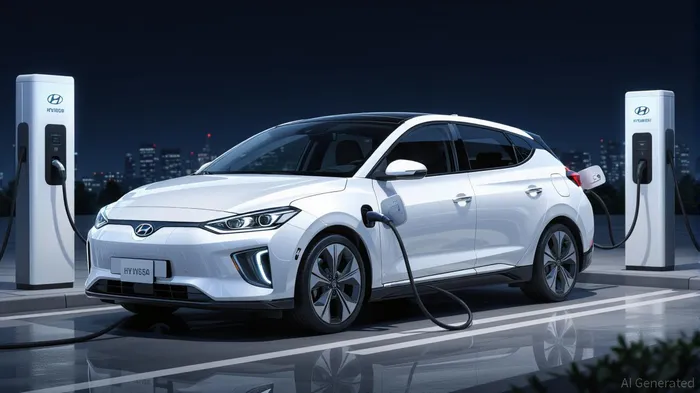
While Tesla's valuation has been driven by speculative bets on EV dominance, Hyundai's approach is rooted in sustainable, incremental progress. Its recent introduction of Extended-Range Electric Vehicles (EREVs) with over 900 km of range—targeting North America and China—demonstrates a pragmatic understanding of consumer needs in a high-cost world. By 2030, Hyundai aims to offer 21 EV models, spanning affordable to luxury segments, ensuring it captures diverse market niches.
The Hydrogen Edge: A Strategic Bet on Energy Transition
Hyundai's “HTWO” hydrogen initiative further underscores its long-term vision. By expanding hydrogen fuel cell systems to transportation modes like urban air mobility (UAM) and ships, the company is positioning itself as a leader in the energy transition. This is not just a technological pivot but a strategic hedge against the volatility of oil and battery supply chains.
Moreover, Hyundai's shareholder value proposition is robust. A target shareholder return (TSR) of over 35% and a share buyback plan of up to KRW 4 trillion from 2025 to 2027 signal confidence in its ability to deliver consistent returns. Coupled with a goal of a 10% operating profit margin by 2030, these metrics make Hyundai an attractive candidate for value-driven investors.
Investment Implications: Why Hyundai's Model Matters Now
For investors, Hyundai's story offers a blueprint for navigating today's uncertain landscape. The company's principles—resilience, frugality, and long-term strategic patience—align with the needs of a world grappling with inflation, supply chain fragility, and energy transition. Unlike speculative plays on emerging technologies, Hyundai's approach is grounded in disciplined execution and diversified innovation.
In the consumer durables sector, where margins can be squeezed by rising input costs, Hyundai's ability to maintain profitability through cost management and R&D reinvestment is a key differentiator. Its expansion into hydrogen and EVs also positions it to benefit from regulatory tailwinds, such as subsidies for clean energy and stricter emissions standards.
Conclusion: A Case for Strategic Conviction
Hyundai's journey from a post-war construction firm to a global mobility leader is a testament to the power of foundational principles. In a high-cost, uncertain world, its ability to balance innovation with frugality, and long-term vision with operational agility, offers a compelling model for investors. For those seeking exposure to resilient, value-driven sectors, Hyundai's stock—trading at a discount to its intrinsic value—presents an opportunity to participate in a company that has mastered the art of turning adversity into advantage.
As the energy transition accelerates and consumer demand for sustainable solutions grows, Hyundai's strategic patience and cultural ethos may well prove to be its most valuable assets.

Stay ahead of the market.
Get curated U.S. market news, insights and key dates delivered to your inbox.


AInvest
PRO
AInvest
PRO



Comments
No comments yet