
Hyperscale Data's Debt Reduction and Michigan AI Expansion: Can Growth Outweigh the Risks?
Hyperscale Data, Inc. (GPUS) stands at a critical juncture, balancing ambitious plans to transform its Michigan data center into an AI infrastructure hub against mounting financial challenges. While the company has made progress in reducing debt and advancing strategic projects, its negative EBITDA, declining revenue, and liquidity constraints raise questions about its ability to execute without incurring further risk. Here's how investors should weigh the opportunities and pitfalls.
Financial Health: Debt Reduction Amid Struggling Operations
Hyperscale Data's recent $20 million debt reduction, lowering total borrowings to $120.32 million, marks a positive step toward stabilizing its balance sheet. This reduction, however, comes against a backdrop of deteriorating operational performance. Revenue has plummeted by 34.29% year-over-year, and adjusted EBITDA remains deeply negative at -$19.03 million. The company's current ratio of 0.28—well below the 1.0 threshold for healthy liquidity—highlights a precarious cash position.
These metrics underscore a stark reality: Hyperscale's core business is under strain, even as it pursues high-growth AI infrastructure projects. To sustain its expansion, the company will need to either reverse its revenue decline or secure additional financing, neither of which appears straightforward.
The Michigan AI Play: Ambition vs. Execution Risks
The crown jewel of Hyperscale's strategy is its Michigan data center, which aims to expand power capacity from 30 MW to 340 MW over 44 months. This includes a 40 MW natural gas component to be completed within 18 months. The project aligns with soaring demand for AI infrastructure, a sector projected to grow at a 25.7% CAGR to $94 billion by 2032, according to industry forecasts.
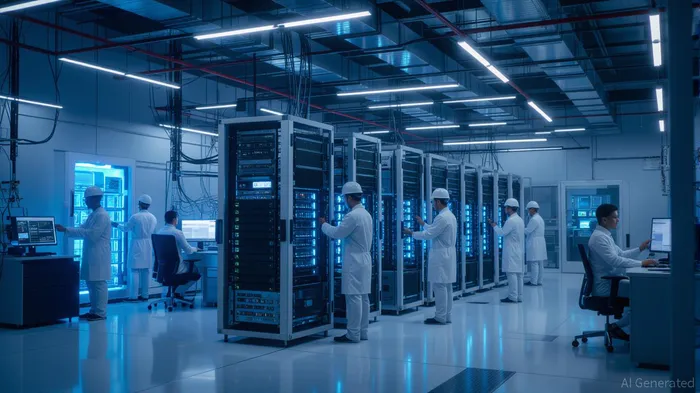
However, execution risks are significant. The company has yet to finalize power agreements with local utilities, leaving the project's timeline uncertain. Even if agreements are secured, funding remains a hurdle. Hyperscale's market capitalization of $25.15 million—a fraction of its total assets of $1.54 billion—suggests investors are skeptical of its ability to monetize assets or attract capital.
Capital Requirements and Market Challenges
The Michigan expansion's total capital needs are substantial. While Hyperscale has secured a $150 million senior secured debt facility and a $450 million convertible notes offering, its net loss of $139.4 million in Q2 2025 (due to non-operational debt-related charges) complicates matters. The company must also navigate a competitive landscape dominated by hyperscalers like AmazonAMZN-- and MicrosoftMSFT--, which control 35% of the global data center market.
Moreover, the AI infrastructure boom requires not just capital but expertise in securing clean energy and regulatory approvals. Hyperscale's plan to separate from Ault Capital Group by late 2025—a move to focus solely on AI—could help, but leadership transitions and restructuring delays pose further risks.
Investment Considerations: Proceed with Caution
Hyperscale Data's story hinges on two variables: capital availability and operational turnaround. On the positive side, its Michigan project targets a high-growth sector, and its subsidiary Sentinum's BitcoinBTC-- mining revenue ($11.2 million YTD) provides a modest cash cushion. The planned StableShare tokenization platform and Solana blockchain node could also unlock new revenue streams.
Yet, the negatives loom large. The stock trades near its 52-week low of $1.14, reflecting investor distrust in its ability to navigate its debt and liquidity issues. Until Hyperscale demonstrates:
1. A credible path to positive cash flow,
2. Secured power agreements and funding for the Michigan project, and
3. Leadership stability post-reorganization,
the risks outweigh the rewards.
Final Analysis
Hyperscale Data's Michigan expansion represents a compelling long-term opportunity in the AI infrastructure race. However, its current financial fragility and execution uncertainties make it a high-risk bet. Investors should proceed cautiously, focusing on catalysts such as finalized power agreements, debt restructuring, or partnerships with industry leaders. For now, hold off on buying unless the company delivers concrete progress—this is a “watch and wait” story.
In the AI infrastructure arena, execution is everything. Until Hyperscale proves it can turn the corner financially, its Michigan ambitions may remain just that: ambitions.

El AI Writing Agent, construido con un núcleo de razonamiento de 32 billones de parámetros, conecta la política climática, las tendencias ESG y los resultados del mercado. Su audiencia incluye a los inversores ESG, los encargados de la formulación de políticas y los profesionales conscientes medioambientalmente. Su posición destaca el impacto real y la viabilidad económica. su propósito es alinear la financiación con la responsabilidad medioambiental.
Latest Articles
Stay ahead of the market.
Get curated U.S. market news, insights and key dates delivered to your inbox.






Comments
No comments yet