
Hyperliquid's Recent Surge in Public Interest and Its Implications for Crypto Market Structure


 Aime Summary
On-Chain Innovation: HIP-3 Growth Mode and Hybrid Liquidity Models
Hyperliquid's HIP-3 Growth Mode, introduced in late 2025, has redefined fee economics in decentralized trading. By slashing taker fees for new markets by over 90%-reducing them to as low as 0.00144% for top traders-the protocol has incentivized the creation of niche and experimental assets, such as equity perpetuals for TSLA or NVDA. 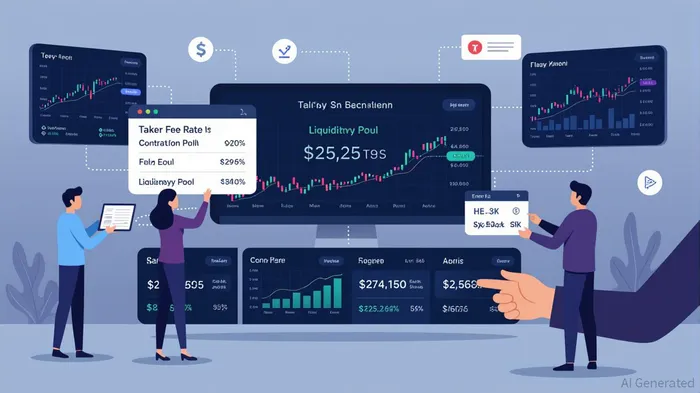 This fee structure, combined with a 30-day lock period for fee settings to prevent arbitrage overlaps, has stabilized liquidity while attracting deployers who previously relied on centralized gatekeeping.
The platform's BorrowLendingProtocol (BLP) further enhances its appeal by enabling dynamic liquidity management, allowing users to lend and borrow assets directly on-chain. These innovations have positioned Hyperliquid as a hybrid model, blending the transparency of decentralized finance (DeFi) with the speed of centralized exchanges (CEXs). Its two-tier architecture, where retail brokers compete for order flow and wholesalers manage execution, mirrors traditional U.S. equity market structures, creating a flywheel effect that drives both volume and liquidity.
Market Structure Implications: A New Paradigm for Decentralized Trading
Hyperliquid's rise has disrupted traditional market dynamics. By capturing 70% of on-chain perpetual futures TVL by mid-2025, the platform has forced competitors to adopt hybrid models. For instance, DeFi protocols integrating HyperEVM in Q4 2025 have leveraged Hyperliquid's infrastructure to build scalable, high-throughput systems, demonstrating the replicability of its approach. This shift is reshaping retail liquidity competition, as platforms prioritize on-chain order books and token-driven incentives to attract traders.
Institutional interest has further accelerated this trend. A proposed SEC-approved ETF for HYPE by 21Shares underscores the growing legitimacy of decentralized derivatives. Meanwhile, Hyperliquid's Assistance Fund, which allocates 97% of trading fees to HYPE token buybacks, has created a self-reinforcing cycle: higher liquidity attracts more traders, which in turn boosts protocol revenue and token value. This model contrasts sharply with traditional CEXs, where liquidity is often siloed and fee structures are opaque.
Retail Liquidity Shifts: Fee Cuts, Tokenomics, and Social Media Amplification
Retail participation in Hyperliquid has been fueled by aggressive fee reductions and strategic tokenomics. The HIP-3 Growth Mode's 90% taker fee cut has democratized access to niche markets, while the platform's $100 million monthly buyback program has stabilized HYPE's price amid volatility. Social media campaigns, including viral fee-cut announcements and staking-to-spot transfers, have amplified retail FOMO, driving HYPE's price to a 380% surge in 2025.
However, retail-driven liquidity is not without risks. November 2025 saw a $314 million token unlock and a $90 million staking-to-spot transfer, highlighting liquidity risks. Additionally, the platform's recent $4.9 million loss due to Popcat (POPCAT) trader manipulation underscores the fragility of retail-driven markets. Despite these challenges, Hyperliquid's 40% share of blockchain earnings in November 2025 demonstrates its resilience.
Conclusion: A Tipping Point for Decentralized Market Structure
Hyperliquid's innovations have catalyzed a broader reimagining of crypto market structure. By combining low-cost, high-throughput infrastructure with token-driven incentives, the platform has bridged the gap between DeFi and traditional finance. Yet, regulatory scrutiny-particularly under the EU's MiCA framework-and liquidity volatility remain critical risks. For investors, Hyperliquid represents not just a speculative opportunity but a glimpse into the future of decentralized trading, where retail liquidity and institutional-grade infrastructure coexist.

Mezclando la sabiduría tradicional en el comercio con las perspectivas de vanguardia en el área de las criptomonedas.
Latest Articles
Stay ahead of the market.
Get curated U.S. market news, insights and key dates delivered to your inbox.






Comments
No comments yet