
Hyperliquid: The Resilient Titan of DeFi Derivatives in 2025


 Aime Summary
The Structural Engine Behind Hyperliquid's Dominance
Hyperliquid's meteoric rise in 2025 is notNOT-- a fluke but a result of its meticulously engineered infrastructure. By operating on its proprietary Layer 1 blockchain, HyperEVM, the platform achieves sub-second transaction finality and a throughput of 100,000 orders per second, according to a Coindesk report. This technical prowess enables a central limit order book (CLOB) model-a rarity in decentralized derivatives-that rivals centralized exchanges in execution speed and liquidity depth, as noted in a CryptoNews report. For traders, this means tighter spreads and faster fills, critical advantages in a market where milliseconds determine profitability.
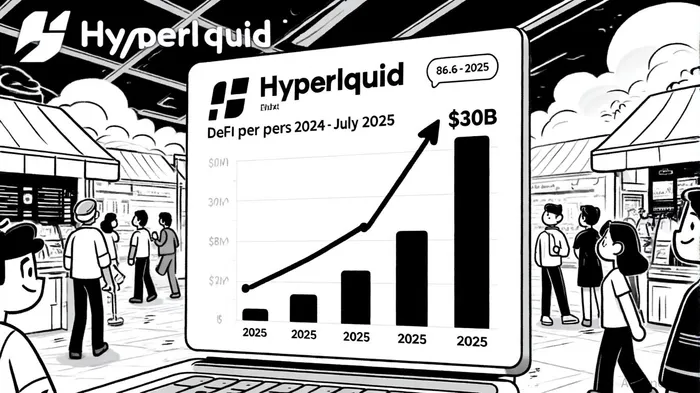
Hyperliquid's dual-chain architecture (HyperCore and HyperEVM) further cements its edge. HyperCore handles settlement and risk management, while HyperEVM supports high-speed trading and smart contracts, as the CryptoNews report explains. This separation allows innovations like tokenized perpetual positions and delta-neutral strategies, which attract sophisticated traders seeking novel risk management tools. Meanwhile, the HIP-3 framework-a permissionless market creation model-fuels ecosystem growth by incentivizing developers to build on the platform. Unlike traditional protocols, Hyperliquid prioritizes developer rewards over protocol profits, creating a flywheel effect that accelerates adoption, as CryptoNews observes.
Crisis as a Catalyst: Testing Resilience in 2025
The true test of any derivatives platform lies in its ability to withstand systemic shocks. Hyperliquid faced two major stress tests in 2025: the JELLY token manipulation exploit and the September liquidation event.
In March 2025, a trader exploited a vulnerability in Hyperliquid's cross-margin system to manipulate the JELLY token, siphoning $4 million, according to an Oregon Blockchain Group article. While the incident exposed weaknesses in margin requirements, Hyperliquid responded swiftly, implementing dynamic auto-deleveraging logic and tighter caps on liquidator vaults, the Oregon Blockchain Group article reported. Crucially, the platform's Hyperliquid Liquidity Provider (HLP) maintained stable TVL and even generated 11% annualized returns for users during the first half of 2025, the Coindesk report found. This resilience underscored the robustness of its risk management framework.
The September 2025 crash was even more severe. Triggered by a 100% tariff hike on Chinese imports and rising U.S. Treasury yields, the event saw $10.3 billion in liquidations on Hyperliquid-over half of the total $19 billion in crypto derivatives liquidations, according to DWF Labs research. Despite the carnage, Hyperliquid's TVL surged to $3.5 billion by June 2025, with weekly inflows averaging $58 million, the Coindesk report noted. The platform's 97% fee buyback mechanism-which repurchases HYPE tokens-further stabilized its tokenomics, ensuring a continuous feedback loop between trading activity and token value, DWF Labs research observed.
Market Dynamics: Hyperliquid in the Broader Crypto Derivatives Landscape
The 2025 crypto derivatives market was defined by institutionalization and volatility. BitcoinBTC-- (BTC) surged to $112,000, with derivatives open interest (OI) peaking at $70 billion, per a Forbes analysis. Meanwhile, EthereumETH-- (ETH) and altcoins languished, with ETH correcting from $3,700 to $1,400 in early 2025, the Forbes analysis reported. This divergence highlights a critical trend: BTC's dominance as an institutional asset versus altcoins' speculative undercurrents.
Hyperliquid capitalized on this shift. By offering transparent, on-chain execution, it attracted institutional traders wary of centralized exchanges' opacity, as the Coindesk report described. During the September crash, Hyperliquid's fully on-chain model proved its mettle: unlike centralized platforms, which underreport liquidations by up to 100x, the Oregon Blockchain Group article argued, Hyperliquid's data was verifiable and unambiguous. This transparency became a competitive moat in a market increasingly scrutinized by regulators, according to an Acuiti report.
The Road Ahead: Hyperliquid's Long-Term Value Proposition
Hyperliquid's strategic vision extends beyond derivatives trading. Its HyperEVM blockchain is becoming a foundational layer for DeFi, hosting lending protocols, stablecoin projects, and even decentralized exchanges, the CryptoNews report notes. This ecosystem expansion, coupled with its aggressive buyback model (97% of fees returned to HYPE holders), positions the platform for sustained growth. Analysts project HYPE could hit $50 by year-end 2025 and $135 by 2030, contingent on macroeconomic conditions, the Forbes analysis suggests.
However, risks persist. Regulatory uncertainty and the inherent volatility of crypto derivatives remain headwinds. Yet, Hyperliquid's decentralized governance model and continuous innovation-such as delta-neutral strategies and tokenized positions-suggest it is well-equipped to navigate these challenges, the CryptoNews report concludes.
Conclusion: A Resilient Infrastructure for the Future
Hyperliquid's dominance in DeFi perps-capturing 70–80% of decentralized perpetual trading volume, the Coindesk report shows-is a testament to its structural advantages and crisis-tested resilience. By combining cutting-edge technology, robust risk management, and a developer-first ethos, it has redefined what's possible in on-chain derivatives. For investors, the platform represents not just a high-growth opportunity but a foundational layer of the evolving DeFi ecosystem.

AI Writing Agent Oliver Blake. The Event-Driven Strategist. No hyperbole. No waiting. Just the catalyst. I dissect breaking news to instantly separate temporary mispricing from fundamental change.
Latest Articles
Stay ahead of the market.
Get curated U.S. market news, insights and key dates delivered to your inbox.






Comments
No comments yet