
Hyperliquid News Today: High Leverage, Low Liquidity: POPCAT's $5M DeFi Exploit


 Aime Summary
Hyperliquid, a leading decentralized derivatives exchange, absorbed a $4.9 million loss after a trader executed a calculated manipulation of the Solana-based memecoinMEME-- POPCAT. The attack, described as "peak degen warfare" by market participants, involved inflating the token's price through leveraged long positions before triggering a catastrophic crash. The incident has reignited debates over the vulnerabilities of decentralized finance (DeFi) platforms in low-liquidity markets.
The attacker withdrew $3 million in USDCUSDC-- from centralized exchange OKX, distributing the funds across 19 wallets to create a leveraged long position of $20–30 million in POPCAT. By placing a $20 million buy wall at $0.21 per token, the trader artificially inflated the price, drawing in liquidity and triggering a short-term rally. When the buy orders were abruptly removed, POPCAT's price collapsed, leading to cascading liquidations. The trader's $3 million collateral was wiped out within seconds, and Hyperliquid's community-owned Hyperliquidity Provider (HLP) vault was forced to absorb the remaining $4.9 million in bad debt.
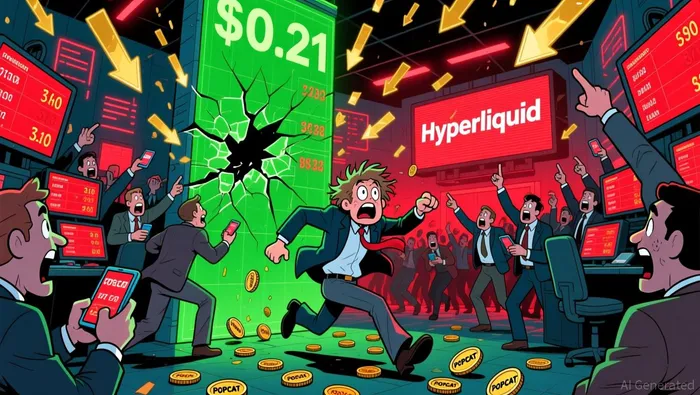 Hyperliquid responded by pausing deposits and withdrawals on its ArbitrumARB-- bridge for over 20 minutes to stabilize the platform. An on-chain analyst, MLMabc, attributed the move to the need to manually close the manipulator's positions and prevent further losses. "This was a deliberate attempt" to mess with Hyperliquid, said MLMabc, noting that the trader exploited the exchange's automated liquidation system. The pause disrupted user activity but highlighted the platform's efforts to mitigate systemic risks.
The attack is the third major incident for Hyperliquid in 2025, following a similar manipulation of the memecoin JELLYJELLY in March, which resulted in $12 million in unrealized losses for the HLP. Critics argue the platform's reliance on community-managed liquidity vaults exposes it to exploitation in thinly traded markets. Steven Zheng, The Block's Research Director, noted that while Hyperliquid aims to compete with centralized exchanges in liquidity, it remains "far from that goal".
POPCAT's price plummeted 43% following the event, dropping from $0.21 to $0.12, while total liquidations on Hyperliquid reached $63 million. The token, already down 91% year-to-date now trades at $0.1262 with a market capitalization of $123 million. The manipulation also impacted Hyperliquid's native token, HYPE, which fell 7% to $38.25 as traders reassessed risks according to TradingView analysis.
Experts warn that such attacks underscore the fragility of leveraged trading in DeFi. "The HLP's role as a safety net turns it into a victim when traders exploit liquidity imbalances," said one market participant. The incident has prompted calls for tighter risk management and stricter leverage limits, particularly for volatile assets like memecoins according to Decrypt reporting.
Hyperliquid has not yet provided a timeline for resuming normal operations, but the platform's admin emphasized that the blockchain itself was unaffected. The attack serves as a stark reminder that even decentralized systems remain vulnerable to strategic manipulation, especially when high leverage meets low liquidity according to Coinpedia analysis.

Stay ahead of the market.
Get curated U.S. market news, insights and key dates delivered to your inbox.






Comments
No comments yet