
Hyperliquid HYPE Token Burns 4.84% Supply Amid Record Trading Volume
 Aime Summary
- Hyperliquid has burned 48.42 million HYPE tokens, representing approximately 4.84% of its maximum supply, driven by a fee-funded buyback mechanism that redirects 97-99% of protocol fees to the open market.
- The Layer-1 blockchain supports approximately 200,000 orders per second through its HyperCore and HyperEVM components, securing a dominant 70-80% market share in on-chain perpetual futures trading.
- HYPE token value is structurally linked to trading volume, as the deflationary buyback engine creates open-market demand that reduces circulating supply without guaranteeing price appreciation.
- Regulatory headwinds remain significant for the ecosystem, as US market entry depends on evolving policy signals from the CFTC rather than formalized rulemaking or established timelines.
Hyperliquid, a Layer-1 blockchain optimized for high-frequency trading, recently executed a significant token burn that removed 48.42 million HYPE tokens from circulation. This action, valued at approximately $4.13 billion based on recent average purchase prices, reflects the cumulative market value of burned assets rather than a direct cash transfer to holders. The burn represents 4.84% of the token's 1 billion maximum supply, reinforcing the protocol's deflationary trajectory.
The execution of this burn is directly tied to Hyperliquid's unique economic model, which channels 97% to 99% of applicable protocol fees into an Assistance Fund. This fund is strictly designated for purchasing HYPE tokens on the open market for permanent burning, distinct from priority fees that are burned directly by the network. The mechanism ensures that higher trading volumes generate greater resources for buybacks, while lower activity reduces the availability of funds for repurchases.
Hyperliquid's technical architecture underpins this high-volume economic activity through its HyperCore and HyperEVM components. Both systems are secured by the HyperBFT consensus mechanism, which was optimized specifically to handle the demands of high-performance trading environments. The network supports a fully onchain order book, ensuring that every order, cancellation, trade, and liquidation remains transparent and verifiable for users.
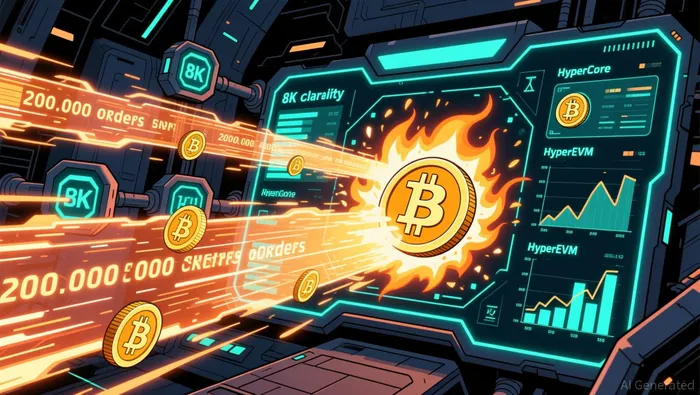
This infrastructure allows the blockchain to process approximately 200,000 orders per second, facilitating trading across crypto, equities, commodities, and FX markets. The platform also supports borrowing, lending, and real-world asset tokenization within an EVM-compatible environment. Development is led by HyperliquidPURR-- Labs, an entirely self-funded entity that has not accepted external capital, prioritizing technical excellence over investor pressure.
How Does the Deflationary Tokenomics Model Work?
The HYPE token serves as the primary utility asset for the ecosystem, with its value proposition anchored in a usage-driven feedback loop. Over 97% of trading fees are directed toward buybacks, creating a fundamental floor and upward price pressure linked to sustained trading volume. In 2026 alone, this mechanism resulted in $379 million in buybacks, burning over 41 million HYPE tokens worth more than $1 billion.
This model reduces the circulating supply by 4.2% in 2026, contributing to the total 4.84% reduction from the original maximum supply. The program has no fixed daily repurchase level, meaning the burn rate fluctuates directly with market activity and fee generation. Investors must recognize that while the burn creates open-market demand, it does not provide a legal claim on Hyperliquid Labs' revenue or direct cash distributions.
The token's market capitalization has hovered near $19.2 billion, with HYPE trading around $86 following the latest burn announcement. This valuation reflects the current market price of the cumulative burned tokens, which fluctuates with HYPE's market price changes rather than representing a fixed historical cost basis. The absence of external investor pressure allows the team to maintain this deflationary policy without short-term performance mandates.
What Are the Regulatory and Competitive Risks?
Hyperliquid faces significant regulatory uncertainty regarding its potential entry into the US market, which remains a key catalyst for future growth. President Trump's August 2026 comments indicated that CFTC Chair Michael Selig is working to bring Hyperliquid into the US in a compliant manner. However, this remains a policy signal without formal rulemaking or a definitive timeline for implementation.
Concurrent regulatory risks persist, highlighted by warnings from entities like the Connecticut Attorney General regarding offshore platforms. These warnings underscore the challenges faced by decentralized derivatives exchanges seeking to operate within US jurisdictional boundaries. The lack of formalized rules creates an environment where policy signals may not translate into immediate market access.
Competitive pressure is also intensifying as regulated entities like Coinbase file with the SEC to offer single-stock perpetuals in the US. Other well-funded decentralized exchanges may fragment liquidity, potentially slowing user growth and fee generation for Hyperliquid. Increased competition could weaken the primary driver of the buyback mechanism, creating bearish valuation pressure if trading volumes stagnate.
Monitoring daily volume and total value locked relative to rivals is essential for assessing the protocol's long-term viability. Stagnation in user growth or fee generation would signal potential headwinds for the deflationary tokenomics model. The ecosystem's ability to maintain its 70-80% market share in on-chain perpetuals will determine the sustainability of the HYPE token's value proposition.
Security assessments conducted by Zellic in July 2023 provided a comprehensive review of the platform source code and architectural design. The audit focused on vulnerability identification and design review to ensure robustness and security integrity for users and investors. This verification serves as a critical baseline for the protocol's safety measures, though ongoing monitoring remains necessary for evolving threat landscapes.

Blending traditional trading wisdom with cutting-edge cryptocurrency insights.
Latest Articles
Stay ahead of the market.
Get curated U.S. market news, insights and key dates delivered to your inbox.


AInvest
PRO
AInvest
PRO




Comments
No comments yet