
Hyperliquid (HYPE) Price Volatility: Market Sentiment Shifts Amid DeFi Liquidity Events


 Aime Summary
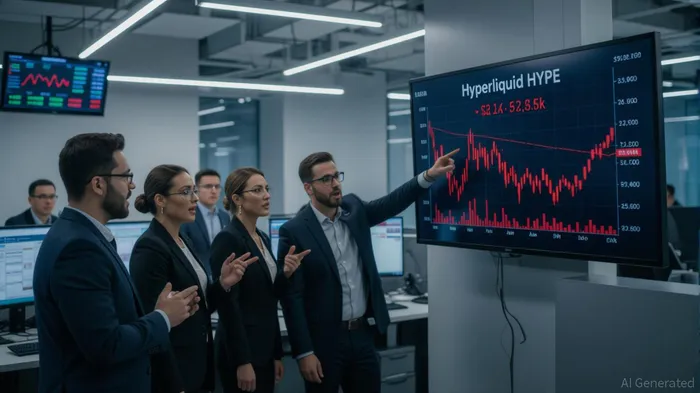
The decentralized finance (DeFi) sector has long grappled with the dual forces of innovation and instability. Hyperliquid (HYPE), a leading decentralized perpetuals exchange, has become a focal point for analyzing how sudden liquidity events and market manipulation can amplify price volatility. In 2025, HYPE's token price has been subjected to sharp swings, driven by a series of high-profile incidents that exposed vulnerabilities in both protocol design and market psychology. This article dissects the interplay between liquidity shocks, trader behavior, and sentiment shifts, offering a roadmap for investors navigating this turbulent landscape.
The November 2025 POPCAT Manipulation: A Case Study in Spoofing and Leverage
In November 2025, Hyperliquid faced its third major liquidity crisis of the year when a coordinated attack on the Solana-based memecoinMEME-- POPCAT triggered a cascade of liquidations. According to a report by Yahoo Finance, an attacker withdrew $3 million in USDCUSDC-- from OKX, distributed it across multiple wallets, and used leveraged positions on Hyperliquid to create artificial price distortions. By placing a large buy wall at $0.21 and then canceling it, the attacker induced a 30% drop in POPCAT's price. This manipulation led to $4.5–$4.9 million in bad debt for HLP liquidity providers, who were left exposed to sudden market shifts.
The attack underscored a critical flaw in high-leverage, low-liquidity markets: the ability of malicious actors to exploit thin order books and community-funded liquidation pools. Unlike traditional exploits, this incident relied on strategic timing and spoofing, highlighting how DeFi's promise of decentralization can clash with its reliance on fragile infrastructure. Hyperliquid's temporary withdrawal pause following the event further fueled skepticism about its operational resilience, with critics questioning whether the platform's semi-centralized architecture could withstand repeated assaults.
The July 2025 API Outage: Infrastructure Fragility and Investor Confidence
A month earlier, Hyperliquid's ecosystem faced a different kind of disruption. On July 29, 2025, a 27-minute API outage left users unable to execute trades during a period of heightened volatility. At the time, the platform held $14.7 billion in open interest and served over 500,000 active users. The outage, attributed to traffic overload rather than a security breach, resulted in a 2–5% drop in HYPE's price as traders reacted to the perceived instability.
While Hyperliquid's engineering team restored services swiftly, the incident reignited debates about the risks of centralized front-end systems in DeFi. As stated by a blog post on WordPress, the outage demonstrated how reliance on web-based APIs can create single points of failure, even in protocols designed to be decentralized. For investors, the event served as a stark reminder that technological robustness is as critical as financial innovation in sustaining trust.
Market Sentiment: TVL, Whale Behavior, and Psychological Biases
Despite these challenges, Hyperliquid's DeFi Total Value Locked (TVL) surged to $2.15 billion in late 2025, signaling a risk-on sentiment among investors. This increase in TVL, coupled with an Open Interest-Weighted Funding Rate of 0.0085%, suggests growing long positions and retail demand. However, the narrative is complicated by whale activity in mid-cap tokens like ARBARB-- and SOLSOL--, where over 60% of large-order events clustered in late morning and noon UTC. These whales, trading with an average leverage of 6.9×, often exhibit short biases on BitcoinBTC--, aligning with macroeconomic expectations.
Psychological factors further amplify volatility. Anchoring bias, for instance, leads whales to cluster orders at specific price levels, while dopamine-driven risk-taking under high leverage encourages aggressive trading during volatile conditions. Analysts must contextualize these behaviors, as they can distort market fundamentals and create false signals for retail investors.
Implications for Investors: Balancing Risk and Resilience
Hyperliquid's recent turbulence offers valuable lessons for DeFi investors. First, liquidity events-whether manipulative or infrastructural-can rapidly erode confidence, even in high-TVL protocols. Second, whale-driven volatility underscores the importance of monitoring on-chain activity and leverage ratios. Finally, the platform's response to crises, such as infrastructure upgrades post-July outage, will be critical in restoring trust.
For HYPE, the path forward hinges on addressing systemic risks. Upgrades to API resilience, enhanced monitoring of spoofing tactics, and deeper liquidity pools could mitigate future attacks. However, investors must remain wary of the broader DeFi ecosystem's susceptibility to manipulation, particularly in markets where retail enthusiasm outpaces institutional safeguards.

Blending traditional trading wisdom with cutting-edge cryptocurrency insights.
Latest Articles
Stay ahead of the market.
Get curated U.S. market news, insights and key dates delivered to your inbox.


AInvest
PRO
AInvest
PRO



Comments
No comments yet