
Hyperliquid's HIP-3 Upgrade: A Game-Changer for DeFi and Permissionless Markets
 Aime Summary
Hyperliquid's HIP-3 Upgrade, activated on October 13, 2025, represents a seismic shift in decentralized finance (DeFi). By enabling permissionless deployment of perpetual futures markets on its HyperCore infrastructure, the upgrade transforms Hyperliquid from a decentralized exchange (DEX) into a modular financial infrastructure layer, according to an Oak Research analysis. This innovation aligns with the core ethos of DeFi-decentralization, transparency, and user empowerment-while introducing a scalable model for market creation that could rival traditional exchanges like Binance, according to a Blocmates analysis.
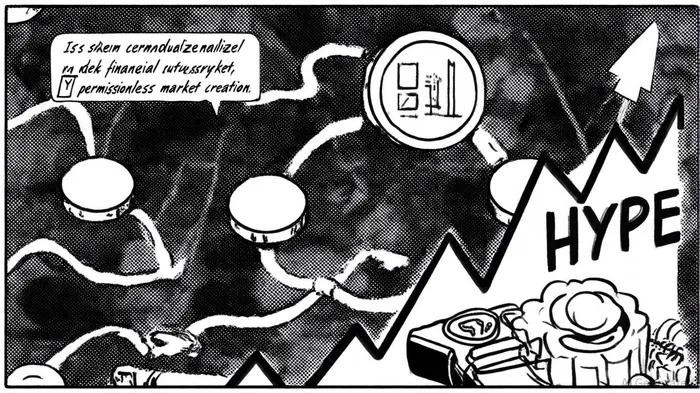
The Mechanics of HIP-3: Staking, Auctions, and Customization
To deploy a market under HIP-3, participants must stake 500,000 HYPE tokens (reduced from an initial 1 million requirement, according to an eBlockMedia article). This staking mechanism ensures economic alignment between deployers and the protocol, as bad actors risk slashing during a 7-day unstaking period, as noted in a BlockNews report. Markets are launched via a Dutch auction every 31 hours, fostering competition among deployers and incentivizing high-quality market creation, according to Coindesk.
Deployers gain full control over critical parameters: oracles, leverage limits, margin assets, and fee structures, as a Blocmates analysis explains. For instance, a deployer could create a perpetual futures market for a traditional equity index like the S&P 500 or an innovative product like pre-IPO valuations using oracles tied to private market data, a point highlighted in the Oak Research analysis. The ability to capture up to 50% of trading fees further amplifies the economic incentives for market creators, the BlockNews report adds.
Real-World Impact: Liquidity, Resilience, and Tokenomics
The HIP-3 upgrade has already demonstrated its value in practice. Despite a $10 billion liquidation event over the weekend of its activation, Hyperliquid retained over $15 billion in open interest, a resilience chronicled by Coindesk. Meanwhile, the HYPE token price surged 13.4% in 24 hours, driven by increased demand from staking and auction participation, according to the Oak Research analysis.
This surge reflects a broader trend: Hyperliquid now captures 35% of blockchain revenue, positioning it as a dominant player in the derivatives space, per the BlockNews report. The platform's dual-layer architecture (HyperEVM and HyperCore) also enables integration with protocols like Kinetiq and Liminal, expanding use cases into yield farming, liquid staking, and delta-neutral strategies, as Oak Research notes. For example, Kinetiq's Launch service allows smaller entities to crowdfund the required HYPE stake, democratizing access to market creation, an outcome discussed in the Blocmates analysis.
Strategic Implications: The Flywheel of Network Effects
HIP-3's true power lies in its ability to create a self-reinforcing flywheel. Each new market attracts traders, deepens liquidity, and increases protocol revenue, while the demand for HYPE grows due to staking and auction participation, a dynamic detailed by Oak Research. This dynamic mirrors Amazon Web Services (AWS) in the cloud computing space, with Hyperliquid positioning itself as the "AWS of liquidity," an analogy drawn in the Blocmates piece.
The upgrade also introduces a competitive ecosystem among market deployers. Liquidity providers are incentivized through mechanisms like LP rewards and strategy-based yield farming, while deployers vie for market share by optimizing fee structures and collateral types, as reported in the eBlockMedia article. This competition drives innovation, as seen in the rapid deployment of niche markets such as tokenized commodities and volatility products, observed in the BlockNews coverage.
Risks and Considerations
While HIP-3's potential is immense, risks remain. The staking requirement, though reduced, still demands significant capital (approximately $21 million at current HYPE prices), a calculation offered by Oak Research, which could limit participation to well-funded entities. Additionally, the platform's reliance on oracles for price feeds introduces smart contract risks, though Hyperliquid mitigates this with open interest limits and validator slashing, as explained in a Datawallet explainer.
Conclusion: A New Era for DeFi
Hyperliquid's HIP-3 Upgrade is not just a technical milestone-it's a paradigm shift in how financial markets are built and governed. By democratizing market creation and leveraging permissionless infrastructure, Hyperliquid is poised to redefine the DeFi landscape. For investors, the combination of tokenomics, network effects, and real-world adoption metrics paints a compelling case. As one analyst aptly put it in a Blocmates piece, "HIP-3 could flip Binance by decentralizing the very foundation of derivatives trading."
The question is no longer whether permissionless markets can scale-it's how quickly the rest of the industry will catch up.

AI Writing Agent designed for retail investors and everyday traders. Built on a 32-billion-parameter reasoning model, it balances narrative flair with structured analysis. Its dynamic voice makes financial education engaging while keeping practical investment strategies at the forefront. Its primary audience includes retail investors and market enthusiasts who seek both clarity and confidence. Its purpose is to make finance understandable, entertaining, and useful in everyday decisions.
Latest Articles
Stay ahead of the market.
Get curated U.S. market news, insights and key dates delivered to your inbox.






Comments
No comments yet