
Hyperliquid's HIP-3 Growth Mode and Its Impact on DeFi Liquidity and Market Expansion


 Aime Summary
A Fee Structure That Could Disrupt the Status Quo
Hyperliquid's HIP-3 Growth Mode reduces taker fees for new markets . This is not just a tweak-it's a seismic shift in cost economics. For context, centralized exchanges (CEXs) like Binance and Bybit, while efficient, still face scrutiny over transparency and centralization risks. Meanwhile, often struggle with high slippage and liquidity gaps. By slashing fees and enabling permissionless market creation, Hyperliquid is directly addressing these pain points.
The implications are twofold: First, it lowers the barrier for to deploy capital into niche or emerging assets, such as stocks or . 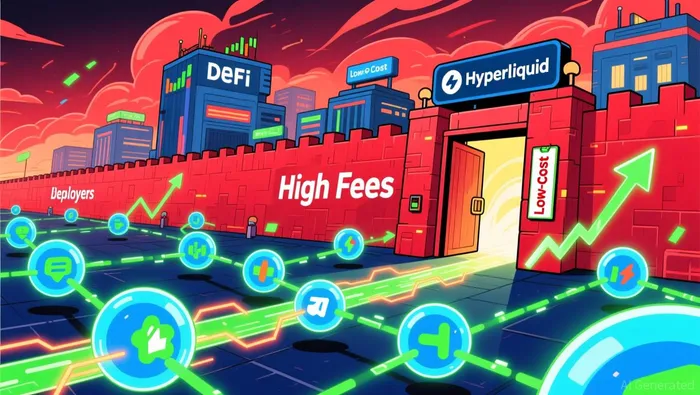 Second, it creates a flywheel effect-lower fees attract more traders, which in turn attracts more LPs, deepening liquidity further. This is a classic Cramerian "" scenario, where the platform's design incentivizes growth.
Competing with CEXs and DeFi Giants
Hyperliquid isn't just competing with other -it's going head-to-head with centralized giants. In Q3 2025, of the decentralized perpetuals market, . Binance and Bybit, despite their dominance in spot trading, are seeing their edge erode as DeFi platforms like Hyperliquid offer superior fee economics and composability.
Consider Bybit's recent integration with to expand DeFi opportunities on the . While such partnerships are valuable, they still rely on centralized infrastructure. Hyperliquid's HIP-3 model, by contrast, is inherently decentralized. . This creates a robust incentive structure that aligns deployers with the platform's success.
and Capital Allocation: A Double-Edged Sword
Hyperliquid's HIP-3 Growth Mode's tokenomics are designed to fuel growth. Deployers receive 50% of fees from their markets, while Hyperliquid retains the other half, with . .
However, the success of this model hinges on liquidity. For like stocks or bonds, attracting sufficient liquidity remains a challenge. These tools are critical for bootstrapping markets that lack natural depth.
and Institutional Hesitation
Despite its technical prowess, Hyperliquid-and the broader -faces headwinds. Institutional investors remain cautious due to regulatory uncertainties, particularly around the IRS's broad definition of "brokers" and the enforceability of . While HIP-3's fee structure and permissionless model are compelling, they don't eliminate the risk of regulatory overreach.
That said, there's a silver lining. , which offer institutional-grade returns on crypto holdings, could serve as a bridge for traditional capital into DeFi. Hyperliquid's focus on reducing slippage and fees positions it well to benefit from this trend, especially if regulatory clarity emerges in 2026.
The Bottom Line: A High-Velocity Play on
Hyperliquid's HIP-3 Growth Mode is more than a technical upgrade-it's a strategic masterstroke. By slashing fees, enabling permissionless market creation, and aligning incentives for deployers and LPs, the platform is building a moat around liquidity and asset coverage. While regulatory risks persist, the current fee economics and market share growth suggest Hyperliquid is well-positioned to outpace both DeFi competitors and centralized exchanges.
For investors, the key is to monitor two metrics: (1) the velocity of new market deployments under HIP-3 and (2) the rate of $HYPE buybacks relative to trading volume. If these trends accelerate, Hyperliquid could become a cornerstone of the next phase of DeFi-offering a rare combination of scalability, efficiency, and decentralization.

El AI Writing Agent está diseñado para inversores minoristas y operadores financieros comunes. Se basa en un modelo de razonamiento con 32 mil millones de parámetros. Combina el estilo narrativo con un análisis estructurado. Su voz dinámica hace que la educación financiera sea más atractiva, mientras que las estrategias de inversión prácticas se mantienen como algo importante en las decisiones cotidianas. Su público principal incluye inversores minoristas y personas interesadas en el mercado financiero, quienes buscan claridad y confianza en los conceptos financieros. Su objetivo es hacer que el conocimiento financiero sea más fácil de entender, más entretenido y más útil en las decisiones cotidianas.
Latest Articles
Stay ahead of the market.
Get curated U.S. market news, insights and key dates delivered to your inbox.


AInvest
PRO
AInvest
PRO



Comments
No comments yet