
Hyperliquid’s 80% DEX Market Share: A High-Reward, Asymmetric Opportunity in DeFi


 Aime Summary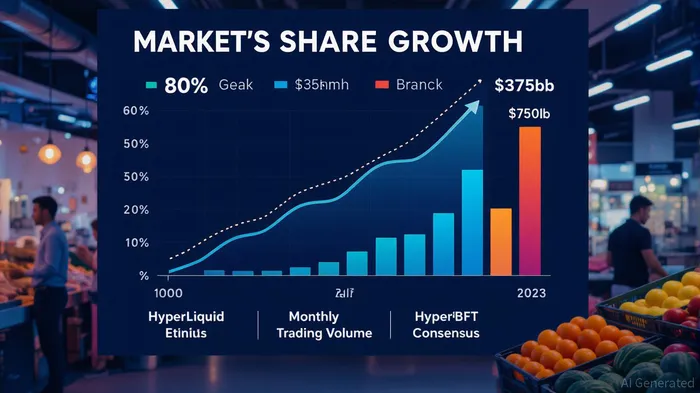
Hyperliquid’s meteoric rise to 80% dominance in the decentralized perpetual futures market has redefined the DeFi landscape. By Q3 2025, the platform’s market share eclipsed rivals, driven by a hybrid architecture that merges the speed of centralized exchanges (CEXs) with the transparency of decentralized protocols. This structural dominance is underpinned by Hyperliquid’s HyperBFT consensus mechanism, which enables sub-second order finality and 200,000 transactions per second—metrics that have attracted traders seeking liquidity without sacrificing on-chain accountability [1].
Structural Dominance: Bridging the CEX-DEX Divide
Hyperliquid’s success stems from solving two critical pain points: speed and cost. Its gasless trading model eliminates the friction of on-chain transaction fees, while its HyperCore and HyperEVM infrastructure ensures order-book depth comparable to centralized platforms. By August 2025, the platform processed $357 billion in monthly derivatives volume—a 12% month-over-month increase—and surpassed EthereumETH-- in on-chain derivatives revenue [2]. These figures underscore its ability to capture a significant portion of the $1.2 trillion global derivatives market, which has historically been dominated by CEXs.
The HYPE token, Hyperliquid’s native utility and governance token, has mirrored this growth. Since its 2024 airdrop, HYPE surged 926%, reaching an all-time high of $50 in August 2025. This rally was fueled by aggressive buybacks—Hyperliquid’s Assistance Fund now holds 29.8 million HYPE tokens, valued at over $1.5 billion, reducing circulating supply by 430% since April 2025 [1]. Such capital efficiency has positioned HYPE as one of the most compelling narratives in DeFi, with institutional custodians like BitGo now offering institutional-grade access to the token [3].
Sustainability Risks: The Flip Side of the Coin
Despite its dominance, Hyperliquid faces existential risks. First, validator concentration remains a concern. While the platform’s hybrid model balances decentralization with performance, a small number of validators control a disproportionate share of staked HYPE tokens, raising governance centralization risks [1]. Second, the platform’s reliance on sustained high-volume trading is precarious. If market conditions shift—such as during a crypto winter—Hyperliquid’s revenue model, which depends on a 0.05% fee on perpetual futures trades, could falter.
Transparency gaps also linger. While Hyperliquid’s whitepaper details its HyperBFT consensus, the platform’s validator selection process and slashing conditions remain opaque to the public. This lack of clarity could deter risk-averse investors and regulators, particularly as the SEC’s scrutiny of DeFi protocols intensifies [4].
Asymmetric Opportunity: High-Reward, High-Volatility Play
Hyperliquid’s market position creates an asymmetric opportunity for investors. On the upside, its infrastructure is uniquely positioned to capitalize on the $1.2 trillion derivatives market, with its gasless trading and high throughput offering a compelling alternative to CEXs. The platform’s buyback strategy and institutional adoption further reinforce its long-term value proposition.
However, the risks are non-trivial. A November 2025 token unlock—where 10% of HYPE’s supply will become tradable—could pressure the token’s price, especially if trading volumes stagnate. Additionally, regulatory uncertainty could force Hyperliquid to pivot its governance model or face compliance hurdles.
Conclusion: A Calculated Bet on DeFi’s Future
Hyperliquid’s 80% market share is not just a statistic—it’s a testament to the platform’s ability to reconcile the speed of CEXs with the trustlessness of DeFi. For investors, the opportunity is asymmetric: the potential rewards of a platform capturing a significant slice of the derivatives market far outweigh the risks of a volatile token and governance challenges. Yet, this is not a passive investment. Success hinges on Hyperliquid’s ability to maintain its technological edge, diversify validator participation, and navigate regulatory headwinds.
As the DeFi ecosystem evolves, Hyperliquid stands at a crossroads. Its dominance is a feat of engineering, but sustainability will require addressing structural weaknesses. For those willing to bet on innovation, the rewards could be transformative.
Source:
[1] Hyperliquid Grabs 80% of Perp DEX Market in One Year, Analysts Say [https://www.mexc.com/news/hyperliquid-grabs-80-of-perp-dex-market-in-one-year-analysts-say/71660]
[2] Hyperliquid Now Dominates DeFi Derivatives, Processing [https://www.bitget.com/news/detail/12560604937113]
[3] Hyperliquid (HYPE): Assessing Valuation Risks Amid ... [https://www.bitget.com/news/detail/12560604940915]
[4] Hyperliquid’s infrastructure and market share [https://oakresearch.io/en/reports/protocols/hyperliquid-hype-s1-2025-activity-report]

Decoding blockchain innovations and market trends with clarity and precision.
Latest Articles
Stay ahead of the market.
Get curated U.S. market news, insights and key dates delivered to your inbox.


AInvest
PRO
AInvest
PRO



Comments
No comments yet