
HYPE Token: Speculative Frenzy or Genuine Innovation in 2025?
 Aime Summary
Market Performance and Key Catalysts
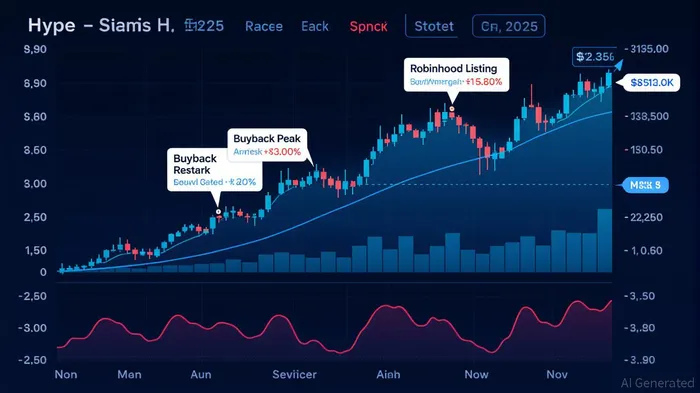
Hyperliquid's HYPE token has experienced a whirlwind of activity in 2025. The platform has allocated over $644.64 million to repurchase 21.36 million HYPE tokens, representing 2.1% of its total supply, averaging $65.5 million per month and peaking at $110.6 million in August, according to a Cryptopotato report. These buybacks, part of a broader industry trend to reduce supply and boost holder confidence, have driven the token's price to $40 as of late October 2025, with a 15% weekly appreciation, as noted in a Currency Analytics analysis.
A pivotal catalyst was the $888 million merger between Nasdaq-listed Sonnet BioTherapeutics and Rorschach I LLC, forming Hyperliquid Strategies Inc., which established a $583 million HYPE token treasury and secured a $1 billion acquisition facility, signaling institutional demand and strategic value, as reported by Bitget. Additionally, Hyperliquid's $303 billion October trading volume and the listing of HYPE on Robinhood further amplified its exposure, with the token surging to $40 post-listing, according to the Currency Analytics analysis.
However, technical indicators suggest caution. HYPE trades near $40 with a weakening RSI of 46 and a negative MACD, hinting at consolidation, as noted in the Bitget report. Whale activity, including a $21 million investment in 48 hours by two major investors, underscores confidence but also highlights the risks of concentrated ownership, according to CryptoRank.
Innovation vs. Speculation: A DeFi Evolution
Hyperliquid's roadmap positions HYPE as more than a speculative asset. The platform's BorrowLendingProtocol (BLP), currently in testing on the Hypercore testnet, enables on-chain lending and borrowing of assets like USDCUSDC-- and PURR, aiming to enhance capital efficiency for traders, as reported by Bitget. This innovation aligns with broader industry shifts toward Web3 infrastructure, where projects like Commonware and Pieverse secure funding for cross-chain payment systems and compliance protocols, as noted in a Blockonomi article.
In contrast, tokens like Dogecoin and SHIBSHIB-- have historically relied on social media-driven hype. While SHIB recently partnered with Unity Nodes to expand telecom utility, HYPE's HIP-3 proposal-which allows permissionless market creation via staking-introduces a structured governance model, as detailed in Superex. HIP-3 requires staking 500K HYPE (~$25 million) to deploy new perpetual markets, with slashing penalties for malicious behavior and revenue-sharing mechanisms, as reported in the Superex. The first HIP-3 market, XYZ100 (tracking the Nasdaq 100), generated $100K in fees within two weeks, demonstrating tangible utility, as reported in the Superex.
Governance, Security, and Regulatory Risks
Hyperliquid's governance model, however, faces scrutiny. The Hyper Foundation controls all 24 validator nodes, raising concerns about centralization, as noted in the Superex. Critics argue this undermines decentralization principles and poses regulatory risks, particularly regarding lack of user identity verification and potential security vulnerabilities, as reported in the Superex.
To address these issues, Hyperliquid is integrating RedStone's HyperStone oracle, which provides fast, reliable price feeds to mitigate manipulation and liquidation risks, as reported in the Bitget report. This contrasts with Dogecoin and SHIB, which lack such infrastructure and remain heavily influenced by social media sentiment, as noted in the Bitget report.
Historical Comparisons and Long-Term Viability
Comparisons to past hype cycles reveal divergent paths. Dogecoin's value has historically been tied to ETF inclusion and celebrity endorsements, while SHIB's recent telecom partnership introduced limited utility, as discussed in a Fool article. HYPE, by contrast, is embedded in a $1.4 billion buyback program and institutional-grade DeFi infrastructure, suggesting a more sustainable model.
Yet, challenges persist. The POPCAT memecoin incident, which led to a $4.9 million loss for Hyperliquid's HLP, highlights the risks of speculative trading on the platform, as noted in a TradingView briefing. Additionally, HIP-3's staking thresholds and auction processes may slow adoption, as deployers navigate complex requirements, as reported in the Superex.
Conclusion: Credible Investment or Passing Fad?
The HYPE token occupies a unique space between speculative fervor and genuine innovation. Its $1.4 billion buyback program, institutional mergers, and DeFi advancements like BLP and HIP-3 suggest a credible foundation for long-term growth. However, centralized governance, regulatory uncertainties, and the inherent volatility of on-chain derivatives trading temper optimism.
For investors, the key lies in balancing these factors. While HYPE's utility-driven roadmap and institutional backing differentiate it from past hype cycles, its success will depend on executing BLP and HIP-3 effectively, mitigating governance risks, and navigating regulatory scrutiny. In a market increasingly prioritizing infrastructure over speculation, HYPE's potential as a three-year hold appears plausible-but not guaranteed.

Mezclando la sabiduría tradicional del comercio con las perspectivas de vanguardia en el área de las criptomonedas.
Latest Articles
Stay ahead of the market.
Get curated U.S. market news, insights and key dates delivered to your inbox.


AInvest
PRO
AInvest
PRO



Comments
No comments yet