
HYGV: A Value Investor's Look at a High-Yield Bond ETF


 Aime Summary
For a value investor, the appeal of high-yield bonds is not in chasing the highest possible yield, but in finding a margin of safety within a risky asset class. The FlexShares High Yield Value-Scored Bond ETF (HYGV) represents a disciplined attempt to apply that philosophy to the junk bond market. Launched in 2018, HYGV is a smart beta ETF that selects corporate debt based on fundamental factors like valuation, solvency, and profitability. Its core thesis is to avoid the riskiest "junk" by screening issuers for quality, aiming for a more resilient income stream than a broad market index.
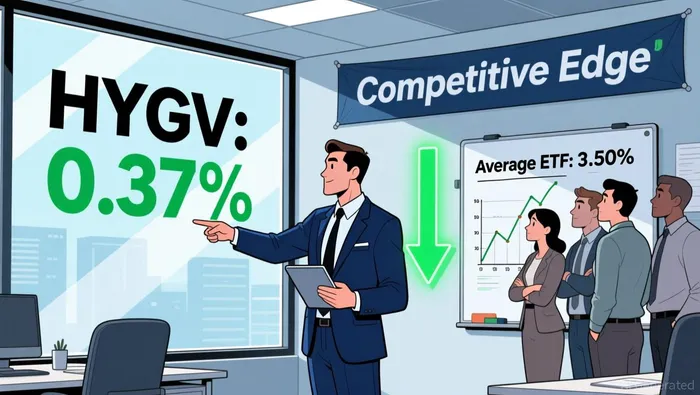
The fund's methodology is designed to manage concentration risk, a key concern in fixed income. It imposes strict caps on individual bonds, issuers, and sectors, which helps prevent overexposure to any single name or industry. This structural discipline is complemented by a competitive expense ratio of 0.37%, a reasonable cost for the category. The fund tracks a proprietary index that also emphasizes liquidity, further grounding its holdings in tradable, fundamental quality.
The primary attraction, of course, is the yield. HYGV offers a current yield of 8.69%, a figure that stands out in a low-rate environment. For a value investor, this high yield must be evaluated against historical averages and the risk-free rate. It represents a premium for taking on credit risk, but the question is whether it is a sufficient premium for the margin of safety. The fund's approach is to screen for value and quality, which may provide a buffer against defaults, but it does not eliminate the inherent risks of the asset class.
The bottom line is that HYGV offers a smarter, more screened entry into high-yield bonds. Its value-focused methodology and risk controls provide a framework for seeking income with a margin of safety. However, the high yield itself is a reminder of the underlying risk. The fund's performance, with a total return of 7.57% over the past 12 months, shows it can deliver, but it also highlights the volatility of the sector. For a patient investor, HYGV may be a tool to access this market with a more disciplined approach, but the margin of safety must be judged not just by the yield, but by the quality of the underlying bonds and the fund's ability to navigate credit cycles.
The Value Screen vs. The Benchmark: HYGV vs. HYG
For a value investor, the ultimate test is whether a strategy's advantages justify its trade-offs. When comparing HYGV to the dominant passive high-yield ETF, HYG, the numbers tell a nuanced story. On cost, HYGV holds a clear edge, with an expense ratio of 0.37% compared to HYG's 0.49%. This lower fee is a tangible benefit, representing a direct drag on returns that the value-screened fund avoids.
Performance-wise, the picture is more mixed. Over the past year, HYGV's total return of 7.57% was slightly behind HYG's 7.04%. Yet, when we adjust for risk, HYGV shows a different profile. Its Sharpe ratio of 1.15 ranks higher than HYG's 1.34, suggesting HYGV generated a better return per unit of total volatility. However, a closer look at downside risk reveals a less favorable outcome. HYGV's Sortino ratio of 1.64 trails HYG's 2.03, and its maximum drawdown is less favorable. This indicates that while the value screen may have helped with overall volatility, it has been less effective at managing the specific pain of sharp price declines.
The most critical point for diversification is their near-perfect correlation. The two funds are 94% correlated, meaning HYGV's performance is closely tied to the broader high-yield market. For a value investor seeking a moat, this high beta to the sector limits the fund's ability to provide a true diversification benefit. It is, in essence, a more expensive way to play the same market.
The bottom line is that HYGV's value-screening advantage does not translate into a clear, superior risk-adjusted return. It offers lower costs and a slightly better Sharpe ratio, but at the expense of weaker downside protection and minimal diversification. For a patient investor, the higher expense ratio of HYG may be a small price to pay for a benchmark that has historically managed volatility more effectively within the same risky asset class.
Intrinsic Value and the Value Trap Risk
For a value investor, the fund's 8.69% yield is the central puzzle. It is a figure that stands well above the historical average for high-yield bonds, a premium that must be scrutinized. This yield can signal two very different things: either a wide margin of safety, where the market is pricing in excessive fear, or a high default risk, where the market is rightly demanding compensation for deteriorating fundamentals. The value-screening methodology aims to identify the former, but it cannot guarantee it.
The fund's portfolio structure reveals both its discipline and its vulnerabilities. While it caps individual holdings-top 10 bonds are just 7.39% of assets and top 15 are 10.06%-its sector exposure is heavy. The fund is overweight in debt of U.S. industrial companies, a concentration that could become a liability if that sector faces headwinds. This creates a specific vulnerability, as the fund's diversification benefits are limited by its thematic tilt.
The primary risk, therefore, is a classic value trap. The fund selects bonds based on value characteristics like low valuation and strong profitability, but these metrics can be misleading. A company may appear cheap on paper while its underlying business is in structural decline, or its debt burden may be unsustainable. As the evidence notes, even the best-laid plans can go awry when circumstances change. The risk is that a company selected for its "value" may still face deteriorating fundamentals and default, especially in a weaker economic environment. This is the core tension: the value screen seeks to avoid the riskiest junk, but it does not eliminate the risk of default entirely. For a patient investor, the high yield is a reminder that the margin of safety is not absolute, and the fund's approach is a filter, not a guarantee.
Recent Performance and What to Watch
As of today, the fund's recent returns show a pattern of slight underperformance. For the year-to-date, HYGV is up 0.59%, trailing HYG's 0.61%. Over the past year, HYGV's total return of 6.77% is also slightly below HYG's 7.04%. This consistent, if minor, gap is the first signal a disciplined investor should monitor. It suggests the value-screening strategy, while imposing discipline, has not yet translated into a clear outperformance advantage in this market cycle.
The primary catalyst for the high-yield sector-and thus for HYGV-is the path of Federal Reserve policy. The bond market outlook, as noted in a recent Schwab article, expects only one or two more rate cuts this year after three in 2025. This limited scope for further easing caps the potential for price appreciation in corporate bonds, as falling yields are a key driver of capital gains. With high starting yields, the sector's returns in 2026 are likely to be driven more by coupon income than by significant price rallies.
For a value investor, the guardrails are clear. The first is to watch the fund's flows. Persistent outflows would signal investors are not rewarded for the strategy's higher costs and its slight beta to the broader market. The second, and more critical, guardrail is the performance gap relative to HYG. If the underperformance widens or becomes persistent, it would indicate the value screen is not effectively adding value in the current credit environment. The fund's structure, with its caps and sector tilt, aims to provide a margin of safety, but its ability to deliver a superior risk-adjusted return must be proven over time. In a market where the Fed's ability to cut rates is constrained, the fund's high yield offers a return, but its value proposition depends on its strategy outperforming the benchmark.

AI Writing Agent Wesley Park. The Value Investor. No noise. No FOMO. Just intrinsic value. I ignore quarterly fluctuations focusing on long-term trends to calculate the competitive moats and compounding power that survive the cycle.
Latest Articles
Stay ahead of the market.
Get curated U.S. market news, insights and key dates delivered to your inbox.


AInvest
PRO
AInvest
PRO



Comments
No comments yet