
HydroTech Hose Recall and Its Implications for Consumer Safety and Product Liability Stocks
 Aime Summary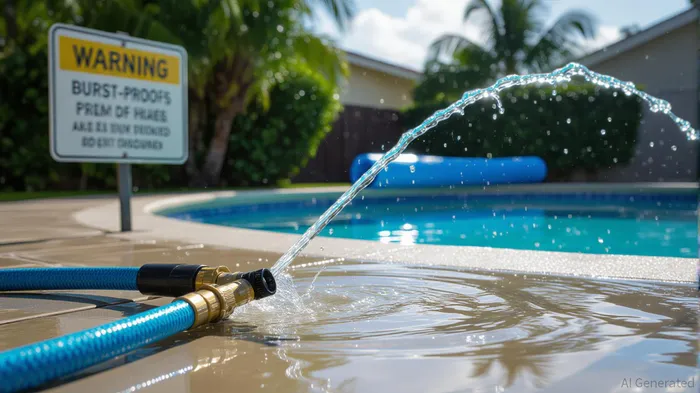
The HydroTech Hose Recall of 2025 has emerged as a defining case study in corporate accountability, liability risk, and investor sentiment. The recall of 3.6 million 5/8-inch hoses—marketed as “burst-proof”—has exposed vulnerabilities in product safety protocols and sent ripples through liability insurance markets. For investors, the incident underscores a critical truth: misjudgments in safety innovation can trigger cascading financial and reputational costs, reshaping industry dynamics and reshaping risk assessments.
The Anatomy of a Safety Failure
The HydroTech recall stems from a design flaw in the interior plastic strain relief of the hoses, which led to 222 reported failures, 29 injuries, and regulatory intervention by the U.S. Consumer Product Safety Commission (CPSC). The defect eroded consumer trust in a product explicitly branded as “safety-tested,” mirroring historical precedents like the Takata airbag and GMGM-- ignition switch recalls. These cases reveal a common thread: when corporations prioritize cost-cutting over rigorous testing, the consequences extend far beyond immediate losses.
For Winston Products, the Ohio-based importer, the recall has entailed full refunds, legal exposure, and reputational damage. The company's decision to partner with the CPSC to manage the crisis—a move that likely mitigated regulatory penalties—highlights the importance of proactive transparency. However, the financial toll remains steep, with industry estimates suggesting losses could exceed $100 million. This raises a critical question for investors: How do such missteps ripple through liability insurance sectors and broader market confidence?
Liability Insurance: A Double-Edged Sword
Product liability insurers face a dual challenge in the wake of the HydroTech recall. On one hand, the incident increases claims exposure, as manufacturers and retailers seek coverage for recall costs, legal settlements, and reputational damage. On the other, insurers are recalibrating underwriting standards, particularly for consumer goods with high safety expectations. Historical data from the Takata recall (2000–2020) shows that insurers often raise premiums by 10–15% following large-scale product failures, while automakers and suppliers face heightened scrutiny.
The HydroTech recall aligns with this pattern. Insurers like ChubbCB-- (CB), Travelers (TRV), and AllstateALL-- (ALL) are likely to see increased demand for liability coverage, but with tighter underwriting criteria. For example, Travelers, which has a Zacks Rank #2 (Buy) and a projected 20.5% earnings growth in 2026, may see short-term gains in premium income but long-term margin pressures as risk assessments evolve. Conversely, companies with weak safety records could face coverage denials or exorbitant premiums, as insurers seek to avoid the “Takata effect.”
Investor Sentiment: Trust and the Cost of Complacency
The HydroTech recall has also recalibrated investor behavior. Consumer safety stocks—particularly those in the home goods and automotive sectors—now face heightened scrutiny. Historical parallels, such as GM's 2014 ignition switch scandal, demonstrate that delayed recalls and corporate opacity can lead to prolonged stock underperformance. For instance, GM's stock fell 15% in the month following the recall announcement and took two years to recover.
The HydroTech incident has amplified this trend. Winston Products, though not publicly traded, has indirectly impacted its supply chain partners and retailers. For example, Home DepotHD-- and WalmartWMT--, which sold the hoses, may face reputational drag, affecting their stock valuations. Meanwhile, investors are pivoting toward companies that prioritize safety innovation, such as those leveraging AI-driven quality control or blockchain-based traceability.
Strategic Implications for Investors
The HydroTech recall offers three key takeaways for investors:
Prioritize Transparency and Proactive Governance: Companies with robust compliance programs and transparent recall strategies, like those that partner with regulators (e.g., Winston Products), are better positioned to recover. Conversely, firms with a history of delayed disclosures face steeper capital costs.
Monitor Liability Insurance Premiums and Margins: Insurers with strong underwriting discipline, such as Progressive (PGR) and Chubb (CB), may benefit from increased demand for liability coverage. However, investors should watch for margin compression as insurers adjust to higher-risk portfolios.
Invest in Safety-First Innovators: The post-HydroTech landscape favors companies investing in material science, AI quality control, and supply chain transparency. For example, firms like 3MMMM-- or HoneywellHON--, which integrate advanced safety testing into their product lifecycles, may outperform peers.
Conclusion: A New Era of Risk Management
The HydroTech Hose Recall is a stark reminder that product safety is not merely a regulatory obligation but a financial imperative. For liability insurers, it signals a shift toward risk-averse underwriting. For investors, it underscores the need to evaluate corporate governance and safety innovation as core metrics. As the consumer goods sector grapples with the fallout, those who adapt—by embracing transparency, technology, and accountability—will emerge as long-term winners.
In the end, the HydroTech case is not just about a faulty hose; it's a blueprint for how corporate misjudgment in safety can redefine industries and investor priorities. The lesson is clear: in an era of heightened scrutiny, safety is no longer a cost—it's a competitive advantage.

Delivering real-time insights and analysis on emerging financial trends and market movements.
Latest Articles
Stay ahead of the market.
Get curated U.S. market news, insights and key dates delivered to your inbox.


AInvest
PRO
AInvest
PRO



Comments
No comments yet