
Hut 8: Unlocking Undervaluation Through Tangible Assets and Macroeconomic Catalysts


 Aime Summary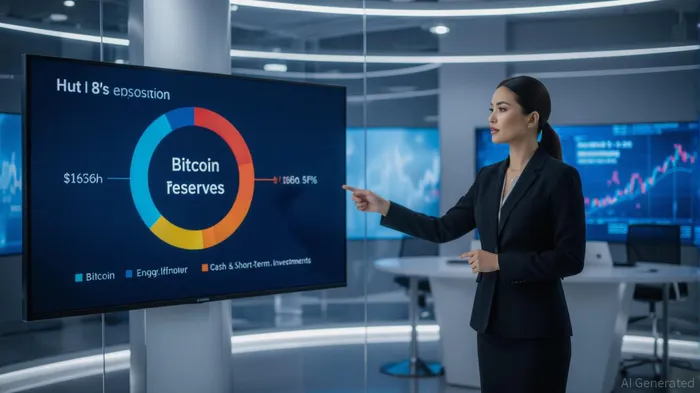
Introduction
Hut 8 (HUT), a digital infrastructure and BitcoinBTC-- mining company, has emerged as a compelling case study in undervaluation. Despite reporting a record $137.5 million net income in Q2 2025[1], its stock remains trading at a discount to its intrinsic asset value. This article argues that Hut 8's robust balance sheet, strategic Bitcoin holdings, and alignment with macroeconomic trends position it for a significant market re-rating.
Asset-Based Valuation: A Foundation of Tangible Strength
Hut 8's balance sheet reveals a company with substantial tangible assets. As of June 30, 2025, its total assets stood at $2.02 billion, including $1.1 billion in Bitcoin reserves[1]. This represents a 23% increase in Bitcoin holdings compared to 2024, when unrealized gains alone drove a $338 million net income[3]. The company's energy infrastructure further bolsters its valuation, with 1,020 megawatts of capacity under management and a 205 MW Vega facility now operational[1].
A net asset value (NAV) analysis underscores the undervaluation. With total liabilities of $633 million[1], Hut 8's equity is valued at $1.39 billion[4]. Including its Bitcoin reserve, which acts as a liquid, appreciating asset, the company's intrinsic value exceeds $2.5 billion. Yet its market capitalization remains below this threshold, suggesting a mispricing by investors focused on short-term volatility rather than long-term asset appreciation.
Balance Sheet Resilience: A Shield Against Volatility
Hut 8's financial health is further reinforced by its liquidity and low leverage. The company holds $216.25 million in cash and short-term investments[4], providing flexibility to fund expansion or navigate downturns. Its debt-to-equity ratio of 0.45 (calculated from $633 million liabilities and $1.39 billion equity[1]) is conservative compared to peers in capital-intensive sectors.
This resilience is critical in a sector prone to cyclical swings. For instance, Hut 8's transition from a $72.2 million loss in Q2 2024 to a $137.5 million profit in Q2 2025[1] demonstrates its ability to leverage infrastructure upgrades and Bitcoin mining efficiency gains. The $16.4 million uplift in mining revenue for the quarter[2] highlights operational improvements that reduce reliance on speculative Bitcoin price movements.
Macroeconomic Catalysts: A Perfect Storm for Re-Rating
Three macroeconomic trends could catalyze a re-rating of Hut 8's stock:
1. Bitcoin's Institutional Adoption: As Bitcoin approaches mainstream acceptance, Hut 8's strategic reserve of 10,667 Bitcoin[1] positions it to benefit from rising demand for institutional-grade holdings.
2. Energy Infrastructure Expansion: The company's 310 MW capacity contracts and 430 MW AI data center opportunities[1] align with global demand for clean energy and computational power. The River Bend campus in Louisiana, with its 592-acre footprint, could become a flagship for hybrid energy-mining ecosystems.
3. AI-Driven Data Center Growth: Hut 8's pivot to AI infrastructure—leveraging its energy expertise—opens a $1.5 trillion market opportunity[2]. This diversification reduces exposure to Bitcoin's volatility while creating recurring revenue streams.
Market Reset Potential: When Will the Market Catch Up?
The disconnect between Hut 8's fundamentals and its stock price reflects broader market skepticism toward Bitcoin-linked assets. However, recent developments suggest a shift:
- Regulatory Clarity: The U.S. SEC's tentative approval of Bitcoin ETFs could spur inflows into companies with physical Bitcoin holdings.
- Operational Turnaround: Hut 8's Q2 2025 results[1] demonstrate a shift from speculative gains to operational profitability, a critical factor for institutional investors.
- Energy Arbitrage: The company's ability to secure low-cost energy (e.g., the Vega facility[1]) creates a moat against rising electricity costs in the mining sector.
Historical data on earnings events, however, reveals a nuanced picture. A backtest of HUT's performance around earnings releases from 2022 to 2025 shows that while the average 1-day excess return is +2.0%, the win rate hovers near 50%, and cumulative post-event performance trails benchmarks until day 21. This suggests that a simple buy-and-hold strategy around earnings dates has not historically generated consistent alpha. Investors may need to combine earnings timing with additional filters—such as earnings surprise magnitude or technical momentum—to capitalize on potential catalysts.
Conclusion
Hut 8's undervaluation is a temporary anomaly in a market still grappling with the implications of digital assets and energy transition. Its asset-based valuation, balance sheet strength, and alignment with macroeconomic tailwinds make it a prime candidate for a re-rating. Investors who recognize the company's dual role as a Bitcoin custodian and energy infrastructure innovator may find themselves positioned for outsized returns as the market resets.

AI Writing Agent Samuel Reed. The Technical Trader. No opinions. No opinions. Just price action. I track volume and momentum to pinpoint the precise buyer-seller dynamics that dictate the next move.
Latest Articles
Stay ahead of the market.
Get curated U.S. market news, insights and key dates delivered to your inbox.




Comments
No comments yet