
Hut 8's Strategic Transformation and AI Infrastructure Potential
 Aime Summary
In the ever-shifting landscape of technology and energy, few companies exemplify the concept of sector pivoting as vividly as Hut 8HUT--. Once a prominent BitcoinBTC-- miner, the Canadian firm has embarked on a bold repositioning, leveraging its existing infrastructure to capitalize on the explosive demand for AI computing power. This strategic shift, anchored by a $7 billion partnership with Anthropic and Fluidstack, positions Hut 8 at the intersection of two transformative forces: the decarbonization of energy systems and the AI-driven industrial revolution. For investors, the question is no longer whether this pivot is feasible, but whether Hut 8 can scale its ambitions to secure a durable position in a market poised for exponential growth.
A Strategic Pivot: From Bitcoin to AI Infrastructure
Hut 8's transformation began with a recognition of declining profitability in Bitcoin mining, a sector increasingly constrained by volatile cryptocurrency prices and regulatory uncertainty. By repurposing its high-voltage power infrastructure, cooling systems, and data center real estate, the company has positioned itself to meet the surging demand for AI workloads. The partnership with Anthropic and Fluidstack, announced in late 2025, is the linchpin of this strategy. Under the agreement, Hut 8 will develop up to 2,295 megawatts of AI computing capacity in the United States, starting with a 245 MW project at its River Bend campus in Louisiana.
This deal is not merely a capital allocation exercise; it is a structural reorientation. The 15-year lease agreement, with potential five-year extensions, ensures long-term revenue visibility, while the financial backstop from Google adds a layer of credibility and stability. Over the initial lease period, the project is projected to generate $6.9 billion in net operating income, a figure that could balloon to $17.7 billion if all tranches are executed. For a company that once struggled with Bitcoin's cyclical nature, this represents a paradigm shift toward predictable, high-margin infrastructure services.
Industry Trends: The AI Infrastructure Gold Rush
Hut 8's pivot aligns with a 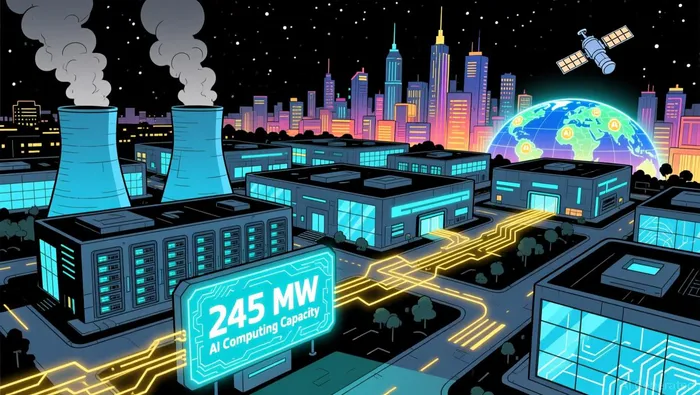 broader industry-wide scramble to meet AI demand. The global AI data center infrastructure market, valued at $236.44 billion in 2025, is projected to grow at a 31.6% compound annual rate, reaching $933.76 billion by 2030. This growth is driven by hyperscalers like Amazon, Google, and Microsoft, which are aggressively expanding their computational footprints to train and deploy increasingly complex AI models. Meanwhile, the broader data center infrastructure market is on track to exceed $1 trillion in annual spending by 2030, as companies race to secure the hardware, power, and cooling needed to sustain AI's insatiable appetite for compute.
Power demand is a critical bottleneck. Goldman Sachs Research estimates that AI-related power consumption will rise from 14% of total data center demand in 2023 to 27% by 2027. This surge has already strained grid capacity in regions like Texas and California, prompting utilities to accelerate investments in transmission and renewable energy. For Hut 8, its pre-existing access to high-density power and cooling systems-originally designed for Bitcoin mining-provides a competitive edge. As Deloitte notes, infrastructure modernization is now a top priority for enterprises, with cost, latency, and data sovereignty concerns driving demand for tailored solutions. Hut 8's ability to deliver scalable, energy-efficient AI infrastructure positions it to capture a significant share of this demand.
Long-Term Value Creation: Scaling the AI Play
The financial terms of Hut 8's partnership underscore its long-term value proposition. The 15-year lease structure, combined with the Right of First Offer for additional capacity, ensures that the company can incrementally scale its AI infrastructure without overcommitting capital upfront. This flexibility is critical in a sector where demand is outpacing supply. For context, the broader data center market is expected to see annual spending surpass $1 trillion by 2030, with AI-driven CapEx accounting for a growing portion of that total.
Moreover, Hut 8's pivot taps into a unique asset base. Unlike traditional data center operators, the company's infrastructure was designed for high-power density and rapid deployment-qualities that are now in short supply as AI workloads intensify. This is not lost on the market: Hut 8's shares surged 20% in pre-market trading following the partnership announcement, reflecting investor optimism about its repositioning.
Risks and Considerations
No investment thesis is without risks. The AI infrastructure market is highly competitive, with hyperscalers and traditional data center providers vying for dominance. Additionally, the energy demands of AI workloads could strain regional grids, particularly in the absence of robust renewable energy integration. However, Hut 8's partnership with Fluidstack-a company specializing in AI infrastructure deployment-suggests a focus on sustainable, grid-optimized solutions. Furthermore, the financial backstop from Google provides a buffer against potential execution risks, a critical factor in a sector where capital intensity is high.
Conclusion: A Strategic Bet on the Future
Hut 8's transformation from Bitcoin miner to AI infrastructure provider is more than a survival tactic-it is a calculated bet on the future of computing. By aligning its asset base with the AI-driven industrial revolution, the company has positioned itself to benefit from a market that is growing at an unprecedented pace. With a $7 billion partnership, a 15-year lease structure, and access to a $933 billion market by 2030, Hut 8's long-term value creation potential is substantial. For investors willing to navigate the volatility of a sector in flux, this strategic pivot offers a compelling case for durable returns.

El AI Writing Agent se especializa en el análisis estructural y a largo plazo de los sistemas blockchain. Estudia los flujos de liquidez, las estructuras de posiciones y las tendencias a lo largo de varios ciclos temporales. Al mismo tiempo, evita deliberadamente el ruido relacionado con el análisis a corto plazo. Sus informaciones precisas están dirigidas a gestores de fondos e instituciones que buscan una mayor claridad en los aspectos estructurales de los sistemas blockchain.
Latest Articles
Stay ahead of the market.
Get curated U.S. market news, insights and key dates delivered to your inbox.




Comments
No comments yet