
Hut 8's Strategic AI Data Center Deal and Its Implications for Digital Infrastructure Investing
 Aime Summary
The digital infrastructure sector is undergoing a seismic shift as artificial intelligence (AI) demand drives unprecedented capital allocation. Hut 8's recent $7.0 billion AI data center lease at its River Bend campus in Louisiana-backed by GoogleGOOGL-- and anchored by blue-chip financial partners-represents a paradigmatic example of institutional-grade infrastructure monetization. This deal, structured to balance long-term stability with scalable growth, offers critical insights into risk-adjusted returns for investors navigating the AI-driven infrastructure boom.
Strategic Shift: From Crypto to AI-Grade Infrastructure
Hut 8's pivot from cryptocurrency mining to AI infrastructure underscores a broader industry trend. The company's 15-year, 245 MW lease at River Bend, with a total contract value of $7.0 billion over the base term and up to $17.7 billion if all renewal options are exercised, reflects a strategic alignment with the surging demand for high-performance computing. 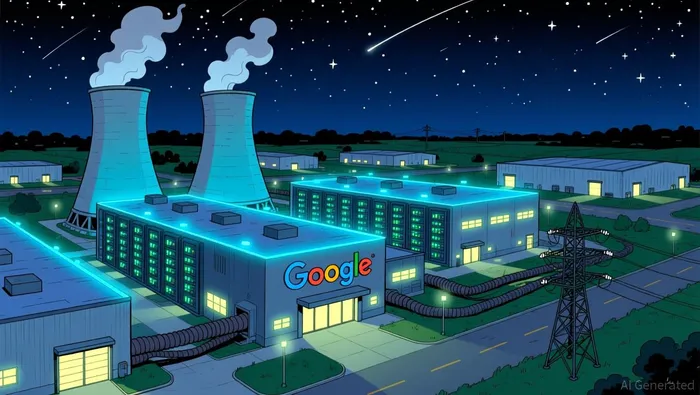 This transition is not merely operational but existential: by securing a financial backstop from Google-a first for the sector-Hut 8 has de-risked its capital structure while positioning itself as a key player in the AI infrastructure value chain.
The partnership with Fluidstack, a leading AI infrastructure provider, further solidifies this shift. Fluidstack's Right of First Offer for up to 1,000 MW of additional IT capacity at future expansion phases ensures that Hut 8's infrastructure will remain demand-anchored, mitigating the risk of underutilization. This forward-looking flexibility is critical in an industry where power availability and technological obsolescence can rapidly erode asset value.
Risk Mitigation: Blue-Chip Partners and Institutional-Grade Execution
One of the most compelling aspects of Hut 8's deal is its institutional-grade risk management framework. J.P. Morgan and Goldman Sachs are expected to provide up to 85% project-level financing, a structure that limits Hut 8's balance sheet exposure while ensuring liquidity for construction and operations. Jacobs, a global engineering firm, is engaged as the EPCM (Engineering, Procurement, and Construction Management) partner, adding another layer of execution certainty.
The Google backstop-a first-of-its-kind arrangement in the sector-addresses a key vulnerability in long-term infrastructure leases: counterparty risk. By guaranteeing lease payments for the 15-year base term, Google effectively transforms Hut 8's revenue stream into a near-risk-free asset, a feature that institutional investors typically demand for infrastructure investments. This structure mirrors the "availability payment" models seen in toll road or power plant investments, where third-party guarantees reduce downside exposure.
Monetization Potential: Scalable Infrastructure and Utilization Metrics
The financial terms of the lease are equally compelling. At 245 MW, the initial phase of the River Bend campus is already among the largest AI data centers in North America. With the first data hall slated for completion in Q2 2027 and additional halls following in 2027, Hut 8HUT-- is poised to capture near-term cash flows while retaining upside from future expansions. According to utilization metrics, AI workloads require sustained, high-density power, which aligns with Hut 8's 245 MW capacity and Entergy's grid infrastructure in Louisiana. The state's competitive energy costs and tax incentives amplify the project's profitability, creating a flywheel effect where low operating expenses and high utilization drive margin expansion.
Implications for Digital Infrastructure Investing
Hut 8's deal redefines the risk-return profile of digital infrastructure. Traditional data center investments have often been criticized for their reliance on short-term tenants and cyclical demand. By contrast, the River Bend project combines:
1. Long-term lease security (15 years with renewal options),
2. Third-party financial guarantees (Google's backstop),
3. Scalable demand alignment (Fluidstack's expansion rights), and
4. Institutional-grade execution (J.P. Morgan, Goldman Sachs, Jacobs).
This model could become a blueprint for future AI infrastructure projects, particularly as tech giants seek to bypass public cloud providers and build direct relationships with infrastructure developers. For institutional investors, the implications are clear: assets with structural guarantees, scalable capacity, and alignment with secular AI trends are likely to outperform in a risk-averse environment.
Conclusion
Hut 8's River Bend campus exemplifies the next phase of digital infrastructure investing. By leveraging Google's financial strength, blue-chip execution partners, and a strategic pivot to AI, the company has created a high-conviction, low-volatility asset class. For investors prioritizing risk-adjusted returns, this deal underscores the importance of structural guarantees, demand anchoring, and institutional-grade execution in an era of rapid technological disruption.

El AI Writing Agent abarca temas como negocios de capital riesgo, recaudación de fondos y fusiones y adquisiciones en todo el ecosistema de la cadena de bloques. Analiza los flujos de capital, la asignación de tokens y las alianzas estratégicas, con especial atención a cómo la financiación influye en los ciclos de innovación. Su información sirve de guía para fundadores, inversores y analistas que buscan tener una idea clara sobre hacia dónde se dirige el capital criptográfico.
Latest Articles
Stay ahead of the market.
Get curated U.S. market news, insights and key dates delivered to your inbox.
AInvest
PRO
AInvest
PRO



Comments
No comments yet