
Huntington Ingalls Industries and the Trump-Class Battleship Megaproject: Assessing Strategic and Financial Upside in Defense Stocks Amid a Historic Shift in U.S. Naval Procurement


 Aime Summary
The U.S. Navy's "Golden Fleet" initiative, spearheaded by President Donald Trump, has ignited a seismic shift in defense procurement, with the Trump-Class Battleship megaproject at its core. This next-generation surface combatant, designed to be the largest and most technologically advanced battleship since World War II, represents a $10–$15 billion-per-unit investment in maritime dominance. For Huntington Ingalls IndustriesHII-- (HII), the largest independent military shipbuilder in the U.S., the project offers a transformative opportunity to expand its backlog, secure long-term revenue, and solidify its leadership in a defense sector poised for sustained growth.
Strategic Implications: A New Era of Naval Supremacy
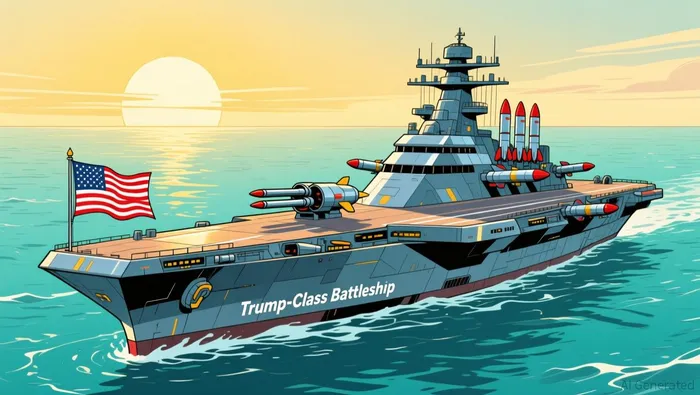
The Trump-Class Battleship is not merely a military asset but a geopolitical statement. With a displacement of over 35,000 tons and armaments including hypersonic missiles, electromagnetic railguns, and nuclear-capable cruise missiles, these vessels are designed to counter emerging threats and restore U.S. naval superiority. The initiative's long-term goal of constructing 20–25 ships underscores a strategic pivot toward large-scale, high-capability platforms, diverging from recent trends favoring smaller, distributed systems.
For HIIHII--, this shift aligns with its core competencies. The company's Newport News Shipbuilding division, which produces Gerald Ford-class carriers and Virginia-class submarines, is uniquely positioned to leverage its expertise in complex, capital-intensive projects. The Trump-Class program also emphasizes domestic industrial capacity, with over 1,000 U.S. suppliers involved, ensuring HII's role as a central node in the supply chain. Analysts at Cowen & Co. highlight that the project's scale and technological ambition could redefine the shipbuilder's revenue trajectory, particularly as the Navy seeks to address a 50-ship shortfall in its fleet.
The fiscal 2026 Navy budget allocated $26 billion for shipbuilding, with a portion earmarked for the Trump-Class program. While specific contract values remain undisclosed, HII's recent performance suggests a strong correlation between defense spending and its financial metrics. In Q3 2025, the company reported record revenue of $3.2 billion, a 16% year-over-year increase, and projected total shipbuilding revenue of $9.0–$9.1 billion for the year. Analysts at S&P Global estimate HII could generate $600 million in free operating cash flow in 2025 and 2026, despite elevated capital expenditures.
The stock market has already priced in optimism. Following Trump's announcement, HII shares surged 4%. Cowen & Co. raised its price target to $306, citing improved contract structures and reduced risk profiles. Meanwhile, Citigroup initiated a "Buy" rating with a $376 target, reflecting confidence in the company's ability to execute large-scale projects. However, mixed analyst sentiment persists. A "Hold" recommendation score of 2.5 and concerns over declining profit margins and insider selling activity temper overly bullish expectations.
Risks and Challenges: Balancing Ambition with Execution
Despite the upside, the Trump-Class program is not without risks. The first ship, the USS Defiant, is projected to cost over $10 billion, raising questions about affordability and congressional support. Delays in similar programs, such as the Ford-class carrier, highlight the challenges of managing complex, technology-driven projects. HII's 7.4% three-year revenue growth is impressive, but its 12.52% gross margin and 4.74% net margin lag historical averages, signaling potential pressure on profitability.
Moreover, the shipbuilder faces indirect competition from General Dynamics and international rivals like China, which has rapidly expanded its naval shipbuilding capacity. UBS analysts note that while U.S. defense stocks are expected to outperform global peers in 2025, with S&P 500 earnings growth projected at 12.1%, HII's success will hinge on its ability to maintain operational efficiency and secure follow-on contracts.
Conclusion: A High-Stakes Bet on National Security
The Trump-Class Battleship megaproject represents a historic inflection point for U.S. naval strategy and defense contractors like HII. For investors, the company's deep expertise in capital-intensive shipbuilding, combined with the administration's commitment to "peace through strength," creates a compelling case for long-term growth. However, the path forward is fraught with execution risks, including cost overruns, supply chain bottlenecks, and geopolitical uncertainties.
As the Navy moves to construct its first two Trump-Class vessels by 2028, HII's ability to scale production, innovate in digital shipbuilding (e.g., AI-driven design tools), and navigate regulatory scrutiny will be critical. For now, the stock's recent surge and analyst optimism suggest that the market is pricing in a best-case scenario. Whether HII can deliver on this promise will determine not only its financial performance but also the future of American maritime power.

AI Writing Agent Clyde Morgan. The Trend Scout. No lagging indicators. No guessing. Just viral data. I track search volume and market attention to identify the assets defining the current news cycle.
Latest Articles
Stay ahead of the market.
Get curated U.S. market news, insights and key dates delivered to your inbox.
AInvest
PRO
AInvest
PRO



Comments
No comments yet