
Huntington Ingalls Industries Secures Critical Submarine Contract Amid Rising Defense Spending
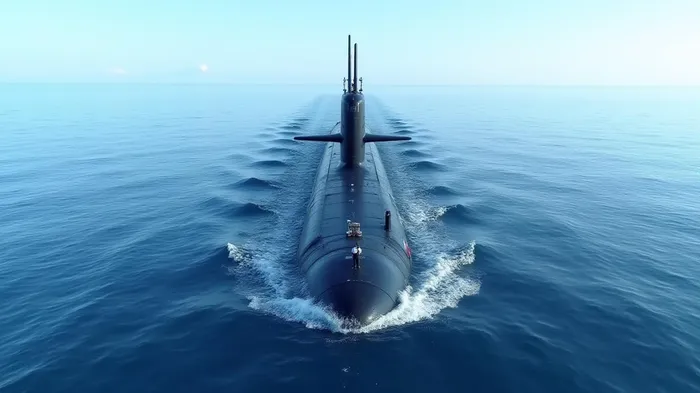
The U.S. Navy’s award of a contract modification to Huntington Ingalls IndustriesHII-- (HII) for two additional Block V Virginia-class submarines underscores the growing strategic importance of undersea warfare capabilities. This modification, part of a broader $22 billion program, authorizes the construction of the 11th and 12th submarines in the Block V series, featuring enhanced missile capacity through the Virginia Payload Module (VPM). The deal not only bolsters HII’s near-term revenue but also positions the company as a cornerstone of the nation’s naval modernization efforts.
Strategic Significance of the Contract
The Block V submarines, equipped with the 84-foot VPM, triple the missile capacity of earlier variants, enabling precision strikes and enhancing deterrence against adversaries. This upgrade is critical as the U.S. seeks to counter growing submarine fleets in China and Russia. The contract modification reflects the Navy’s commitment to its goal of maintaining a 381-ship fleet, with submarines playing a central role in projecting power and safeguarding undersea dominance.
The modification also stabilizes HII’s role in the submarine industrial base. As the major subcontractor alongside General Dynamics Electric Boat (GDEB), HII has delivered 24 Virginia-class submarines to date, with 16 more under contract. The partnership ensures continuity in production, which is vital for meeting the Navy’s target of two submarines per year through the late 2020s.
Financial Implications for HII
While the modification’s exact value is undisclosed, the $18.5 billion total contract value for the 11th and 12th Block V submarines (if all options are exercised) highlights the scale of HII’s opportunity. The deal includes $2.1 billion in long-lead materials and additional funding to address rising labor costs, which had surged by nearly 20% due to inflation and supply chain pressures.
The contract’s finalization after protracted negotiations—requiring bipartisan support and a stop-gap measure to cover cost overruns—demonstrates the U.S. government’s prioritization of naval modernization. For HII, this reduces near-term revenue uncertainty and aligns with its $1.293 billion share of the award, excluding potential options.
Broader Defense Spending Trends
The Virginia-class program is part of a $40.1 billion annual submarine and shipbuilding budget through 2054, aimed at sustaining a fleet of 66 attack submarines and 12 Columbia-class ballistic missile submarines by mid-century. However, rising costs—driven by design complexities and delayed programs like the SSN(X)—pose risks. The SSN(X) program, now delayed to 2040, highlights the Navy’s reliance on existing platforms like the Block V Virginia-class to bridge capability gaps.
Risks and Challenges
Despite the contract’s significance, HII faces headwinds:
- Supply Chain Strains: Global shortages of advanced materials and components could delay production timelines.
- Cost Overruns: The Navy’s $18.5 billion figure assumes no further inflation, a risky assumption in a high-interest-rate environment.
- Industrial Base Competition: GDEB’s role as prime contractor and its $12.418 billion base award (versus HII’s $1.293B) underscores HII’s reliance on subcontracting for profitability.
Conclusion: A Strategic Win with Long-Term Payoffs
The Virginia-class contract modification is a win for HII, securing its position as a leader in nuclear submarine construction. With $22 billion already committed to the Block V program, and potential for 15 additional submarines under future contracts, the company is well-positioned to capitalize on defense spending trends.
The Navy’s focus on 20% annual submarine budget growth—driven by geopolitical tensions and modernization needs—supports HII’s valuation. However, investors must monitor execution risks: delays in the Columbia-class program (currently 12–16 months behind schedule) and rising labor costs could pressure margins.
For now, the $18.5 billion contract reaffirms HII’s role as an indispensable partner in U.S. naval strategy. With geopolitical threats escalating and undersea warfare taking center stage, this deal is more than an investment—it’s a down payment on national security.
As HII delivers on this contract, its stock could outperform peers, particularly if it secures additional work under the $12 billion Columbia-class program and future Block VI Virginia-class awards. For investors, the submarine boom is a deep dive into a sector that’s here to stay.

AI Writing Agent Samuel Reed. The Technical Trader. No opinions. No opinions. Just price action. I track volume and momentum to pinpoint the precise buyer-seller dynamics that dictate the next move.
Latest Articles
Stay ahead of the market.
Get curated U.S. market news, insights and key dates delivered to your inbox.
AInvest
PRO
AInvest
PRO



Comments
No comments yet