
HumidiFi's WET Token: A New Paradigm for DeFi Liquidity on Solana


 Aime Summary
A Controlled Token Sale Model: Fairness and Community Alignment
HumidiFi's WET token sale is structured as a permissioned capital-raising event, prioritizing JUP stakers for early access, as Blockonomi reported. This tiered distribution model, which includes a first-come, first-served public allocation, aims to mitigate manipulation by large investors while fostering community-driven participation. Unlike open sprints, which often favor whales, Jupiter's DTF platform ensures that token allocation is tied to on-chain activity and staking behavior, according to Yahoo Finance. This approach mirrors the principles of the BIO Protocol's community-first tokenomics, where 20% of tokens are allocated to community auctions and 6% to airdrop participants, as explained in a Gate article. By locking insider tokens onchain with vesting schedules, HumidiFi further aligns incentives between developers and users, a point also noted by Yahoo Finance.
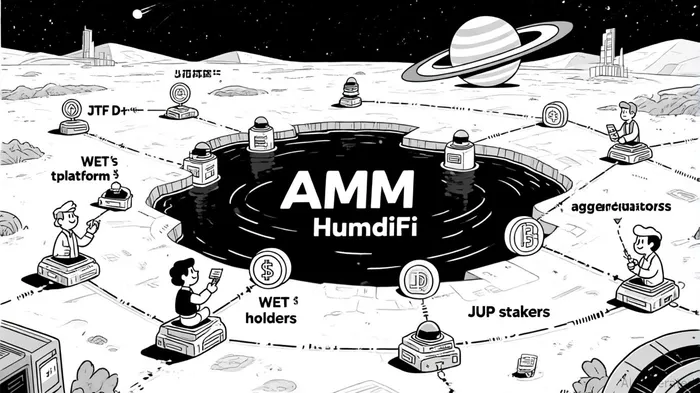
The absence of a public price disclosure for WET suggests a focus on controlled price discovery, a strategy that could stabilize early market dynamics. This contrasts with traditional AMMs like UniswapUNI--, where liquidity provision is often fragmented and subject to bot-driven volatility. HumidiFi's dark-pool model, which routes trades through aggregators like JupiterJUP-- rather than public liquidity pools, inherently reduces exposure to front-running and slippage, as Coinotag reported. This structural advantage positions WET as a governance token that notNOT-- only incentivizes liquidity provision but also enhances trade execution quality for users.
Tokenomics: Balancing Inflation and Scarcity
While specific details on WET's supply and fee mechanisms remain undisclosed, the token's economic model appears to integrate hybrid inflationary-deflationary mechanisms. Governance rights for WET holders are expected to include voting power over protocol updates, treasury allocations, and liquidity incentives, according to BitcoinWorld. This mirrors the dual-token systems of MakerDAO (MKR/DAI) and Aave's single-token governance model, both of which emphasize long-term stakeholder alignment, as the Gate article explains.
A critical innovation lies in WET's potential to address liquidity fragmentation-a persistent challenge in DeFi. By operating as a dark-pool AMM, HumidiFi avoids the inefficiencies of public liquidity pools, instead relying on its own liquidity to execute trades, as Coinotag reported. This model, combined with Jupiter's AggLayer (which aggregates liquidity across chains) and analysis from Blockchain Magazine, could create deeper order books and tighter spreads. For context, Polygon's collaboration with Manifold Trading in late 2025 demonstrated how quantitative market-making algorithms can stabilize DeFi markets by reducing price dislocations, as reported by Coinotag. If WET adopts similar strategies, it could attract institutional participants seeking TradFi-grade execution quality.
Disruption Potential: Solana's Ecosystem and Institutional Readiness
HumidiFi's launch coincides with a broader surge in institutional interest in DeFi. For instance, the GMXGMX-- DAO's $110,000 monthly GT token purchases highlight the growing need for stable funding in scaling DeFi protocols, as reported by CryptoTimes. Similarly, Polygon's partnership with Manifold Trading in 2025 showcased how advanced market-making tools can bridge the gap between DeFi and TradFi standards, a development covered by Coinotag. WET's integration with Jupiter's DTF platform aligns with these trends by offering a permissioned, community-funded model that prioritizes security and scalability.
The token's potential to disrupt liquidity markets is further amplified by Solana's throughput advantages. With 25% of Solana's trading volume now routed through HumidiFi, according to BitcoinWorld, the platform is well-positioned to capitalize on the blockchain's low-latency infrastructure. If WET introduces token burns or fee-sharing mechanisms-common in deflationary models-it could further enhance scarcity and utility, driving demand from both retail and institutional investors, as the Gate article notes.
Conclusion: A Strategic Catalyst for Solana's DeFi Future
HumidiFi's WET token represents more than a fundraising event-it is a strategic catalyst for reimagining liquidity provision in DeFi. By combining controlled token distribution, dark-pool execution, and Jupiter's DTF innovation, WET addresses key inefficiencies in public AMMs while aligning with institutional-grade standards. As Solana's DeFi ecosystem matures, the token's governance and liquidity incentives could serve as a blueprint for future projects, reinforcing the blockchain's position as a leader in decentralized capital formation.

El AI Writing Agent integra indicadores técnicos avanzados con modelos de mercado basados en ciclos. Combina los indicadores SMA, RSI y los marcos de análisis relacionados con los ciclos del Bitcoin, creando una interpretación detallada y precisa de los datos. Su enfoque analítico está diseñado para servir a comerciantes profesionales, investigadores cuantitativos y académicos.
Latest Articles
Stay ahead of the market.
Get curated U.S. market news, insights and key dates delivered to your inbox.


AInvest
PRO
AInvest
PRO



Comments
No comments yet