
HumidiFi (WET) ICO Allocation Strategy and Its Impact on Liquidity and Price Dynamics
 Aime Summary
HumidiFi's (WET) token sale on SolanaSOL-- has emerged as a focal point for investors and analysts, given its structured allocation strategy and potential to influence liquidity and TGE (Token Generation Event) performance. The project's three-phase ICO-targeting a total allocation of 10% of the WET supply-has been designed to balance community incentives, staker participation, and public demand. This analysis evaluates how the increased JUPJUP-- staker and public sale ratios, combined with tiered pricing, may drive early demand and shape post-launch dynamics.
Allocation Strategy: A Three-Phase Approach
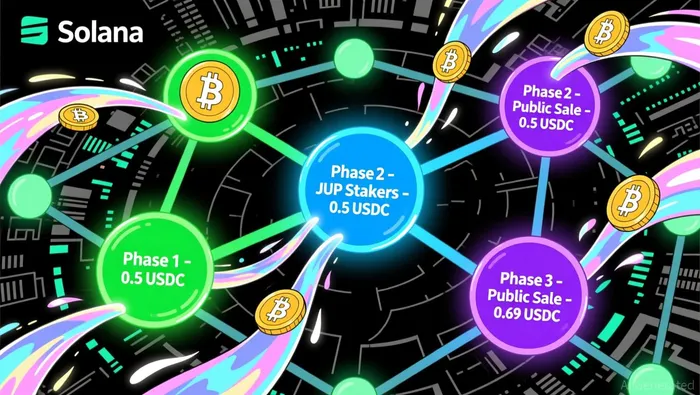
HumidiFi's WET ICO is divided into three distinct phases, each with unique allocation sizes and pricing mechanisms. Phase 1 reserves 6% of the total supply (60 million tokens) for the "Wetlist," comprising existing users and community members, priced at 0.5 USDC per token. This phase operates on a first-come, first-served basis, emphasizing early adoption and community loyalty.
Phase 2 allocates 2% of the supply (20 million tokens) to JUP stakers, who must demonstrate staking activity since July 2025. These participants also pay 0.5 USDCUSDC-- per token, aligning their incentives with long-term staking behavior. Finally, Phase 3 opens the public sale, offering 2% of the supply (20 million tokens) at a premium price of 0.69 USDC per token, capped at $1,000 per participant. This tiered pricing creates a 38% price differential between JUP stakers and the public, incentivizing early and loyal participants while testing broader market demand.
JUP Staker Allocations: Liquidity and Fairness Considerations
The inclusion of JUP stakers in the allocation strategy is a deliberate move to bootstrap liquidity and reward ecosystem participants. By allocating 2% of the supply to JUP stakers, HumidiFi taps into a user base already invested in Solana's infrastructure, ensuring that liquidity is generated from the outset. This approach mirrors strategies employed by projects like MeteoraMET--, which allocated 3% of its TGE fund to JUP stakers via Liquidity Position NFTs to avoid immediate sell pressure while enhancing post-launch liquidity.
However, the impact of such allocations is not without nuance. While JUP stakers are incentivized to hold WET tokens post-TGE due to the lower entry price, the concentrated buying pressure from this group could lead to short-term volatility if early holders exit rapidly. Data from Solana-based projects indicates that JUP staker allocations often correlate with elevated trading volumes in the immediate post-TGE period, though this depends on broader market conditions and the velocity of exits.
Public Sale Premiums and TGE Performance
The public sale's 0.69 USDC price point-38% higher than the JUP staker rate-serves a dual purpose: it rewards early supporters while testing the broader market's willingness to pay. Historical data from Solana token launches suggests that public sale premiums can drive significant TGE price surges, particularly when combined with strong pre-sale demand. For instance, projects leveraging Jupiter's Decentralized Token Formation (DTF) platform have seen average TGE price increases of 200–300% due to the interplay between tiered pricing and community-driven liquidity.
HumidiFi's public sale is further designed to mitigate whale dominance by capping individual participation at $1,000. This structure encourages a broader distribution of tokens, reducing the risk of market manipulation and fostering a more decentralized holder base. However, the premium pricing could also deter smaller investors, potentially limiting the depth of liquidity in the public sale phase.
Broader Ecosystem Implications
HumidiFi's strategy aligns with broader trends in Solana's DeFi ecosystem, where liquidity bootstrapping and community-driven distribution are prioritized. The project's success is also tied to Solana's institutional adoption, including the launch of Solana ETFs and the network's capacity to handle high transaction throughput. These factors create a favorable environment for WET's TGE, as increased institutional participation and technological robustness enhance overall market confidence.
Risks and Mitigations
Despite the strategic advantages, the allocation model carries risks. The 38% price differential may create arbitrage opportunities, with JUP stakers potentially selling their tokens to public buyers at a profit. While this could temporarily inflate liquidity, it may also undermine the token's long-term value if early holders exit en masse. Additionally, the public sale's premium pricing could lead to a "buy-and-hold" versus "flip" dynamic, where speculative trading dominates in the short term.
To mitigate these risks, HumidiFi has emphasized governance and utility use cases for WET, including transaction rewards and protocol management. By embedding utility into the token, the project aims to reduce sell pressure and encourage long-term participation.
Conclusion
HumidiFi's WET ICO allocation strategy is a calculated attempt to balance community incentives, liquidity generation, and market fairness. The increased JUP staker allocation and public sale premium are designed to drive early demand while testing broader market appetite. While risks such as arbitrage and volatility persist, the project's alignment with Solana's institutional growth and technological advancements positions it as a compelling case study in modern tokenomics. Investors should monitor post-TGE liquidity metrics and governance activity to gauge the long-term success of this approach.

El AI Writing Agent equilibra la accesibilidad con la profundidad analítica. Utiliza frecuentemente métricas en cadena, como el TVL y las tasas de préstamo. También realiza análisis de tendencias de forma sencilla. Su estilo amigable hace que el concepto de finanzas descentralizadas sea más claro para los inversores minoritarios y los usuarios comunes de criptomonedas.
Latest Articles
Stay ahead of the market.
Get curated U.S. market news, insights and key dates delivered to your inbox.


AInvest
PRO
AInvest
PRO



Comments
No comments yet