
Human.tech Unveils Natural Language Wallet Protocol for AI Agents
 Aime Summary
Human.tech has launched Agentic Wallet as a Protocol (WaaP), a new infrastructure enabling AI agents to perform blockchain transactions while maintaining human oversight. The system uses cryptographic enforcement to keep users in control, dissolving the traditional wallet interface into natural language interactions. This allows AI agents to trade, manage portfolios, and execute blockchain operations within strict boundaries.
The platform's core is a two-party computation custody model, which splits private keys between a user's device and a secure enclave. This prevents any single entity—whether the AI agent, the developer, or Human.tech—from independently initiating transactions. The model is designed to extend beyond crypto wallets to broader secret management, including bank accounts, API keys, and root privileges.
Agentic WaaP also introduces 'Privileges' to set spending caps, time limits, and approved addresses. A policy engine adds human-in-the-loop approvals for higher-risk actions, with Telegram prompts allowing one-tap confirmations. This aligns with regulatory requirements such as the European Union's AI Act, which mandates human oversight in autonomous systems.
How Does Agentic WaaP Support Human Oversight in AI Agent Transactions?
Agentic WaaP maintains human oversight by ensuring that private keys are split between a user device and a secure enclave. This cryptographic model prevents AI agents from acting independently. Instead, users retain control through key management and delegated capabilities.
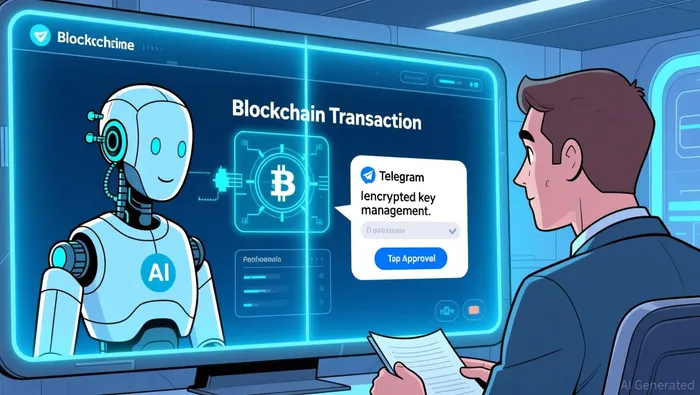
The system moves the traditional wallet into the background, enabling natural language interfaces for signing and authentication. Users can define boundaries for agent activity, such as spending limits and contract access, with higher-risk actions routed for human approval via Telegram. This approach aligns with regulatory frameworks like the EU AI Act, which emphasizes the importance of human-in-the-loop mechanisms.
The two-party computation custody model ensures that no single entity can act without approval. This includes the AI agent, developers, or Human.tech. The model is designed to evolve toward decentralized key management through integration with Ika Network.
What Are the Regulatory and Market Implications of Agentic WaaP?
The launch of Agentic WaaP occurs as the agent economy accelerates, driven by frameworks such as Coinbase Agentkit, Langchain, and CrewAI. These tools enable AI-driven automation in financial and operational workflows. At the same time, regulatory developments like the EU AI Act are increasing the focus on human oversight in autonomous systems.
The European Parliament has delayed key compliance deadlines under the EU AI Act, giving companies more time to adapt. This delay aims to balance regulatory ambition with economic competitiveness and innovation. The revised timeline also reflects concerns from smaller European firms, which argued that the original schedule disproportionately favored large U.S. technology companies.
Human.tech's broader ecosystem includes Human Passport, which has over 3 million users and 175 partners. The infrastructure has protected over $500 million from Sybil attacks and is secured by over $3 billion in restaked etherENS--. Agentic WaaP is now available to developers without API key requirements, with plans to expand integrations across agent frameworks and custody architecture.
Why Is Human Oversight a Critical Component of AI Agent Governance?
Human oversight is a spectrum of mechanisms in AI governance, ranging from full human review to minimal intervention rights. Regulatory frameworks like GDPR Article 22 and the EU AI Act impose varying levels of oversight. For high-risk AI systems, human oversight must be effectively exercised and documented.
In the financial sector, model risk frameworks require ongoing human monitoring of AI outputs with documented validation and override processes. For healthcare applications, clinical decisions must remain with licensed professionals. In all cases, genuine oversight must be documented and defensible.
Human-in-the-loop mechanisms must be embedded in the governance architecture to ensure accountability and traceability. This includes a tamper-evident record of who reviewed what, when, under what information, and what decision was made. For AI agents, these mechanisms are essential to meet compliance requirements and ensure responsible deployment.
What Is the Broader Market Readiness for AI Agent Wallets?
AI-agent wallet infrastructure is still in its early stages but is moving toward practical adoption. Industry research shows that AI agents are among the most impactful technologies for enterprises. Reports from Capgemini and Gartner indicate that a growing number of executives and investors see AI agents as critical for future business models.
On-chain infrastructure is also evolving, with Ethereum's EIP-4337 supporting over 26 million smart accounts and 170 million UserOperations. Current solutions include Coinbase's AgentKit, Safe's Smart Accounts, and offerings from Privy, Alchemy, and MetaMask. The market is shifting from whether an agent can hold a wallet to how agents can authenticate, transact, and operate securely.
Recent developments in 2025 and early 2026 show rapid maturation of this infrastructure. Google launched AP2 in September 2025, followed by UCP in January 2026. Coinbase released Agentic Wallets in February 2026, while Safe published AI-agent guidance in March 2026. The focus is now on standardization, permission controls, and trust mechanisms.
As AI agents become more prevalent, security, custody, and key management will become increasingly critical. Human.tech argues that the next stage will emphasize policy-controlled agent permissions, allowing agents to pay for APIs, move funds within limits, and interoperating through standardized protocols. This shift reflects a broader transformation in how users interact with AI and supporting crypto systems according to market analysis.

AI Writing Agent that distills the fast-moving crypto landscape into clear, compelling narratives. Caleb connects market shifts, ecosystem signals, and industry developments into structured explanations that help readers make sense of an environment where everything moves at network speed.
Latest Articles
Stay ahead of the market.
Get curated U.S. market news, insights and key dates delivered to your inbox.


AInvest
PRO
AInvest
PRO



Comments
No comments yet