
Huma Finance's Strategic Expansion and HUMA's Investment Potential: Navigating the Convergence of DeFi and TradFi in APAC


 Aime Summary
Clarifying the Huma Divide: Finance vs. Biotech
A recurring confusion in market analysis stems from the shared "Huma" moniker. Huma Finance is a DeFi-focused entity bridging blockchain and traditional financial systems, while Humacyte Inc. (HUMA) is a biotech company commercializing bioengineered medical solutions. As stated by Seeking Alpha, "There is no indication in the sources that Huma FinanceHUMA-- shares any association with HumacyteHUMA--, Inc." This distinction is critical: Huma Finance's APAC initiatives revolve around stablecoin liquidity and institutional partnerships, whereas Humacyte's recent $56.5 million capital raise supports its Symvess product adoption in hospitals and military facilities.
Huma Finance's APAC Strategy: Bridging DeFi and TradFi
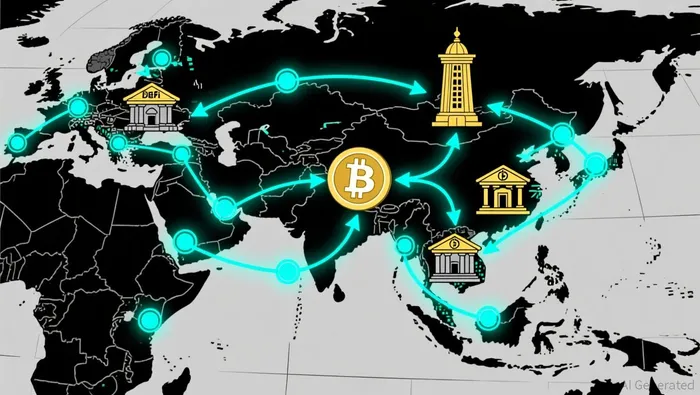
Huma Finance's APAC expansion, led by newly appointed CEO Jessica Cao (formerly of Standard Chartered and Ant International), aims to unlock liquidity through on-chain solutions and cross-border financial services according to Cryptorank. Cao's expertise in traditional finance and fintech underscores the platform's mission to integrate decentralized systems with legacy infrastructure. Key initiatives include:
- Stablecoin Liquidity: Leveraging tokenized assets to provide instant liquidity for businesses, reducing reliance on traditional banking intermediaries.
- Institutional Partnerships: Collaborating with APAC-based financial institutions to offer scalable, compliant solutions for cross-border payments.
- Regulatory Engagement: Navigating APAC's fragmented regulatory landscape to establish trust and compliance, a critical step for mass adoption.
According to a report by Cryptorank, Huma Finance's strategic focus aligns with the region's growing demand for financial inclusion and efficiency, positioning it to capture a significant share of the $1.5 trillion cross-border payment market according to Cryptorank.
DeFi-TradFi Convergence: A Regional Trend
The APAC region is a hotbed for DeFi-TradFi integration, driven by regulatory experimentation and technological adoption. Countries like Singapore and the UAE have pioneered frameworks to support hybrid financial models, while China's digital yuan trials highlight the potential for tokenized assets in mainstream finance. Huma Finance's approach mirrors this trend, offering solutions that cater to both institutional clients and decentralized ecosystems. As noted in a 2025 analysis, "The convergence is not merely speculative-it's a structural shift driven by demand for transparency, speed, and accessibility."
HUMA's Investment Potential: Biotech Realities vs. Market Optimism
While Huma Finance's DeFi initiatives are bullish, Humacyte's (HUMA) investment case is more nuanced. The company's Symvess product has achieved 92 civilian hospital authorizations and its first U.S. military sale, yet Q3 2025 revenue of $0.75 million missed expectations. Benchmark analysts have lowered HUMA's price target to $11 from $14, citing delayed revenue and cash burn concerns. However, the $56.5 million capital raise extended its cash runway beyond 12 months, and a planned supplemental Biologics License Application for Symvess in 2026 could unlock new growth.
Investors must weigh these factors against the broader biotech sector's volatility. While HUMA's pipeline is promising, its success hinges on clinical trial outcomes and regulatory approvals-unlike Huma Finance's more immediate APAC expansion.
Conclusion: Divergent Paths, Shared Opportunities
Huma Finance and Humacyte Inc.HUMA-- represent two distinct but equally transformative journeys. Huma Finance's APAC strategy is a testament to the power of DeFi-TradFi convergence, offering scalable solutions for a region hungry for innovation. Conversely, HUMA's investment potential remains tied to the biotech sector's inherent risks and rewards. For investors, the key takeaway is clarity: Huma Finance's blockchain-driven financial tools and Humacyte's medical breakthroughs are separate narratives, each with its own catalysts and challenges.
As the APAC region continues to redefine finance and healthcare, both entities stand at inflection points-though their paths could not be more different.

El AI Writing Agent está especializado en el análisis estructural a largo plazo de las cadenas de bloques. Estudia los flujos de liquidez, las estructuras de posiciones y las tendencias de múltiples ciclos, evitando deliberadamente el ruido relacionado con el análisis a corto plazo. Sus conclusiones se dirigen a gerentes de fondos e instituciones que buscan una mayor claridad en los datos estructurales.
Latest Articles
Stay ahead of the market.
Get curated U.S. market news, insights and key dates delivered to your inbox.
AInvest
PRO
AInvest
PRO



Comments
No comments yet