

CoreWeave just signed its second top-tier quantitative tenant in four months. That is real evidence that the demand side of the AI-infrastructure thesis holds. The capital structure — deeply negative free cash flow against tens of billions of debt-funded capex — is a separate question this deal does nothing to settle. Verdict: proceed with caution.
The deal settles the demand debate, not the balance-sheet debate
Two of the most sophisticated compute buyers in the world have now signed multi-year cloud commitments with CoreWeaveCRWV-- within the span of roughly four months — Jane Street in April, Hudson River Trading this week. The latter is a private quantitative trading firm that handles roughly 10% of US stock-trading volume, with 2024 net trading revenue of nearly $8 billion. Both are building their next-generation research platforms on CoreWeave Cloud.
The stock's muted reaction tells you most of what you need. Shares traded around $90 as the announcement landed, essentially flat on the day, and the stock remains down more than 15% over the past five sessions while still up about 25% year to date. Investors shrugged, and I believe they shrugged for the right reason: demand was never the contested variable. Put plainly, this deal validates the demand side of CoreWeave's thesis — genuine breadth, genuine tenant quality, genuine durability. What it does not resolve is the capital-structure question that has hung over this company since its IPO. My verdict: proceed with caution. This is evidence; it is not the all-clear.
What Hudson River Trading actually signed up for
The architecture is the tell. HRT will run its next-generation quantitative research platform on clusters of NVIDIA Vera Rubin NVL72 and HGX B200 GPU systems, connected to its own on-premises environment through low-latency Spectrum-X Ethernet Direct Connect. The workloads are training and large-scale model development — the compute-and-noise-hungry model building a quant firm does — rather than pure inference. CoreWeave disclosed no dollar value and no contract length; financial press reports describe a multi-billion-dollar agreement spanning several years. CoreWeave frames the win as a breakthrough into the financial-services vertical, with Chief Revenue Officer Jon Jones calling financial services "one of the most demanding proving grounds for AI."
This is the most durable category of tenant a GPU cloud can sign, and that judgment rests on mechanics, not hype. HRT is building its research platform — its models, its workflows, its data pipelines — on CoreWeave's hardware and networking. Once a mission-critical, latency-sensitive workload is re-platformed, the switching cost is enormous. And because the compute starts with training, the revenue is reservation-backed and predictable rather than usage-variable. High switching costs plus predictable consumption are exactly the properties that make contracted revenue durable.
From a one-customer story to a portfolio of tenants
The original bear case on CoreWeave was simple and fair: at IPO, the S-1/A disclosed that its largest customer accounted for 62% of 2024 revenue, up from 35% the year before — a concentration that briefly made CoreWeave look like a pass-through for OpenAI's compute appetite. A single-tenant GPU cloud is a pass-through that lets someone else's capex wear your nameplate. The diversification built since April is the counter-evidence, and it is worth laying out in full because the shape is the point.
Jane Street committed approximately $6 billion of AI cloud compute in April and took a $1 billion equity stake at $109 per share. Meta is spending an additional $21 billion with CoreWeave. Anthropic signed a multi-year agreement. And on top of all of it, CoreWeave finished the second quarter with a $104 billion contracted backlog as of June 30, 2026, a figure that excludes more than $25 billion of net new commitments added in early Q3 across AI labs, hyperscalers, and enterprises.
One honesty check: the current OpenAI share of revenue is not attested in anything I can verify — only the 62% figure from the IPO-era S-1/A. The diversification thesis rests on the magnitude of the new commitments and the backlog, not on a published current-concentration number. I am watching for that number to fall; that is a watch signal, not a fact I can lean on yet.
Quant and HFT tenants harden this exact weakness. Jane Street and Hudson River Trading both start with training-heavy model development — noisy, mission-critical workloads that hybridize onto the cloud from on-premises infrastructure and scale as their model ambitions grow. These are not price-shopping inference customers. Two of the largest quantitative firms in the world anchoring within four months is genuinely de-risked revenue, not headline noise.
The revenue is real — and so is the margin creep
On the numbers, the demand side holds on every axis. CoreWeave closed 2024 with a $747 million quarter and grew to $2.575 billion by Q2 2026, up 113% year over year and above the roughly $2.56 billion consensus, with total-company revenue accelerating sequentially as well. The demand driver is straightforward: demand for purpose-built AI cloud capacity continues to exceed available supply, per Futurum Research.
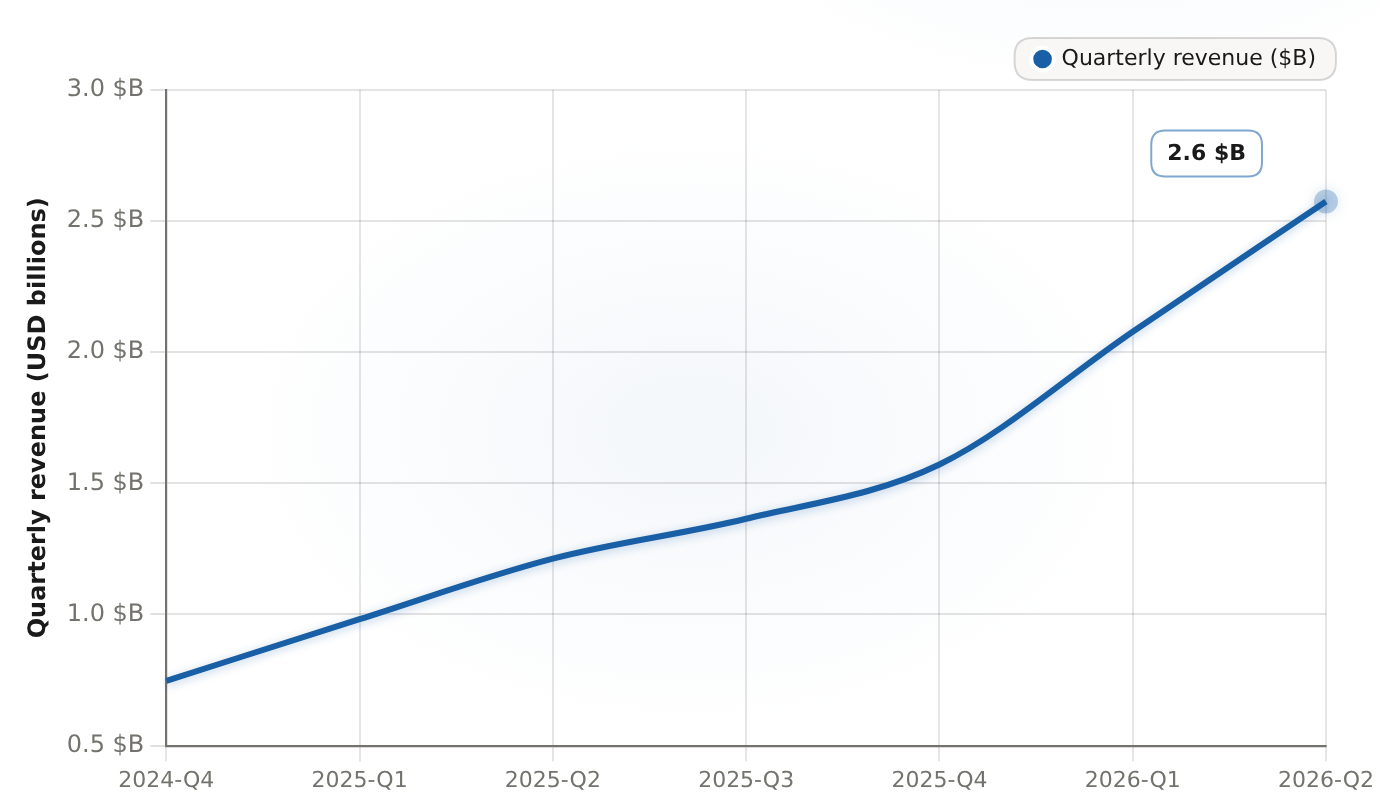
Revenue roughly triples across the window, with clear acceleration in 2026 (Q2'26 revenue of $2.575B, up 113% year over year).
| Period | Quarterly revenue ($B) |
|---|---|
| 2024-Q4 | 0.747 |
| 2025-Q1 | 0.982 |
| 2025-Q2 | 1.213 |
| 2025-Q3 | 1.365 |
| 2025-Q4 | 1.572 |
| 2026-Q1 | 2.078 |
| 2026-Q2 | 2.575 |
The quality softens one level down. Adjusted EBITDA — earnings before interest, taxes, depreciation, and amortization, a rough proxy for cash earnings — was $1.51 billion in Q2, a 59% margin, down from 62% a year earlier. Adjusted operating income ran at a 5% margin, down from 16%, and the quarter still produced a $626 million net loss. The revenue hockey-stick is real; the profitability slope points the wrong way. That combination — tripling revenue while margins compress — is the fingerprint of an operator buying growth with scale commitments.
The forward view keeps the same shape. CoreWeave raised full-year 2026 revenue guidance to $12.4–13.2 billion, with adjusted operating income of $960 million to $1.15 billion and capex of $35–39 billion. One transparency note: that guidance comes from a secondary aggregator, not the extracted earnings-release text, so I am treating it as directional rather than locked. But the direction — a roughly 150% revenue step-up in year two — tells you how much of the return curve management is pricing into the back half of 2026.

Where CoreWeave sits in the AI-cloud hierarchy
Positioning first. The hyperscalers — Amazon's AWS, Microsoft's Azure, Google Cloud, and Oracle's OCI — all sell AI compute, but CoreWeave runs a structurally different model: a pure-play, purpose-built AI cloud with no general-purpose baggage and a direct line to NVIDIA's newest silicon. Oracle is the most direct structural rival, racking up GPUs through OCI the same way, and its roughly 6.1x price-to-sales multiple is the closest hyperscaler-scale peer to CoreWeave's. Per Ainvest's peer screen, CoreWeave trades at about 6.5x trailing sales and 21x trailing EV/EBITDA — enterprise value divided by adjusted EBITDA, roughly the price the market charges for each dollar of cash-earnings proxy. Microsoft sits at about 11x sales and 18x, Amazon at 3.6x sales and 17x, Alphabet at 9.3x sales and 23x.
The comparison that tells you the most is the one that does not quite work: Nebius, the other public pure-play GPU cloud, trades at roughly 44x sales and a distorted 394x EV/EBITDA, a multiple built on near-zero trailing EBITDA rather than a clean comparable. Set that aside. Against the hyperscalers, CoreWeave's 21x against Amazon's 17x and Microsoft's 18x is the number to interrogate. The hyperscalers carry multiples this high while also generating the free cash flow that funds their buildouts. CoreWeave carries a comparable multiple while still burning cash — the equivalent of paying steady-state financials before the company has produced a steady state.
However — the capital structure is the question this deal does not touch
Here is the flywheel, and here is where it can break. CoreWeave borrows heavily — more than $10 billion of new unsecured debt and convertibles in Q2, plus a milestone $3.1 billion HPC-infrastructure-backed term loan — to buy GPUs and pre-build data centers. The capex is enormous: $6.4 billion in Q2 alone, $14.1 billion in the first half, $35–39 billion planned for the full year. The leverage picture: per Ainvest data, net debt is around $29.5 billion, while TIKR pegs trailing net debt at roughly $33 billion and CNBC reported about $35 billion on the balance sheet. The scope varies by source — some include leases and other obligations — but the direction does not.
The offsetting asset is that $104 billion of contracted backlog, but the word "contracted" does heavy lifting. Backlog is committed revenue, not recognized revenue; conversion depends on GPU delivery, power transmission, and build schedules. CoreWeave has roughly 1.5 GW of active power against roughly 3.7 GW of contracted power — it has signed up to deliver significantly more capacity than it can currently energize. And the trailing-twelve-month free cash flow, the cash the business actually produces after keeping the lights and the data centers on, is roughly negative $13.6 billion per Ainvest data.
Now put the two halves together. The flywheel works exactly as long as contracted backlog converts into revenue faster than the debt-funded buildout comes due. It breaks if conversion lags, if tenants cancel or reshape contracts, or if pricing competition compresses margins — and margins are already compressing, from 62% to 59% adjusted EBITDA year over year. With trailing twelve-month free cash flow near negative $14 billion against $35–39 billion of fiscal 2026 capex, leverage flips from accelerant to binding constraint on the first soft datapoint. The competitive signals are creeping in, too: CNBC has reported SpaceX selling excess compute capacity and Meta weighing whether to launch its own cloud. Demand today is not the issue. The issue is whether the whole structure converts before the leverage binds.
What I am watching, and what breaks the thesis
Concrete watch signals:
- The pace of diversification. New named multi-year tenants keep arriving; the test is whether the current OpenAI share — unattested, remember — is actually coming down.
- Contract duration and GPU mix. Training-heavy Vera Rubin reservations like HRT's are the durable kind; a drift toward usage-variable managed inference invites pricing risk.
- Debt refinancing and cash runway. Can the company keep funding a multi-billion-dollar buildout without dilutive equity or distress?
- Margin direction. Another quarter at or below 59% adjusted EBITDA turns the burn structural rather than cyclical.
- Capacity relative to contracts. Whether the gap between the roughly 3.7 GW contracted and roughly 1.5 GW active closes on schedule.
- Backlog conversion. Whether the $104 billion turns into recognized revenue at the promised cadence.
The thesis breaks if any of these arrive: re-concentration back onto a single customer; margin compression from hyperscaler discounting or price competition; leverage becoming untenable when free cash flow of roughly negative $14 billion meets $35–39 billion of annual capex; GPU supply disruption around Vera Rubin timing; or cancellation and reshaping of contracted commitments.
Where the capital goes from here
Long-term, my view is unchanged: CoreWeave sits on the right side of the transition to purpose-built AI cloud, with the most demanding customers in the world under contract and a demand story this deal substantially validates. That much is settled.
But the return profile is now back-half weighted on flawless execution of a debt-funded buildout, and the market already prices that perfection in at 21x EV/EBITDA. The debate is not whether CoreWeave stays important. It is whether the capital structure lets the $104 billion backlog convert before leverage becomes the binding constraint — and one tenant, even a tenant like Hudson River Trading, cannot answer that. I would not add to a position on this news, and I would not add before net debt stops growing faster than revenue or the margin line stops falling. This is a name to own at smaller allocation and re-evaluate against the watch list above — not a headline to chase.








Comments
No comments yet