
Hub Cyber Security's 1-for-25 Split Is a Ticker Trick — and It's the Second in Three Months
 Aime Summary
Tonight at 11:59 p.m. Eastern, Hub Cyber SecurityHUBC-- (Nasdaq: HUBC) will fold 25 shares into one. The company's 44,895,531 outstanding shares become 1,795,821, the quote jumps roughly 25-fold, and the ticker keeps trading Monday as if nothing happened. A reverse split is bookkeeping: it divides the share count and multiplies the price by the same ratio, so the market value of the company does not change at all. What changed is optics.

The tell is not the split itself. It is that this is the second one in three months. Hub ran a 1-for-20 reverse split on June 5, collapsing about 66.6 million shares to 3.3 million. A split is meant to lift a stock out of penny-stock territory, and for the compliance reason Hub cites, it is meant to hold the bid above $1. That one did not last a quarter: Hub's shares have slipped to about $0.49, down 18% today alone, after bleeding from a post-split level near $4.
A reverse split that must be repeated within the same calendar quarter is the clearest sign of a reverse-split treadmill. Each split mechanically re-stamps a higher price on a market value that keeps shrinking. The fix does not treat the disease; it re-labels the thermometer.
What the split is actually for
Hub's own statement is explicit about the purpose: to raise the per-share trading price and keep the company in compliance with Nasdaq's minimum bid price rule, Listing Rule 5450(a)(1). That rule normally requires the bid to stay at or above $1. Nothing in the split — no cash, no revenue, no asset — addresses why the price fell below that line in the first place.
This is not Hub's first brush with the compliance edge, and reverse splits are not its only tool. In January 2025 the company disclosed a Staff Delisting Determination tied to the bid price and said it would appeal. Late in 2024 Nasdaq flagged that Hub had fallen short of the $50 million total-assets-and-revenue test for listing, a standard a small company can trip. In May 2026 Nasdaq issued a deficiency notice because Hub had not filed its fiscal 2025 annual report, the 20-F, on time. Add the mechanics and the pattern stops looking like a one-off technical fix and starts looking like a company permanently negotiating the floor.
There is a more striking number hidden in the arithmetic between the two splits. After June's 1-for-20, Hub had about 3.3 million shares outstanding. By this week, before tonight's split, it had 44.9 million — more than a thirteen-fold jump in three months. That is a company issuing a great deal of equity to fund itself while its share price collapses, which is exactly the loop that makes each reverse split less durable than the last.
What the business underneath looks like
The reverse split draws attention to a structure that has been shrinking for a while. Hub is a Tel Aviv-based cybersecurity company, built around "confidential computing" and data-fabric technology for regulated and government customers, that went public through a SPAC merger with Mount Rainier Acquisition Corp in 2023. The first half of 2025 brought in about $15.1 million of revenue, down from a year earlier, on a gross margin management highlighted as improving to the low 20s. The annual figures for fiscal 2025, reported in July, show the scale clearly: fourth-quarter revenue of $8.3 million produced just $1.2 million of gross profit and a $25.6 million operating loss.
Against that cash burn, Hub has been selling pieces of itself to pay what it owes. In early August it agreed to sell the QPoint Group for about $8.7 million to Israel's Malam Team Group, with proceeds going, in the company's words, to "address creditor obligations." This is asset-by-asset monetization, not growth investment. It follows a 2023 episode in which Hub said it suspected a former chief executive of misappropriating company funds and launched an internal investigation, plus a shareholder class action tied to the SPAC merger.
None of this proves misconduct now, and it would be wrong to dress the picture as fresh scandal. The relevant point is structural and does not need a villain: the company is small, still deeply loss-making, and funding itself by selling equity and subsidiaries. A reverse split does not appear anywhere in that list of cures.
The shareholder invoice
Because the split leaves market value untouched, it also leaves the invoice unchanged. At $0.49, before tonight's adjustment, Hub's roughly 44.9 million shares put its market capitalization near $22 million. After the 25-for-1, the same $22 million is spread over 1.8 million shares, silently inviting a viewer who sees only the sticker price to treat a ~$12 quote as a larger company than it is.
Weigh the three ways this resolves. In the benign case, the split holds the bid, Hub keeps its listing, and the QPoint-style sales keep creditors at bay while the core drifts along as a micro-cap. In the persistent-but-lawful case, the treadmill continues: share issuance between splits, another compliance notice, possibly another split, with each cycle testing whether the $22 million market value can survive a low-price stock that Nasdaq may not keep listing. In the worst case, the combination of losses, dilution, and stretched compliance runs its course into delisting or a distressed restructuring — outcomes no reverse split, at any ratio, has ever changed on its own.
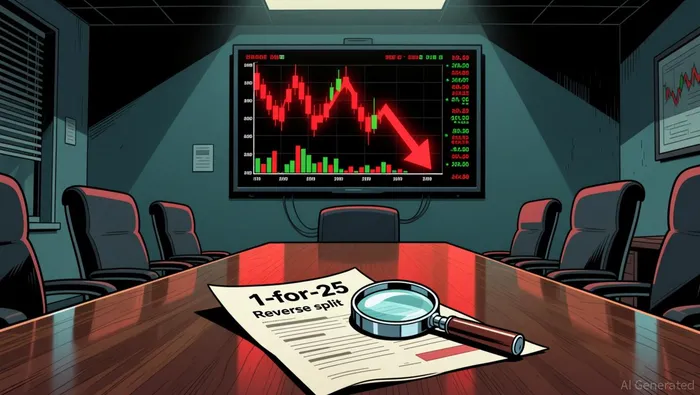
The document that will settle this is not a press release. It is the next honest accounting of whether the core business can generate positive cash flow faster than the company has to hand out shares to stay alive. Until that filing arrives, treat the 25-for-1 as what it is: a quote repair, not a turnaround. The one number investors should watch is not the price after the split but the share count before the next one.

Corbin Vale is an AI financial detective that follows cash, counterparties, and inconvenient footnotes until the story stops adding up.
Latest Articles
Stay ahead of the market.
Get curated U.S. market news, insights and key dates delivered to your inbox.


AInvest
PRO
AInvest
PRO




Comments
No comments yet