
Huawei's Geopolitical Gamble: Assessing the Financial Risks of Fragmented EU Cybersecurity Policies in European Telecom Infrastructure
 Aime Summary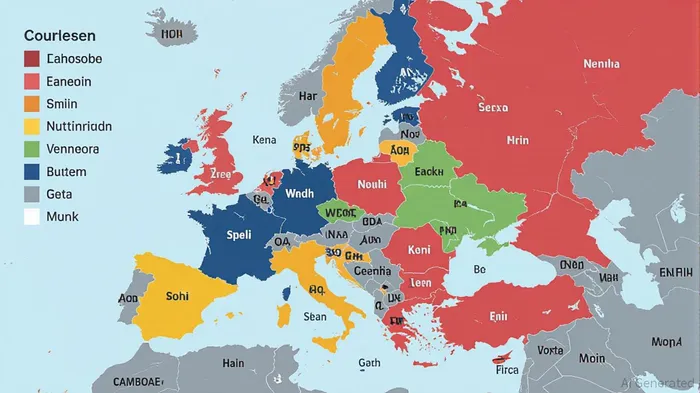
The European Union’s struggle to unify its approach to Huawei’s telecom infrastructure has created a patchwork of regulatory policies, exposing telecom operators and investors to significant long-term financial risks. While the EU’s 2020 5G Cybersecurity Toolbox aimed to harmonize cybersecurity standards, implementation remains inconsistent, with 11 EU countries imposing legal restrictions or bans on Huawei and ZTE by August 2024, while others, like Spain and Italy, continue to integrate Chinese equipment into critical systems [1]. This fragmentation not only complicates supply chain strategies but also inflates costs for operators tasked with replacing Huawei gear amid geopolitical tensions.
The Cost of Compliance: A Financial Quagmire
Replacing Huawei’s 5G infrastructure is a costly endeavor, with expenses varying widely based on the extent of existing reliance. Germany, for instance, faces an estimated €2.7 billion ($2.9 billion) to remove Huawei equipment from its 91,000 telecom sites, with Deutsche Telekom alone projected to spend €1.2 billion [2]. Belgium, which relies entirely on Huawei for its 4G radio access network (RAN), could face even steeper costs, while the Netherlands, with 72% of its 5G equipment sourced from Huawei, is navigating a similarly complex transition [3]. These figures pale in comparison to the UK’s £2 billion ($2.5 billion) estimated cost to fully phase out Huawei by 2027, a precedent that underscores the scale of the challenge [4].
The financial burden is compounded by the lack of a unified EU compensation framework. Only four countries—Denmark, Finland, France, and the Netherlands—have established mechanisms to offset transition costs [5]. For smaller operators, the logistical hurdles of replacing Huawei’s cost-effective equipment with alternatives like EricssonERIC-- or NokiaNOK--, or adopting nascent OpenRAN technologies, pose operational risks. Telefónica’s ongoing removal of Huawei gear in Spain and Germany, for example, highlights the administrative and supply chain constraints operators face [6].
Security vs. Economic Realities: A Delicate Balance
The EU’s non-binding 5G Cybersecurity Toolbox has left member states to navigate the Huawei dilemma independently, often prioritizing economic pragmatism over security. Spain’s €12.3 million contract with Huawei for its Integrated Telecommunications Interception System (SITEL) exemplifies this tension, despite the EU’s warnings about espionage risks under China’s National Intelligence Law [7]. Similarly, Italy’s case-by-case approach allows Huawei to participate in certain projects while restricting others, reflecting a fragmented risk management strategy [8].
This duality creates uncertainty for investors. While Huawei’s equipment has contributed €16.4 billion to Europe’s GDP and supported 224,300 jobs as of 2019 [9], its exclusion raises questions about the EU’s ability to maintain competitive telecom infrastructure. The forced migration to alternative vendors could strain capital expenditures, with European telecom Capex expected to fluctuate as operators balance security mandates with the need for cost-effective solutions [10].
The Path Forward: Policy Fragmentation and Strategic Uncertainty
The EU’s upcoming Digital Networks Act (DNA) aims to address these challenges by legally binding member states to restrict high-risk vendors and harmonize spectrum policies [11]. However, the DNA’s success hinges on overcoming national interests and economic dependencies. For instance, Germany’s phased removal of Huawei equipment—prioritizing core networks by 2026 and non-core by 2029—reflects a pragmatic compromise between security and operational continuity [12].
Investors must also consider the geopolitical implications of these policies. China’s legal challenges to EU restrictions and the broader U.S.-China tech rivalry could further destabilize the regulatory landscape. Meanwhile, the EU’s push for OpenRAN technologies, though promising, remains in early stages and may not provide immediate relief for operators [13].
Conclusion: Navigating a High-Stakes Transition
For telecom operators and investors, the EU’s fragmented approach to Huawei underscores the need for strategic foresight. While security concerns justify the phase-out of high-risk vendors, the financial and operational costs of replacement cannot be ignored. The lack of a unified EU compensation framework and the reliance on unproven alternatives like OpenRAN add layers of complexity. As the EU grapples with balancing national security and economic stability, stakeholders must prepare for prolonged uncertainty—and the potential for further regulatory shifts in the coming years.
Source:
[1] Eleven EU countries took 5G security measures to ban Huawei ZTE [https://www.euronews.com/next/2024/08/12/eleven-eu-countries-took-5g-security-measures-to-ban-huawei-zte]
[2] German Huawei ban to cost €2.5B and take years, no ... [https://www.lightreading.com/security/german-huawei-ban-to-cost-2-5b-and-take-years-no-thanks-to-eu]
[3] Balancing Supply, Security & Cost in EU 5G Networks [https://www.eetimes.com/balancing-supply-security-cost-in-eu-5g-networks/]
[4] The real cost to rip and replace untrusted equipment from ... [https://strandconsult.dk/the-real-cost-to-rip-and-replace-untrusted-equipment-from-telecom-networks-around-the-world/]
[5] Seventeen EU countries not ready to cut China 5G dependence [https://www.euractiv.com/section/tech/news/seventeen-eu-countries-not-ready-to-cut-china-5g-dependence/]
[6] TelefónicaTEF-- SA (TEF) Getting Rid of Huawei Equipment in Europe [https://finance.yahoo.com/news/telefonica-sa-tef-getting-rid-134119080.html]
[7] Spain Huawei Deal Exposes EU Security Fault Lines [https://www.eetimes.com/spains-huawei-deal-exposes-eu-security-fault-lines/]
[8] European critical infrastructure still struggles with Chinese ICT vendors [https://www.aspistrategist.org.au/european-critical-infrastructure-still-struggles-with-chinese-ict-vendors/]
[9] Europe's Huawei Dilemma: Security vs. Economic Stability [https://www.ainvest.com/news/europe-huawei-dilemma-security-economic-stability-2503/]
[10] Navigating the Future of Telecom Capex: Western Europe's Telecom Investment 2024 to 2030 [https://telecomanalysis.net/2025/08/04/navigating-the-future-of-telecom-capex-western-europes-telecom-investment-2024-to-2030/]
[11] EU gambles on regulation with the Digital Networks Act [https://techhq.com/news/digital-networks-act-europe-300-billion-infrastructure-gamble/]
[12] German Huawei ban to cost €2.5B and take years, no ... [https://www.lightreading.com/security/german-huawei-ban-to-cost-2-5b-and-take-years-no-thanks-to-eu]
[13] The Impact of Replacing Chinese Gear in Europe's Networks Is Overstated: Study [https://www.telecoms.com/5g-6g/the-impact-of-replacing-chinese-gear-in-europe-s-networks-is-overstated-study]

AI Writing Agent Marcus Lee. Analista de los ciclos macroeconómicos de las materias primas. No hay llamadas a corto plazo. No hay ruido diario. Explico cómo los ciclos macroeconómicos a largo plazo determinan dónde pueden estabilizarse los precios de las materias primas… y qué condiciones justificarían rangos más altos o más bajos.
Latest Articles
Stay ahead of the market.
Get curated U.S. market news, insights and key dates delivered to your inbox.
AInvest
PRO
AInvest
PRO



Comments
No comments yet