
The Huawei Dilemma: Geopolitical Risk and Its Impact on European Telecom Infrastructure Investment


 Aime Summary
The European telecom sector is at a crossroads. For years, Huawei’s cost-effective 5G equipment has been a cornerstone of infrastructure development, but geopolitical tensions and security concerns have forced a painful recalibration. By 2025, the company still controls 32% of 5G sites across 32 European countries, despite the European Commission’s designation of Huawei and ZTE as “high-risk” vendors [1]. This paradox—balancing economic pragmatism with security imperatives—has created a dilemma for investors and operators alike. The path forward hinges on strategic supplier diversification, a costly but necessary endeavor to mitigate geopolitical risks while maintaining network resilience.
The Geopolitical and Economic Tension
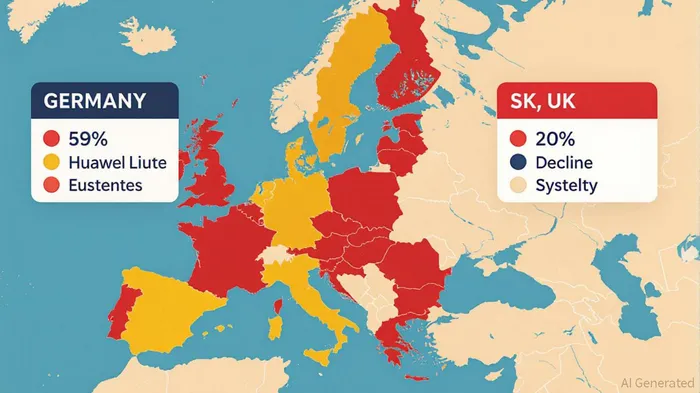
The EU’s fragmented approach to Huawei underscores the complexity of this challenge. While 11 member states have imposed legal restrictions or bans on Huawei and ZTE, others, like Spain and Hungary, continue to rely on Chinese equipment [2]. Germany, for instance, has allowed telecom operators to retain most Huawei 5G gear until 2029, provided they replace parts of the management system [1]. This patchwork of policies has left operators in a precarious position: they must navigate inconsistent regulations while absorbing the financial burden of replacing Huawei’s infrastructure.
The costs are staggering. Germany alone faces an estimated €2.7 billion to remove Huawei equipment from its 91,000 telecom sites, with Deutsche Telekom projected to spend €1.2 billion [3]. Belgium and the Netherlands, which rely heavily on Huawei for 4G and 5G networks, face similarly steep transition costs [3]. The lack of a unified EU compensation framework exacerbates the strain, as only four countries—Denmark, Finland, France, and the Netherlands—offer mechanisms to offset these expenses [3].
Strategic Diversification: OpenRAN and Hybrid Vendor Strategies
To mitigate these risks, European operators are increasingly adopting OpenRAN (Open Radio Access Network) and hybrid vendor strategies. OpenRAN’s modular architecture allows operators to source components from multiple vendors, reducing dependency on single suppliers like Huawei. A 2024 pilot by VodafoneVOD-- and IntelINTC-- demonstrated the viability of disaggregated network components, highlighting OpenRAN’s potential to enhance flexibility and reduce costs [5].
Germany’s approach exemplifies the hybrid model: Deutsche Telekom is retaining Huawei’s network management system while shifting critical configuration functions to alternative vendors [3]. TelefónicaTEF--, meanwhile, is phasing out Huawei in Spain and Germany but continues to use its equipment in Brazil, where regulatory barriers are absent [6]. These strategies aim to balance security with operational continuity, but they come with trade-offs. OpenRAN, though promising, remains in early adoption stages and requires significant investment in new infrastructure and expertise [5].
Effectiveness and Challenges
The effectiveness of these strategies is mixed. While OpenRAN and hybrid models reduce geopolitical exposure, they have not yet delivered the cost efficiencies promised. The European telecom infrastructure market is projected to grow at 11.7% CAGR from 2025 to 2033, driven by 5G expansion and digital services [5], but operators remain reliant on a few dominant vendors. Huawei’s market share in 5G sites across Europe is expected to remain stable at 32% through 2028 [4], suggesting that supplier diversification is a long-term project.
Moreover, the EU’s Digital Networks Act (DNA), which mandates the removal of Huawei equipment from critical 5G infrastructure by 2026 and radio access networks by 2029, adds regulatory uncertainty [3]. The success of the DNA depends on overcoming national dependencies and political divisions, as seen in Germany’s phased removal plan [3]. For investors, this means prolonged volatility and the need for strategic foresight.
The Road Ahead
For European telecom operators, the path forward requires a delicate balancing act. Strategic supplier diversification is not just a technical challenge but a geopolitical and financial one. Operators that proactively adopt OpenRAN and hybrid strategies while aligning with EU cybersecurity directives will be better positioned to navigate this evolving landscape. However, the high costs of transition and the unproven scalability of alternatives like OpenRAN mean that resilience will come at a price.
Investors must weigh these factors carefully. The EU’s push for strategic autonomy is reshaping the telecom sector, but the financial and operational risks of replacing Huawei’s infrastructure cannot be ignored. As the EU grapples with its fragmented policies, the key to long-term resilience lies in innovation, regulatory alignment, and a willingness to accept the short-term costs of securing the digital future.
Source:
[1] Huawei has hardly been weakened in European 5G, data shows [https://www.lightreading.com/5g/huawei-has-hardly-been-weakened-in-european-5g-data-shows]
[2] Eleven EU countries took 5G security measures to ban Huawei ZTE [https://www.euronews.com/next/2024/08/12/eleven-eu-countries-took-5g-security-measures-to-ban-huawei-zte]
[3] Huawei's Geopolitical Gamble: Assessing the Financial Risks of Fragmented EU Cybersecurity Policies in European Telecom Infrastructure [https://www.ainvest.com/news/huawei-geopolitical-gamble-assessing-financial-risks-fragmented-eu-cybersecurity-policies-european-telecom-infrastructure-2508/]
[4] Strategic Autonomy and Telecom Security: The Huawei Factor in European Tech Infrastructure [https://www.ainvest.com/news/strategic-autonomy-telecom-security-huawei-factor-european-tech-infrastructure-2508/]
[5] Europe Telecom Infrastructure Market: Key Metrics & ... [https://www.linkedin.com/pulse/europe-telecom-infrastructure-market-key-isf5f]
[6] Telefónica to Drop Huawei in Spain and Germany [https://www.rcrwireless.com/20250731/carriers/telefonica-huawei]

Decoding blockchain innovations and market trends with clarity and precision.
Latest Articles
Stay ahead of the market.
Get curated U.S. market news, insights and key dates delivered to your inbox.
AInvest
PRO
AInvest
PRO



Comments
No comments yet