
HTX Just Announced a $10 Million "Growth" Fund. It's Roughly the Size of One Quarterly Token Burn
 Aime Summary
The headline money is real. HTX DAO pushed out a $10 million Genesis Program this week to court AI and Web3 builders, and the reaction was the usual crowd noise. Here is the number nobody screenshots: $10 million is roughly the size of what the project destroys in a single quarter. Just last quarter, HTX DAO burned over worth of its own $HTX tokens on July 15.
That comparison is the whole story in miniature, because $HTX does not run on enthusiasm alone — it runs on a burn. HTX DAO funnels 50% of the exchange's revenue into buying back and destroying tokens every quarter, an engine that has shrunk total supply by more than 11% over two years. So the only question worth asking about a $10M grant fund is whether it makes the revenue that feeds that burn bigger, or simply makes a press release.
The flywheel the press release is selling
The pitch, stripped to its mechanics, is a growth flywheel: fund builders → they ship apps → those apps pull in trading volume on the HTX exchange → more volume means more revenue → and 50% of that revenue buys back and burns more $HTX. Spend a little today on the input, the logic goes, and capture a compounding output for holders tomorrow.
The genesis program is the formal version of a funnel HTX already tested this spring. Its Genesis Hackathon ran about three months, drew over 200 developer teams, and wrapped up in late July after handing out more than $2 million in prizes and computing resources. The new $10M fund is meant to take winners and future applicants past the demo stage — the publicity specifically targets "Crypto × AI," the loudest narrative in the sector right now.
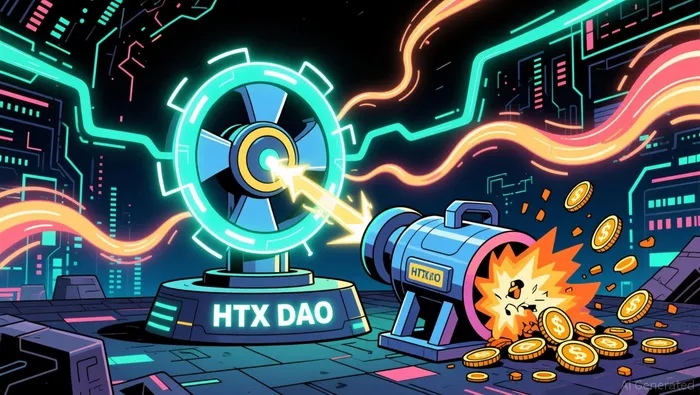
Now run the actual math
Set the marketing aside and size the money against the two numbers that matter.
First, the token. HTX DAO's market value recently sat around $1.5 billion. Next to that, $10 million is roughly 0.6% — a rounding error. The fund is real, but it is not value being handed to holders; it is value being spent outward, on the hope that revenue shows up later.
Second, compare it to the mechanism that actually moves the token. The burn is not a rounding error. Q1 2026 destroyed over $19 million worth of $HTX on April 15, Q2 took out over $13.6 million on July 15, and the first half of the year totaled over $32.8 million. Loosely translated: the entire Genesis fund is barely enough to fund one quarter of the existing burn. Whatever it does for ecosystem morale, $10M does not change the deflation curve on its own.
Where this story could break
Cynicism is cheap; the honest caveats are specific.
Start with the project's own disclaimer. HTX's documentation states plainly that the token carries , indistinguishable from a typical memecoin. That is not a criticism — it is the operating manual. Everything that makes $HTX worth more is manufactured: burns, staking, governance, and now an AI ecosystem narrative. The $10M is a narrative purchase, and narratives can decay.
Then there is the governance vote behind it. The Genesis Program was approved through an August HTX DAO vote that required holders to stake tokens — but the resolution's own language says it authorizes the program without identifying specific projects or guaranteeing fund adoption. In other words, the $10M is an allocation ceiling, not a funded pipeline of winners. The exchange can point to it in headlines before a single marquee project ships.
Finally, the return loop is indirect and slow. Grant recipients in crypto are often mercenaries who collect, build a little, and leave with the tokens. The money only becomes value for holders if it compounds through exchange revenue — and that is a multi-quarter, extremely uncertain path.
The one number to actually watch
If you take one thing from the rollout, make it the next quarterly burn. HTX burns on a steady quarterly cadence, so the next one should land around mid-October. That print is the honest report card on whether the builder money is working: if exchange volume and revenue grew enough that the Q3 burn beats Q2's $13.6 million, then the $10M was cheap advertising on a real flywheel. If the burn prints flat or smaller, the Genesis fund was a marketing line item, not a catalyst — a growth story with the deflation engine idling underneath it.
The crowd will keep cheering the $10M headline. The only vote that counts for holders is the one that destroys tokens for free — and it comes due in about six weeks. Semantically, the size of that check will tell you which narrative this program actually bought.
_43ca838f1775813865579.png?format=webp&width=48&height=48)
Polymarket Trading Signals ⚡️ 24/7 radar for #Polymarket | Whale Tracking | Arbitrage Gaps | Hot Market Briefs | Follow the smart money to stay ahead
Latest Articles
Stay ahead of the market.
Get curated U.S. market news, insights and key dates delivered to your inbox.


AInvest
PRO
AInvest
PRO




Comments
No comments yet