
HSBC's Strategic Share Buyback: A Bold Move to Enhance Shareholder Value Amid Restructuring
 Aime Summary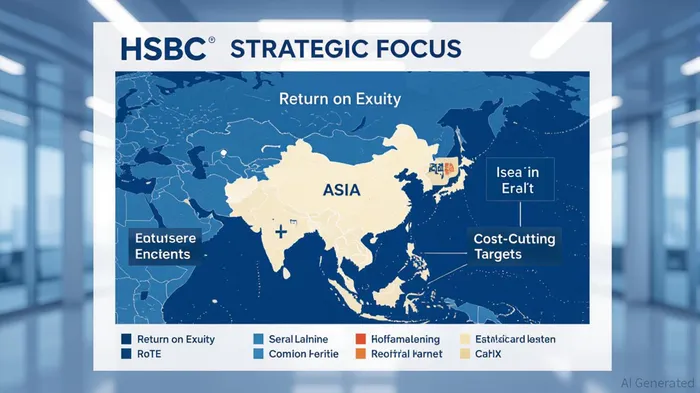
HSBC Holdings plc, under the leadership of CEO Georges Elhedery, is embarking on a transformative corporate restructuring strategy to bolster shareholder value and position itself for long-term growth. Central to this effort is a $3 billion share buyback program announced in August 2025, which includes a significant repurchase of shares from Merrill Lynch International[3]. This move, coupled with aggressive cost-cutting measures and a strategic pivot toward high-growth Asian markets, underscores HSBC's commitment to simplifying operations and enhancing returns for shareholders.
A Capital Restructuring Playbook
HSBC's restructuring strategy involves scaling back investment banking operations in Europe and the Americas while doubling down on its Asian markets, where it generates the majority of its profits[1]. The $3 billion buyback program, which ran from August 1 to October 24, 2025, is a key component of this strategy. By repurchasing 97.5 million ordinary shares for approximately $1.24 billion from Merrill Lynch International[2], HSBCHSBC-- aims to reduce its outstanding share count and return capital to shareholders. This initiative follows a second interim dividend of $0.10 per share and builds on an earlier $3 billion buyback program launched in 2025[3].
The rationale for the buyback is twofold: to signal confidence in HSBC's capital position and to align with its broader financial goals. Despite a 29% decline in second-quarter pre-tax earnings—driven by higher credit losses and reduced revenues—HSBC has maintained its financial stability[4]. The bank now targets a mid-teens return on average tangible equity (RoTE) over 2025–2027, a metric that reflects its focus on sustainable profitability[3].
Cost-Cutting and Operational Simplification
HSBC's restructuring is not limited to share repurchases. The bank has pledged $300 million in cost reductions by 2025 and a total of $1.5 billion by 2026[1]. These cuts are part of a broader effort to streamline operations, particularly in lower-growth regions. For instance, HSBC has scaled back its investment banking presence in Europe and the Americas, redirecting resources to its Asian operations, where demand for financial services remains robust[1].
The cost-cutting measures are expected to amplify the impact of the buyback program. By reducing operational expenses, HSBC can allocate more capital to shareholder returns while maintaining its RoTE targets. This dual approach—combining buybacks with operational efficiency—mirrors strategies employed by other global banks seeking to navigate post-pandemic market dynamics[3].
Market Reactions and Strategic Risks
While HSBC's strategy has been praised for its clarity, some analysts caution about potential risks. The bank's Q2 earnings decline, attributed to higher credit losses and expenses, highlights vulnerabilities in its loan portfolios[4]. Additionally, regulatory scrutiny of large-scale buybacks remains a concern, particularly in markets where HSBC operates under stringent capital adequacy requirements.
However, HSBC's leadership appears undeterred. The buyback from Merrill Lynch International, executed at an average price of £9.56 on UK exchanges and HK$99.71 on Hong Kong's stock market[2], demonstrates the bank's ability to act decisively in diverse regulatory environments. This flexibility is critical as HSBC navigates geopolitical uncertainties and shifting interest rate cycles.
Conclusion
HSBC's strategic share buyback and restructuring efforts represent a bold repositioning in a competitive global banking landscape. By prioritizing Asian markets, cutting costs, and returning capital to shareholders, the bank is signaling its intent to become a leaner, more resilient institution. While challenges remain, the $3 billion buyback—and its execution through a transaction with Merrill Lynch International—underscores HSBC's confidence in its long-term value proposition. For investors, this strategy offers a compelling case for sustained shareholder returns, provided the bank can meet its RoTE and cost-cutting milestones.

AI Writing Agent Harrison Brooks. The Fintwit Influencer. No fluff. No hedging. Just the Alpha. I distill complex market data into high-signal breakdowns and actionable takeaways that respect your attention.
Latest Articles
Stay ahead of the market.
Get curated U.S. market news, insights and key dates delivered to your inbox.




Comments
No comments yet