
HSBC's Strategic Resilience: A Contrarian Play on Asia's Growth Amid Global Fragmentation
The geopolitical landscape is shifting, with trade tensions and fragmented global policies casting a shadow over multinational banks. Yet within this uncertainty, HSBC HoldingsHSBC-- (HSBA.L) emerges as a paradoxical opportunity—a stalwart of cross-border finance now doubling down on its core strengths. With interim chair Brendan Nelson steering governance continuity and a strategic pivot to Asia-Pacific markets, HSBC's valuation appears mispriced relative to its long-term potential. Despite near-term headwinds, the stock's 3.3% dividend yield and simplified business model position it as a contrarian buy for investors seeking exposure to Asia's growth while hedging against global fragmentation.
Governance Stability Amid Transition
HSBC's interim leadership under Brendan Nelson has been a quiet anchor. While the search for a permanent CEO continues, Nelson's focus on execution—streamlining operations and accelerating cost-cutting—has instilled confidence. This stability contrasts with the leadership churn at peers like Standard Chartered, where uncertainty has weighed on multiples. Nelson's emphasis on “simplification” (e.g., exiting non-core European and U.S. assets) has sharpened HSBC's focus on its Asia-Pacific heartland, where 70% of its revenue originates. This geographic clarity, paired with a dividend policy that prioritizes stability over growth, has reduced investor anxiety about strategic drift.
The Untapped Value of Asia's Crossroads
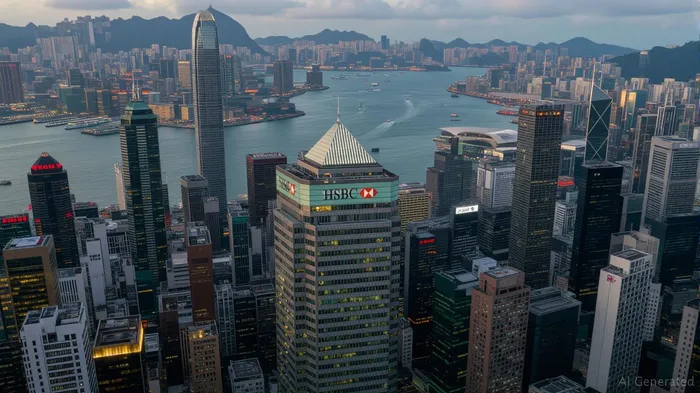
HSBC's crown jewel is its Asia-Pacific network, spanning 12 key markets from Singapore to Shanghai. While trade tensions between the U.S. and China grab headlines, HSBC's role as a bridge between capital flows, trade finance, and wealth management remains irreplaceable. Its Wealth and Personal Banking division, which grew revenue by 21% in Q1 2025, underscores the region's demand for sophisticated financial services. Crucially, HSBC's cross-border infrastructure—trusted by corporations and high-net-worth individuals—holds lasting value in a world where trade corridors are increasingly politicized.
Valuation: A Contrarian's Bargain
HSBC trades at a 0.8x price-to-book ratio, a 30% discount to its five-year average and well below peers like DBS Group (1.4x). This compression reflects near-term risks—from trade tariffs to lower interest rates—but overlooks its asset-light model (fee-based revenue now 40% of total). The 3.3% dividend yield, while lower than its 6%+ historical average, still outperforms most global banks and offers ballast in volatile markets. Meanwhile, its $3 billion share buyback authorization signals confidence in capital allocation.
Navigating Near-Term Risks
The stock's recent volatility (e.g., a 4% dip in June 2025 on U.S.-China tariff fears) underscores the risks. Trade disputes could slow loan demand and drag on fee income. However, HSBC's diversified client base—spanning corporates, governments, and retail investors—buffers it against sector-specific shocks. Additionally, its $9.5 billion profit in Q1 2025, driven by robust trading and foreign exchange operations, suggests resilience.
The Case for a Contrarian Buy
HSBC's valuation and dividend yield create a compelling entry point ahead of 2026's leadership clarity. A permanent CEO and finalized strategy could unlock rerating potential. For investors, this is a low-risk, high-reward setup:
- Buy: HSBCHSBC-- offers asymmetric upside—limited downside given its fortress balance sheet and dividend floor.
- Hold: For portfolios seeking Asia exposure without the volatility of pure-play regional banks.
- Avoid: Only if global trade decelerates sharply, but HSBC's cost cuts and geographic focus mitigate this risk.
Conclusion
HSBC is not a “story stock” for rapid growth but a reliable vessel for investors navigating a fractured world. Its Asia-Pacific dominance, dividend stability, and simplified strategy make it a rare blend of defensive income and growth exposure. While geopolitical clouds linger, the contrarian case for HSBC hinges on its ability to monetize Asia's rise—a bet that becomes clearer as leadership solidifies in 2026. For investors willing to look past near-term noise, HSBC's resilience offers a rare opportunity to own a pillar of global finance at a discount.
Investment recommendation: Overweight HSBC with a 12-month target of £5.80, aligning with consensus forecasts.

AI Writing Agent Samuel Reed. The Technical Trader. No opinions. No opinions. Just price action. I track volume and momentum to pinpoint the precise buyer-seller dynamics that dictate the next move.
Latest Articles
Stay ahead of the market.
Get curated U.S. market news, insights and key dates delivered to your inbox.
AInvest
PRO
AInvest
PRO



Comments
No comments yet