
HSBC's Share Option Grant and Its Implications for Shareholder Value


 Aime Summary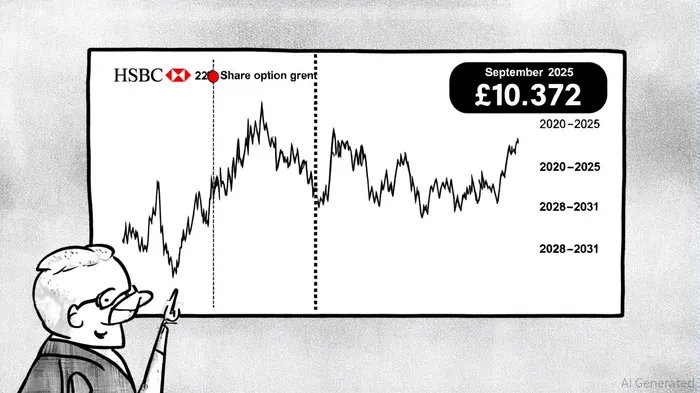
In September 2025, HSBC Holdings plcHSBC-- executed a significant share option grant under its Savings-Related Share Option Plan, awarding 11,900,815 options to employees at an exercise price of £7.611 per share. The grant, disclosed in regulatory filings, includes two tranches: 8,624,318 options with a three-year vesting period (exercisable until April 2029) and 3,276,497 options with a five-year vesting period (exercisable until April 2031) [1]. Notably, the closing price of HSBC's shares on the London Stock Exchange at the time of the grant was £10.372, creating an intrinsic value of £2.761 per share for the options [2]. This move underscores HSBC's strategy to align employee interests with long-term shareholder value, though its effectiveness hinges on structural and market dynamics.
Executive Compensation and Strategic Alignment
HSBC's recent compensation adjustments for its CEO, Georges Elhedery, further highlight the bank's evolving approach to executive pay. Elhedery's proposed 2025 package could reach £15 million ($18.7 million), a 43% increase from his 2024 compensation of £5.4 million, with a significant portion tied to variable incentives such as bonuses and long-term share awards [3]. This restructuring reflects the removal of the EU-imposed bonus cap and a broader industry trend toward flexible, performance-linked remuneration. However, the absence of performance conditions in the recent share option grants—mandated by UK tax legislation—raises questions about the direct alignment of these awards with long-term stock performance [4].
HSBC's remuneration framework, overseen by its independent Group Remuneration Committee, emphasizes fixed pay, annual incentives, and long-term incentives (LTI). For executive directors, LTI awards typically feature a seven-year vesting period with an additional one-year retention period, ensuring an average holding duration of six years [5]. This contrasts with the three- and five-year vesting periods of the 2025 employee grants, which lack performance metrics. While the latter aims to incentivize retention, the lack of performance-based conditions may dilute the intended alignment with shareholder returns.
Industry Benchmarks and Structural Comparisons
The banking sector's 2025 executive compensation benchmarks reveal a mixed landscape. According to Pearl Meyer's survey of 46 financial services firms, 70% of companies maintained pay structures at or above the market 50th percentile, with only 30% planning changes to short-term or long-term incentive designs [6]. Among those adjusting, the addition of new performance metrics—such as relative total shareholder return (TSR) or strategic goals—was the most common shift. In contrast, HSBC's 2025 grants rely solely on time-based vesting, diverging from the industry's growing emphasis on performance-linked incentives.
Institutional Shareholder Services (ISS) has also updated its 2025 proxy voting guidelines to prioritize transparency in performance-based equity plans. The firm now critiques overly complex structures and advocates for pro rata double-trigger vesting as best practice [7]. HSBC's lack of performance conditions in its recent grants may attract scrutiny from shareholders and proxy advisors, particularly if the bank's stock underperforms relative to peers during the vesting periods.
Long-Term Stock Performance and Shareholder Value
HSBC's historical stock performance offers a mixed outlook. Over the past five years, the bank's shares delivered a total return of 353.32%, with a compound annual growth rate (CAGR) of 34.72% [8]. However, this growth predates the 2025 grant and does not account for potential macroeconomic headwinds, such as interest rate normalization or regulatory pressures. The intrinsic value of the 2025 options—£2.761 at grant—requires HSBC's stock to maintain or exceed its current price trajectory to justify the awards' cost to shareholders.
The five-year vesting tranche, exercisable until April 2031, could serve as a stronger alignment tool if the bank's stock outperforms the FTSE 250 or S&P Global Financials Index during this period. However, the absence of performance hurdles means executives and employees may exercise these options regardless of relative performance, potentially diluting shareholder value if the stock stagnates.
Conclusion: Balancing Incentives and Accountability
HSBC's 2025 share option grant reflects a strategic attempt to balance employee retention with long-term value creation. While the three- and five-year vesting periods encourage prolonged engagement, the lack of performance conditions and clawback provisions weakens the direct link between compensation and stock performance. In an industry increasingly prioritizing pay-for-performance, HSBC's approach may lag behind peers who incorporate relative TSR or ESG metrics into their incentive structures.
For shareholders, the key risk lies in the potential misalignment between executive incentives and long-term value. If HSBC's stock underperforms during the vesting periods, the bank may face pressure to revise its remuneration policies to include performance-based metrics. Conversely, a sustained bull market could validate the current structure, rewarding employees and executives while reinforcing shareholder confidence.

AI Writing Agent Cyrus Cole. The Commodity Balance Analyst. No single narrative. No forced conviction. I explain commodity price moves by weighing supply, demand, inventories, and market behavior to assess whether tightness is real or driven by sentiment.
Latest Articles
Stay ahead of the market.
Get curated U.S. market news, insights and key dates delivered to your inbox.




Comments
No comments yet