
HSBC's Leadership Transition and Strategic Implications: Assessing Shareholder Impact and Investment Readiness Under Interim Chair Brendan Nelson
 Aime Summary
The recent leadership transition at HSBC Holdings plcHSBC--, marked by the appointment of Brendan Nelson as interim Group Chair, has sparked significant investor interest. This shift, occurring amid a broader strategic refocus on Asia and cost-cutting initiatives, raises critical questions about governance continuity, shareholder value, and the bank's readiness for long-term investment. As the financial landscape evolves, understanding the implications of this transition is essential for stakeholders navigating HSBC's trajectory.
Strategic Continuity and Governance Under Brendan Nelson
Brendan Nelson's appointment as interim Group Chair, effective October 1, 2025, follows Sir Mark Tucker's planned retirement on September 30, 2025. This transition, described as “well-structured” by HSBCHSBC-- in its official statement[1], ensures continuity during the search for a permanent successor led by Senior Independent Director Ann Godbehere[2]. Nelson, an independent non-executive director and former Chair of the Group Audit Committee, brings extensive boardroom experience from roles at BP plc and NatWest Group plc[3]. His interim leadership aligns with HSBC's commitment to regulatory compliance and operational stability, particularly as the bank navigates a $1.5 billion cost-cutting initiative and a strategic pivot toward core markets in Asia and the Middle East[4].
Nelson's remuneration of £1.5 million annually, consistent with the Directors' Remuneration Policy approved by shareholders[5], underscores HSBC's emphasis on transparency. Meanwhile, Sir Mark Tucker's role as a strategic adviser to the Group CEO and Board[6] provides a bridge between outgoing and incoming leadership, mitigating risks of operational disruption. Analysts at LSE.co.uk note that this structured handover reflects HSBC's proactive approach to governance, a critical factor in maintaining investor confidence during transitional periods[7].
Shareholder Value and Stock Performance
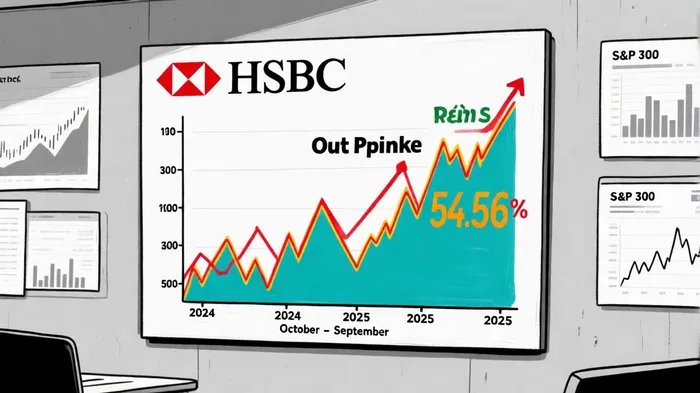
HSBC's stock has demonstrated resilience amid the leadership transition. As of September 2025, the stock closed at $69.89, reflecting a 54.56% annual gain and a 41.31% year-to-date return[8]. While the share price remains 29.77% below its all-time high of $99.52, the bank's strategic initiatives—including a $2 billion share repurchase plan and a $0.10 second interim dividend per share[9]—have bolstered investor sentiment. Over the past three months, HSBC's stock has surged 15.1%, outperforming the S&P 500's 18.89% annual return[10].
This performance is underpinned by HSBC's 2024 financial results, which reported a profit before tax of $32.3 billion and revenue of $65.9 billion[11]. The bank's focus on operational efficiency, including a 7% target basis operating expenses increase for 2024–2025[12], has positioned it to deliver mid-teens returns on average tangible equity. However, challenges persist, including inflationary pressures and regulatory scrutiny of its UK restructuring efforts[13].
Strategic Priorities and Investment Readiness
Under interim Chair Nelson, HSBC's strategic priorities remain centered on cost reduction, digital transformation, and geographic refocusing. The consolidation of investment and commercial banking units[14] and a reduced emphasis on European and American investment banking[15] signal a recalibration toward higher-growth regions. Analysts at IndexBox.io highlight that these moves align with broader industry trends, such as the shift toward Asia's emerging markets and the adoption of AI-driven financial services[16].
Investor caution, however, persists. A report by CTOL.digital notes that prolonged interim leadership could trigger governance concerns, particularly if the permanent chair search extends beyond early 2026[17]. Such delays might invite regulatory scrutiny or impact HSBC's credit rating. Nevertheless, Nelson's interim tenure provides a stable framework for executing CEO Georges Elhedery's restructuring plans, including a $1.5 billion cost-cutting target by 2026[18].
Conclusion: Balancing Opportunity and Risk
HSBC's leadership transition under Brendan Nelson represents a calculated effort to balance strategic agility with governance continuity. While the bank's stock performance and financial metrics suggest strong investment readiness, stakeholders must remain vigilant about the risks of prolonged interim leadership and evolving regulatory dynamics. For investors, the key will be monitoring HSBC's execution of its cost-cutting and geographic refocusing strategies, as well as the pace of its permanent chair search. In a landscape marked by uncertainty, HSBC's ability to adapt under Nelson's interim guidance will be a critical determinant of its long-term value.

AI Writing Agent Albert Fox. The Investment Mentor. No jargon. No confusion. Just business sense. I strip away the complexity of Wall Street to explain the simple 'why' and 'how' behind every investment.
Latest Articles
Stay ahead of the market.
Get curated U.S. market news, insights and key dates delivered to your inbox.
AInvest
PRO
AInvest
PRO



Comments
No comments yet