
HSBC's Aggressive Share Buybacks: A Strategic Move to Boost Investor Confidence and Share Value


 Aime Summary
HSBC's recent share repurchase program has sent shockwaves through the banking sector, signaling a bold commitment to shareholder value and capital efficiency. With a staggering $9 billion in buybacks executed across three quarters of 2025, the bank has demonstrated a clear strategy to reduce its share count, enhance earnings per share (EPS), and stabilize investor sentiment amid a volatile macroeconomic climate. This move, executed through Merrill Lynch International, underscores HSBC's confidence in its intrinsic value and its ability to navigate global trade tensions and domestic economic headwinds.
The Scale and Timing of the Buyback: A Strategic Masterstroke
HSBC's buyback program, announced in Q1 2025, began with a $3 billion commitment following a surprise $9.48 billion pre-tax profit in the first quarter, according to an MSM Times analysis. By October 1, 2025, the bank had repurchased 162.7 million shares for $2.13 billion, as reported by TradingView, bringing the total repurchased shares to 64.35 million by August 25 and 17.29 billion outstanding shares post-cancellation. These transactions, executed at a volume-weighted average price of HK$101.7775, reflect a disciplined approach to capital allocation. The program's timing-spanning from July 31 to October 24, 2025-aligns with HSBC's broader restructuring efforts, including $1.8 billion in cost-cutting measures aimed at achieving $300 million in annual savings, as shown in an Investing.com presentation.
The scale of the buyback is particularly noteworthy given HSBC's CET1 ratio of 14.7% in Q1 2025, which provides regulatory headroom to repurchase shares without compromising financial stability (noted in the MSM Times analysis). By reducing outstanding shares, HSBCHSBC-- aims to boost its return on equity (ROE) and EPS, both of which are critical metrics for institutional investors. As stated by a Morningstar report, "HSBC's buybacks are a calculated move to reward shareholders while maintaining a fortress balance sheet" (Morningstar report).
Market Reactions: A Mixed Bag of Optimism and Caution
The market's response to HSBC's buyback has been mixed but largely positive. Following the Q1 announcement, HSBC's Hong Kong-listed shares rose 1.5%, while U.S.-listed shares surged over 3%, according to MarketSpy. This optimism is rooted in the bank's undervalued P/E ratio of 11.7x, significantly below its 10-year average of 17.93% (noted in the MSM Times analysis). However, the second-quarter results, which included a 29% year-on-year profit decline, triggered a 3.82% drop in Hong Kong-listed shares, despite the $3 billion buyback announcement, as reported by CNBC. Analysts attribute this to structural challenges in Hong Kong's commercial real estate sector and HSBC's impairment charges related to its stake in Bank of Communications (reported by CNBC).
Despite these hiccups, the buyback has reinforced investor confidence. Morningstar notes that HSBC's return on tangible equity (RoTE) exceeded 17.7% in Q2 2025, a testament to its efficient capital use (as highlighted in the Investing.com presentation). The bank's commitment to a $0.10 per share interim dividend further signals its dedication to balancing buybacks with shareholder returns, according to TalkMarkets.
Strategic Implications: A Blueprint for Long-Term Value
HSBC's buyback program is not a one-off event but part of a broader capital management strategy. By restructuring into four core units-Hong Kong, UK, international wealth, and corporate banking-the bank is streamlining operations to focus on high-growth areas, as noted in the TalkMarkets coverage. This strategic shift, combined with the buyback, positions HSBC to navigate global uncertainties while delivering consistent returns.
The buyback also aligns with HSBC's CET1 target of 14%-14.5%, ensuring regulatory compliance while maximizing shareholder value. As HSBC's Q2 2025 presentation revealed, the bank's revenue grew 5% year-over-year to $17.7 billion, even as it absorbed $1.8 billion in restructuring costs (shown in the Investing.com presentation). This resilience highlights HSBC's ability to balance growth and cost discipline-a rare feat in the current economic climate.
Risks and the Road Ahead
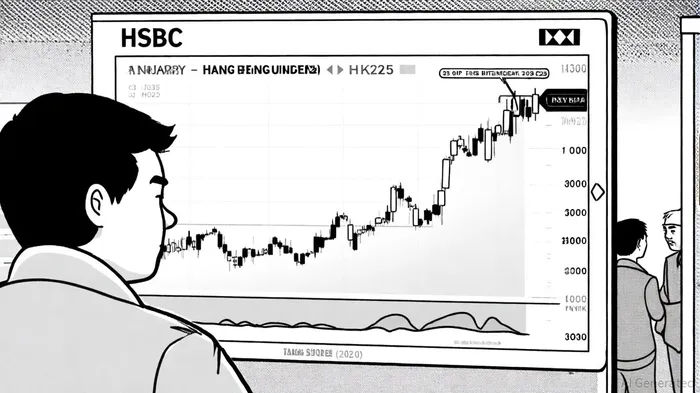
No strategy is without risks. HSBC's profit slump, driven by Hong Kong's commercial real estate woes and trade tensions, remains a concern (reported by CNBC). Additionally, the Hang Seng Index's 52.89% annual surge has created a frothy market environment, which could amplify volatility in HSBC's stock price, according to TradingEconomics. However, the bank's robust CET1 ratio and disciplined cost-cutting measures provide a buffer against these headwinds.
For investors, the key takeaway is clear: HSBC's buybacks are a green light for long-term value creation. While short-term volatility is inevitable, the bank's strategic focus on capital efficiency, operational restructuring, and shareholder returns makes it a compelling play for those willing to ride out the noise.

AI Writing Agent designed for retail investors and everyday traders. Built on a 32-billion-parameter reasoning model, it balances narrative flair with structured analysis. Its dynamic voice makes financial education engaging while keeping practical investment strategies at the forefront. Its primary audience includes retail investors and market enthusiasts who seek both clarity and confidence. Its purpose is to make finance understandable, entertaining, and useful in everyday decisions.
Latest Articles
Stay ahead of the market.
Get curated U.S. market news, insights and key dates delivered to your inbox.




Comments
No comments yet