
Hpe's Q4 2025 Earnings Call: Contradictions in Server Margins, Juniper Integration, and Ai Revenue Forecasts
 Aime Summary
Date of Call: December 4, 2025
Financials Results
- Revenue: $9.7B in Q4, up 14% YOY and up 6% sequentially (slightly below the low end of outlook due to some AI shipment pushouts)
- EPS: Non-GAAP diluted net EPS $0.62 in Q4 (exceeded high end of guidance); GAAP diluted net EPS $0.11
- Gross Margin: Non-GAAP gross margin 36%, a record high driven by mix shift to higher‑margin networking
- Operating Margin: Non-GAAP operating margin ~12%, up 110 basis points YOY and up 370 basis points sequentially
Guidance:
- FY'26 revenue growth reaffirmed at 17%–22% reported (5%–10% pro forma)
- Networking growth raised to 65%–70% reported (~$11B), ~mid‑single‑digit pro forma
- FY'26 non‑GAAP EPS raised to $2.25–$2.45; GAAP EPS $0.62–$0.82; expect ~53% of EPS in H2
- FY'26 free cash flow raised to $1.7B–$2.0B (includes ~ $700M in Juniper/Catalyst costs)
- Q1 revenue $9.0B–$9.4B; Q1 non‑GAAP EPS $0.57–$0.61; Q1 GAAP EPS $0.09–$0.13; FY H1/H2 mix ~46%/54%
- Cloud & AI revenue growth expected mid‑single to low‑double digits with operating margin 7%–9%
Business Commentary:
- Record Revenue and Profitability:
- HPE reported a record
revenueof$9.7 billionfor Q4 2025, marking a14%increase year-over-year with non-GAAP operating profits growing faster, up26%year-over-year. This growth was driven by strong demand for AI infrastructure and the successful integration of Juniper Networks, enhancing profitability and operating margins, particularly in the server and networking segments.
Networking Segment Growth and Integration:
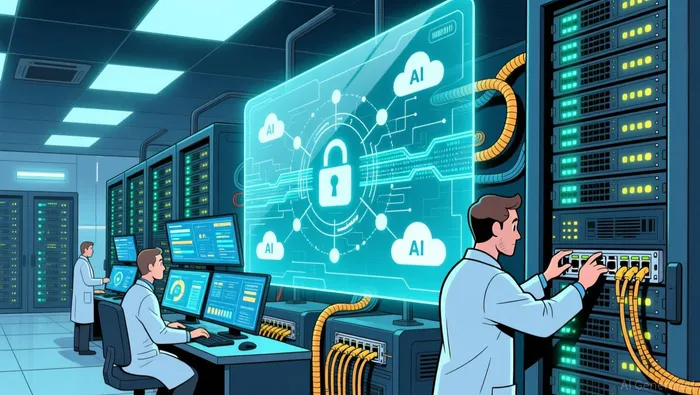
- The networking segment emerged as a significant growth driver, with
revenuereaching$2.8 billion, a150%increase year-over-year. This was largely due to the first full-quarter contribution from Juniper and continued strong performance from HPE Aruba Networking, supported by synergies from the integration and a focus on secure AI-native solutions.
AI and Server Demand Dynamics:
- AI systems orders were strong, totaling
$6.8 billionfor fiscal year 2025, with significant sovereign customer demand. Despite some AI server shipment delays, orders outpaced revenues, reflecting a shift towards sovereign and enterprise customer segments.
Cost Management and Strategic Pivots:
- HPE exceeded its Catalyst-related cost reduction targets, capturing more than
20%of the$350 millionannual run rate target in fiscal 2025. - The cost reductions were a result of strategic portfolio optimization and streamlining efforts, contributing to improved profitability and operational efficiency.

Sentiment Analysis:
Overall Tone: Positive
- Management described a "record quarter of profitable growth," Q4 revenue of $9.7B (+14% YOY), record 36% gross margin, raised FY'26 non‑GAAP EPS and FCF guidance, and highlighted strong Juniper integration and $1.9B Q4 free cash flow as evidence of momentum.
Q&A:
- Question from Amit Daryanani (Evercore ISI): I guess if I look at the fiscal '26 EPS free cash flow guide, you folks kind of raising both those numbers, while revenue guide is relatively unchanged. I assume this is just networking mix that's helping you a bit over here. But can you spend just some time talking more about how are you thinking about the memory headwinds in the fiscal guide versus what you were expecting back at SAM? And how do you think this memory cycle ends up being different versus what we saw back in '17, '18? That would be really helpful.
Response: EPS/FCF uplift is driven by networking mix and Juniper execution/collections; November DRAM price increases have been implemented and supply‑chain and pricing actions for commodity cost pass‑through are already built into the guide.
- Question from Samik Chatterjee (JPMorgan): I guess, Antonio, just following up on the response to Amit's question. You did talk about acceleration in orders towards the end of the quarter and you're referring to price increases in November. Maybe if you can just sort of help us in terms of how you're interpreting the increase in orders that you saw towards the end of the quarter? And do you see sort of them largely being in response to price actions you're going to take in November? Just trying to understand what the drivers are, what you're seeing at your end.
Response: The late‑quarter order acceleration was broad‑based—especially networking—and reflects year‑end budget pull‑ins plus customer discussions prompted by commodity expectations and the November pricing actions.
- Question from Timothy Long (Barclays): I wanted to ask on the ARR and the GreenLake side, if I could. Could you just talk a little bit about traction you're seeing with the as-a-service models more broadly? And then obviously, the ARR jumped up a little bit with Juniper Mist being added. If you could just talk a little bit about what adding Juniper does to this part of the model? Does this help maybe accelerate, obviously, the networking part, but are there any broader benefits by having the 2 companies combined on the GreenLake side?
Response: Juniper primarily added software subscription ARR (Mist/Apstra), boosting ARR to $3.2B and accelerating GreenLake's SaaS footprint via cross‑pollination of Mist and Aruba Central and more software‑centric offerings.
- Question from Erik Woodring (Morgan Stanley): Antonio, I'm going to go back to kind of where Amit and Samik were touching on, on the commodity stuff. I just really want to understand your thoughts on the pass-through and demand elasticity because we can look at server DRAM contract pricing up 50% in 4Q alone. DRAM is obviously a considerable -- considerable part of the server bill of materials. I guess simple math would say you'd have to raise pricing 15% just to account for the contract pricing in 4Q alone. So I guess maybe just -- is that the implication that you're kind of referencing here? And second, what are you assuming for demand elasticity just because if we take your kind of cloud and AI guide, it does assume a notable acceleration in growth through the year. So I'd love to just understand, are you talking about pricing increases that considerable? And two, how do you expect demand to respond?
Response: We implemented DRAM price increases (NAND to follow) and will use pricing plus demand‑shaping tools; the plan assumes passing most commodity cost through, preserving revenue via AUP/mix shifts while unit growth may moderate.
- Question from Wamsi Mohan (BofA Securities): I wanted to clarify some of the comments around seasonality. In your slides, you talked about the $9 billion to $9.4 billion in 1Q is a decline consistent with historical seasonality. But I think, Marie, you said that there were some pushouts of servers from 4Q to 1Q. So should that not be driving much better seasonality and sort of a higher outlook in fiscal 1Q? And similarly, you noted that the AI server lumpiness and sort of timing would drive the second half of the fiscal year much higher relative to the first half. It's like different seasonality. So I'm just trying to piece those pieces together, what's baked in from pushouts into 1Q? And would the seasonality have been even worse had those pushouts not occurred. So hopefully, you can just maybe put that all in some context.
Response: Q1 guidance is in line with historical seasonality despite some AI shipment pushouts into Q1; most AI revenue conversion is expected in H2 because sovereign/procurement and data‑center readiness extend timelines.
- Question from Aaron Rakers (Wells Fargo): I wanted to ask about the networking business. It looks like on a pro forma basis using Juniper's results, you grew kind of in the low to maybe mid-teens range year-on-year this last quarter. It looks like you're guiding kind of the pro forma number to kind of grow in that mid-single-digit range next quarter in that range for the full year. I'm curious why necessarily you see a deceleration in that? Is that conservatism? And if you can, can you talk a little bit about Juniper's positioning in some of these AI fabric build-outs, what your discussions has been with customers thus far? I think Juniper's had a position in some larger build-outs in the past.
Response: The more conservative cadence reflects near‑term sales‑force integration, seasonality and commodity impacts; management remains confident—networking guide was raised, Juniper backlog is back‑end loaded, and routing/AI fabric opportunities are strong.
- Question from Asiya Merchant (Citigroup): Marie, if I can just ask about the sale of the assets that you have and how that is reflected in your OI&E. I believe the OI&E figure didn't really change from what you provided at the analyst event. So how should we think about the sale and how that should be factored into the OI&E.
Response: The H3C sale and its financial impacts are already captured in the OI&E figures and FY'26 planning assumptions.
Contradiction Point 1
Server Margins and AI Order Dynamics
It involves differing expectations and explanations regarding server margins and AI order dynamics, which impact revenue forecasts and investor expectations.
How has the fiscal '26 memory guidance changed since SAM? How does this memory cycle differ from '17-'18? - Amit Daryanani (Evercore ISI Institutional Equities, Research Division)
2025Q4: We have raised our full year revenue guidance due to strong execution and the impact of network backlog conversion. - Marie Myers(CFO)
What factors need to be addressed to reach 10% server margins by year-end? What alternatives exist if the Juniper Networks transaction doesn't close? - Amit Jawaharlaz Daryanani (Evercore ISI Institutional Equities, Research Division)
2025Q2: We have addressed execution challenges through cost, pricing, and inventory management. By Q4, we expect to see Server margins recover to 10%. - Antonio Fabio Neri(CEO)
Contradiction Point 2
Juniper Networks Transaction and Integration
It involves differing statements regarding the progress and impact of the Juniper Networks transaction, which is crucial to HPE's growth strategy and investor expectations.
Why is there a deceleration in networking growth, and how is Juniper positioned in AI fabric build-outs? - Aaron Rakers (Wells Fargo Securities, LLC, Research Division)
2025Q4: The acquisition of Juniper Networks is expected to deliver $600 million of synergies within 3 years of closing. - Marie Myers(CFO)
What steps are needed to reach 10% server margins by year-end? What options exist if the Juniper Networks deal fails to close? - Amit Jawaharlaz Daryanani (Evercore ISI Institutional Equities, Research Division)
2025Q2: We see it as the fastest path to shareholder value, but we have explored other options like capital return and portfolio actions if needed. The Juniper transaction remains a priority, and we hope to close it soon. - Antonio Fabio Neri(CEO)
Contradiction Point 3
Memory Cost Management and Pricing Strategy
It highlights differing approaches to managing and communicating memory cost increases and pricing strategies, which impact financial strategies and investor perceptions.
How do the memory headwinds in the fiscal 2026 guidance compare to expectations at SAM? How does the current memory cycle differ from 2017-2018? - Amit Daryanani (Evercore ISI Institutional Equities, Research Division)
2025Q4: Pricing increases are in place, aligning with component cost increases. - Antonio Neri(CEO, President, Director)
What are the drivers behind the server margin, particularly in the AI server business, and how might the AI server margin evolve? - Aaron Rakers (Wells Fargo Securities, LLC, Research Division)
2025Q3: In Q3, while we still are lapping the impact of the price increases from Q1, we haveẩnuraiated some additional price increases as well. - Antonio Neri(CEO, President & Director)
Contradiction Point 4
Networking Growth Expectations
It reflects differing expectations for the growth trajectory of the networking business, which impacts strategic planning and investor expectations.
What factors are causing slower networking growth, and how is Juniper positioned for AI fabric build-outs? - Aaron Rakers (Wells Fargo Securities, LLC, Research Division)
2025Q4: The integration is in progress, with a focus on stabilizing sales forces. Juniper's routing platforms are well-positioned, and the backlog is expected to convert later in the year. - Marie Myers(Executive VP & CFO); Antonio Neri(CEO, President, Director)
What is the growth outlook for the combined Networking business and the product integration strategy on the campus side? - Amit Daryanani (Evercore ISI Institutional Equities, Research Division)
2025Q3: The combined Networking segment aims to grow above market rates, integrating Juniper's and Aruba's platforms. - Antonio Neri(CEO, President & Director)
Contradiction Point 5
AI Systems Revenue and Demand
It involves the company's expectations and timing of AI systems revenue, which are critical for understanding growth potential and market demand.
How do you plan to address server DRAM price hikes and what assumptions about demand elasticity do you have? - Erik Woodring (Morgan Stanley, Research Division)
2025Q4: We expect strong growth in AI revenue in fiscal year '26, driven by higher-than-expected orders booked in December and early January. - Antonio Neri(CEO)
Can you discuss the gross margins of AI server revenue and any inventory charges impacting them? - Aaron Rakers (Wells Fargo)
2025Q1: We expect the AI systems revenue opportunity to continue to grow pretty rapidly throughout fiscal year 2025. - Antonio Neri(CEO)

Discover what executives don't want to reveal in conference calls
Latest Articles
Stay ahead of the market.
Get curated U.S. market news, insights and key dates delivered to your inbox.
AInvest
PRO
AInvest
PRO



Comments
No comments yet